

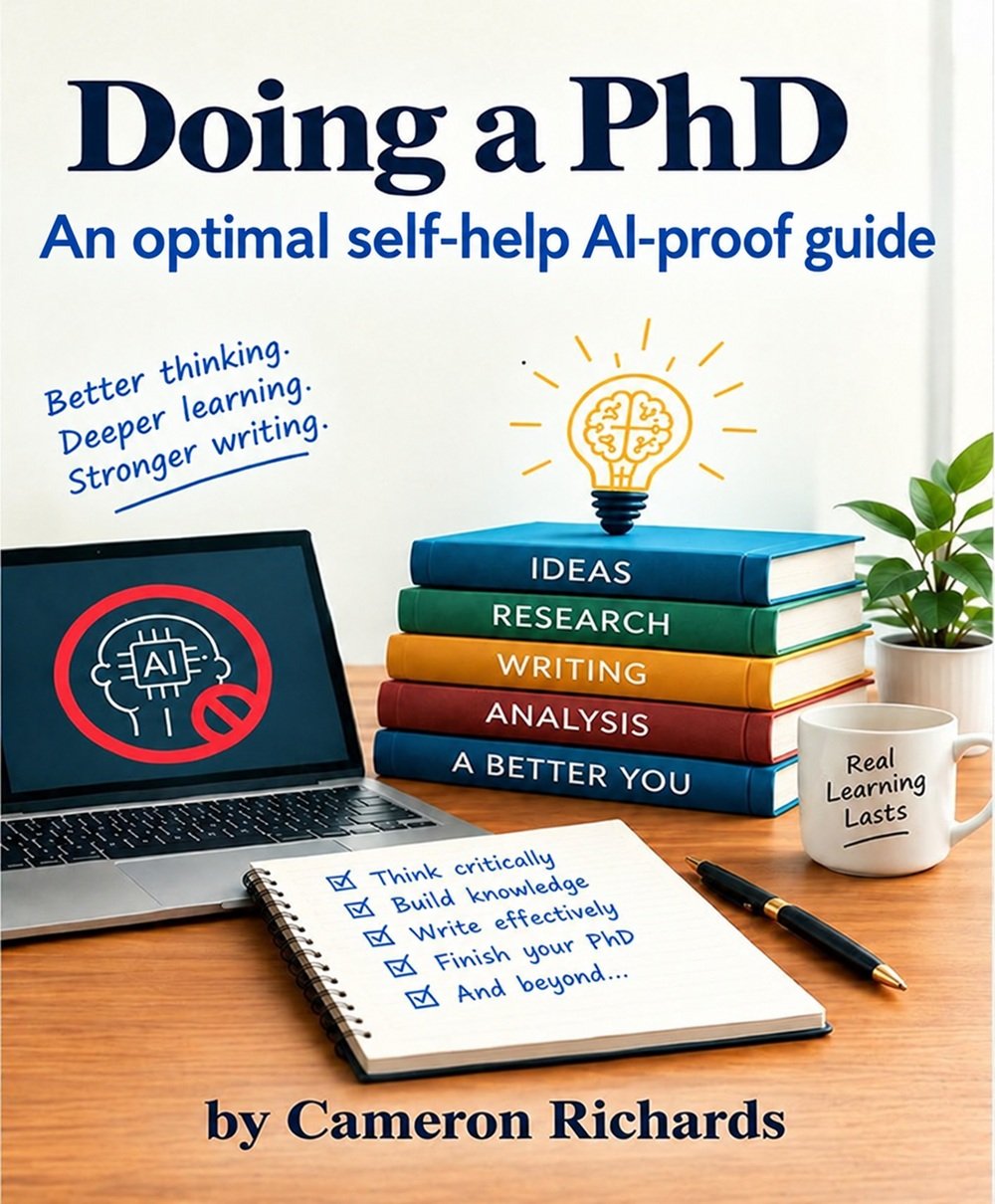
Doing a PhD: An optimal self-help AI-proof guide
Doing a PhD’ is a self-help AI-proof guide to more effective academic dissertation (or other) writing and knowledge-building
How can researchers learn to think, write, and build knowledge more effectively—and avoid losing their way in the process? Drawing on several decades of experience working with PhD students, this book develops a practical “emergent method of academic writing” designed to bring thinking and language-use into a more productive relationship. At its core is a simple idea: academic writing is not merely a way of reporting what we already know. It is a means of developing ideas, exploring questions, making connections, and constructing knowledge. By working from a focused question or problem and following a related thread of inquiry, researchers can develop their thinking through the process of writing itself. The approach has relevant application well beyond doctoral research. But its particular value lies in addressing the distinctive challenges of research-based academic writing and the experience and process of “doing a PhD.”
The book develops the emergent method into a broader “foolproof approach to optimal knowledge building,” including an analysis of the four ways and stages in which researchers can “lose their way.” This provides a framework for understanding the phenomenon of the “lost PhD” and for recognizing some of the difficulties that can interrupt or derail doctoral research. Central to the approach is deep learning—not simply acquiring information, but developing the capacity to understand, transform, apply, and communicate knowledge. In particular, the ability to generate and express ideas in our own words becomes a fundamental part of developing intellectual independence and scholarly mastery. These issues have become even more significant with the rapid development of generative AI, specialised AI agents, and chatbot-based technologies. The book examines the important distinction between using AI as a tool to support research and writing, and allowing AI to become a co-creator that increasingly directs or takes over the intellectual process.
Ultimately, this book presents a framework for (optimal) thinking through writing, writing through inquiry, and building knowledge through the process of research and related problem-solving inquiry. It is intended not simply to help researchers complete a PhD, but to support the development of the intellectual independence, scholarly judgement, and mastery of knowledge that doctoral education is supposed to achieve.