
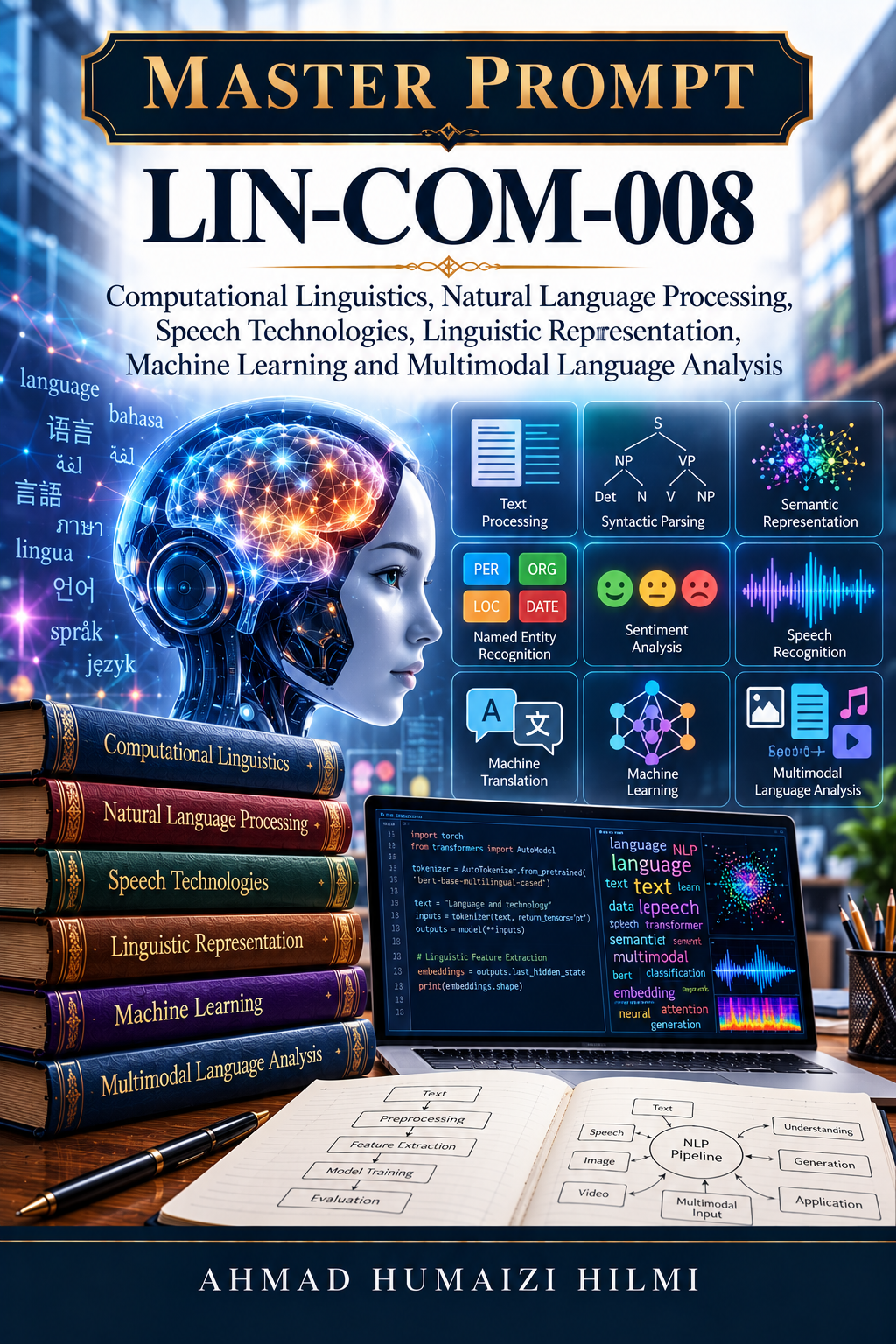
8. LIN-COM-008 — Computational Linguistics, Natural Language Processing, Speech Technologies, Linguistic Representation, Machine Learning and Multimodal Language Analysis
Description
This Master Prompt establishes an advanced research framework for applying computational methods, machine learning, and artificial intelligence to the representation, processing, analysis, and generation of human language. It examines natural language processing architectures, linguistic feature engineering, text classification, syntactic parsing, semantic representation, named entity recognition, relation extraction, sentiment analysis, speech recognition, language identification, and multimodal language understanding. Particular emphasis is placed on computational representations of phonological, morphological, syntactic, semantic, and discourse-level information, as well as the integration of linguistic knowledge into machine learning and deep learning systems. The framework incorporates statistical natural language processing, neural language modeling, transformer architectures, graph neural networks, linguistic knowledge graphs, speech processing, computer vision–language integration, and explainable artificial intelligence. It supports research involving multilingual datasets, low-resource languages, automated linguistic annotation, text recognition, speech-based prediction, sign-language technologies, and multimodal information extraction. Researchers are guided in designing computational experiments, preparing linguistic datasets, selecting appropriate algorithms, evaluating predictive performance, conducting comparative benchmarking, and interpreting model behavior. The Master Prompt also addresses computational efficiency, linguistic generalizability, model interpretability, algorithmic bias, dataset representativeness, reproducibility, and ethical deployment of language technologies.