
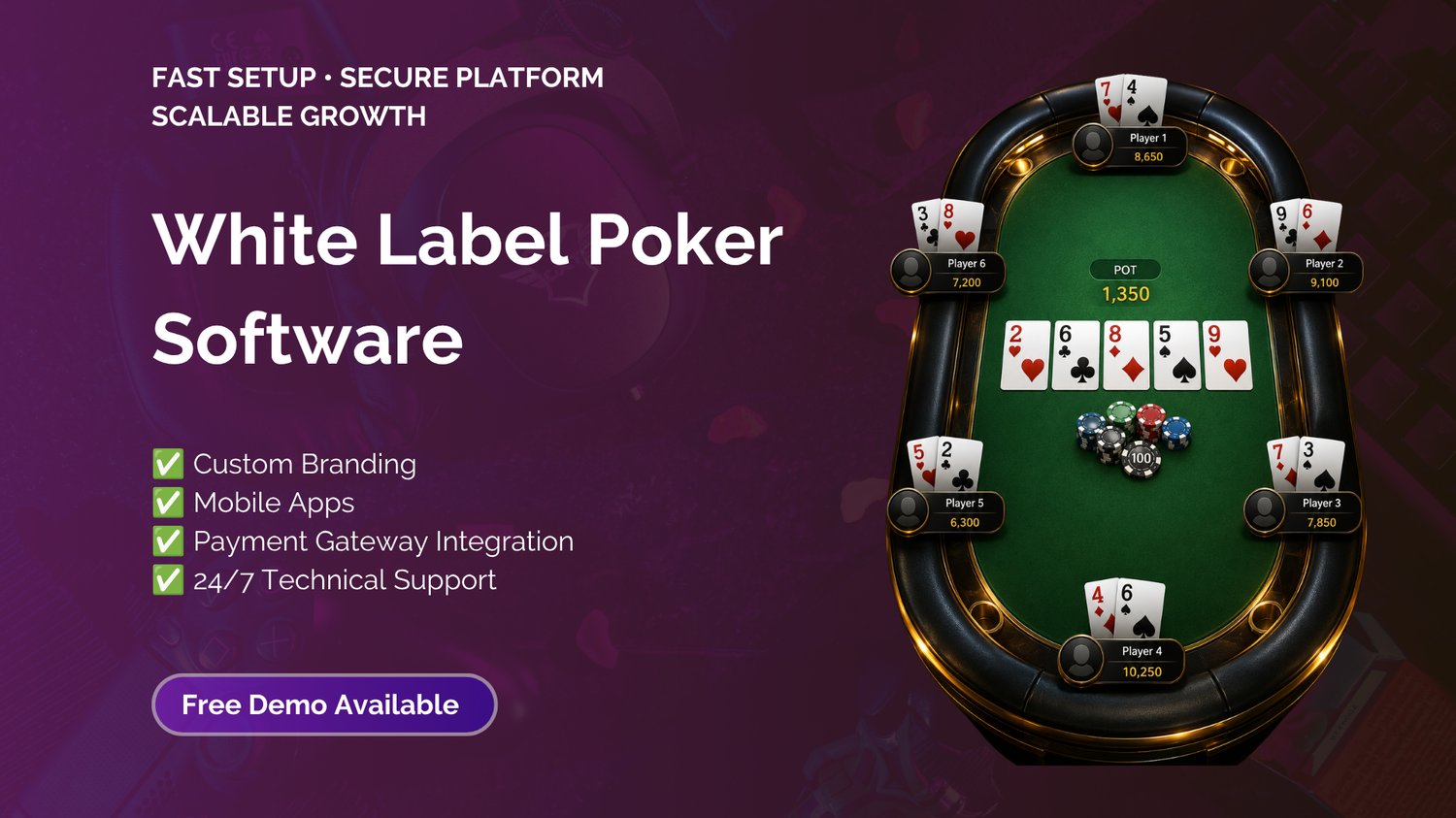
Poker Tournament Management Software Explained: The Engine Behind the Action
In the world of online poker, cash games are the steady heartbeat, but tournaments are the spectacle. They drive traffic, create viral moments, and generate significant revenue through buy-ins and add-ons. However, running a successful tournament room is a logistical nightmare without the right technology.
Poker Tournament Management Software is the specialized backend engine that automates, organizes, and executes every aspect of a poker tournament, from the initial registration to the final hand and prize distribution. It is the invisible conductor ensuring that thousands of players, across hundreds of tables, play by the same rules at the exact same time.
What Is It?
At its core, tournament management software is a module within a larger poker platform (or a standalone system) designed to handle the specific complexities of competitive play. Unlike white label poker software cash games, where players can join or leave at any time, tournaments have a fixed start time, a defined structure (blind levels), and a specific end condition (one player remains).
This software manages:
- Scheduling: Setting start times, rebuy periods, and break intervals.
- Structure: Configuring blind levels, ante schedules, and time limits.
- Registration: Handling buy-ins, rebuys, add-ons, and late registrations.
- Seating: Automatically assigning players to tables and managing table balancing as players bust.
- Prize Pools: Calculating payouts based on the number of entrants and the payout structure.
- Reporting: Generating detailed stats on tournament performance and player earnings.
Key Features of Modern Tournament Software
A robust tournament management system includes several critical components that work in unison.
1. Flexible Structure Configuration
The most vital feature is the ability to define the tournament's "DNA." Operators can customize:
- Blind Levels: Set the starting blinds, the increment amount, and the duration of each level (e.g., 15-minute levels, 30-minute levels).
- Antes: Configure when antes kick in and their values relative to the blinds.
- Rebuy & Add-on Rules: Define the window for rebuys (e.g., first 60 minutes) and add-ons (usually one-time offers after the rebuy period).
- Late Registration: Allow players to join after the start time but before a specific cutoff, often with a higher buy-in or specific rules.
- Freezeout vs. Shootout: Support various formats, including standard freezeouts, shootouts (winner of table advances), and step tournaments.
2. Dynamic Seating and Table Balancing
As players bust out, tables become uneven. The software must automatically:
- Move Players: Shift players from full tables to half-empty tables to maintain efficiency.
- Break Tables: When a table drops below a certain threshold (e.g., 6 players), the system consolidates players onto fewer tables.
- The "Bubble" Logic: Ensure that the software correctly handles the transition from the bubble (the point just before the money) to the money, often pausing or adjusting rules if necessary.
3. Real-Time Registration and Buy-In Handling
The system must handle high-volume transactions instantly.
- Instant Entry: Players click "Register," funds are deducted, and they are seated immediately.
- Waitlists: If a tournament is full, players can join a waitlist. The software automatically seats them if a spot opens up (e.g., a player refunds or a table breaks).
- Multi-Entry Handling: Managing players who enter multiple white label poker software tournaments simultaneously without software conflict.
4. Automated Prize Distribution
Calculating payouts for thousands of players is prone to human error. The software automates this:
- Payout Structures: Support for flat payouts, step structures, and custom percentage distributions.
- Guarantees: If a tournament fails to meet its "Guaranteed" prize pool, the system automatically tops up the pool.
- Instant Payouts: Funds are credited to player accounts immediately upon tournament conclusion, often before the final hand is even fully processed.
5. Tournament Rooms and Lobbies
The "front end" where players browse and join tournaments.
- Filtering: Players can filter by buy-in, format (Hold'em, Omaha), speed (Turbo, Hyper-Turbo), and guarantee size.
- Countdown Timers: Real-time clocks showing time until the next tournament starts.
- Player Counts: Live updates on how many players are currently registered.
How It Works: The Lifecycle of a Tournament
Understanding the workflow helps appreciate the complexity of the software.
- Creation: The operator sets up the tournament in the admin panel: Name, Buy-in, Start Time, Structure, Guarantee, and Max Players.
- Registration Phase: Players register. The software validates funds, manages the waitlist, and reserves seats.
- Seating: At the start time (or when full), the software assigns players to tables using an algorithm to ensure fairness (randomized seating).
- Execution: The game begins. The software advances blind levels automatically based on the timer.
- Elimination & Balancing: As players bust, their chips are removed, and the system triggers table balancing algorithms to move survivors to fewer tables.
- The Bubble & Money: The software tracks the number of players remaining. Once the "bubble" bursts, it switches the payout mode.
- Conclusion: The final hand is dealt. The software determines the winner, calculates the prize pool, and distributes winnings.
- Reporting: A summary is generated for the operator (total entrants, rake collected, ROI) and for the players (hand histories, stats).
Advanced Features: Taking It to the Next Level
Top-tier tournament software offers features that define modern poker experiences:
- Step Tournaments: A ladder system where players win tickets to larger tournaments by finishing in the money of smaller ones. The software must handle the complex logic of ticket conversion and re-entry.
- Satellite Tournaments: Tournaments where the prize is a seat in a larger event (e.g., a WSOP Main Event qualifier). The software must manage the specific rules of satellite payouts (all prizes are seats).
- Heads-Up Displays (HUD) Integration: Allowing third-party tracking software to read tournament data (though this varies by platform policy).
- Live Leaderboards: Real-time updates of chip leaders and prize pool progression for marketing purposes.
- Custom Payouts: Allowing operators to create unique payout structures for specific events (e.g., "Top 10% pay 50% of the prize pool").
The Role of the Operator: Admin Control
The software provides a powerful Admin Dashboard for the operator. Key capabilities include:
- Manual Intervention: The ability to pause a tournament, delay a blind level, or manually move a player if a technical issue occurs.
- Refund Management: Process refunds for players who need to leave due to connectivity issues.
- Rakeback & Bonuses: Apply specific bonuses or rakeback rules to tournament buy-ins.
- Analytics: Deep dives into which tournaments perform best, peak traffic times, and player retention rates.
Challenges in Tournament Software Development
Building this software is difficult due to several factors:
- Concurrency: Handling thousands of simultaneous hands across hundreds of tables requires immense server power and efficient database locking mechanisms.
- Fairness: The seating algorithm must be truly random to prevent collusion or "table selection" advantages.
- Latency: In a tournament, a delayed hand can cost a player a chip or a seat. The system must be near real-time.
- Complexity of Rules: Different poker variants (Hold'em, Omaha, Stud) and tournament formats (Shootout, Freezeout) require different logic paths.
Why It Matters for the Business
For a poker operator, the tournament software is the engine of player retention.
- Engagement: Tournaments create excitement and a sense of community.
- Revenue: High buy-in tournaments and large guarantees attract high-volume players.
- Differentiation: Unique tournament formats (e.g., "Double or Nothing," "Survival") can differentiate a site from competitors.
- Trust: Reliable software that never crashes during a final table builds trust with serious players.
Conclusion
Poker Tournament Management Software is far more than a simple scheduler. It is a complex, real-time system that orchestrates the entire lifecycle of competitive play. From the moment a player clicks "Register" to the final hand and prize distribution, this software ensures fairness, efficiency, and excitement.