
DISPOSITOR IN VEDIC ASTROLOGY Predictive Techniques of the Poshaka Method By SAKET SHAH
DISPOSITOR IN VEDIC ASTROLOGY
Predictive Techniques of the Poshaka Method
By SAKET SHAH
What if the planet you are studying is NOT the planet actually delivering the result?
Most Jyotish students learn the dispositor as a simple rule:
“A planet gives results according to the lord of the sign it occupies.”
Then they move on.
This book asks you to stop there.
What happens when the dispositor itself is dependent on another planet?
What happens when several planets ultimately report to one powerful “landlord”?
What happens when the chain becomes an exchange?
What happens when three or four planets form a circular system?
And most importantly:
WHERE DOES A PLANET'S PROMISE ACTUALLY GET DELIVERED?
This book develops dispositor analysis into a structured predictive framework.
The central idea is simple and powerful:
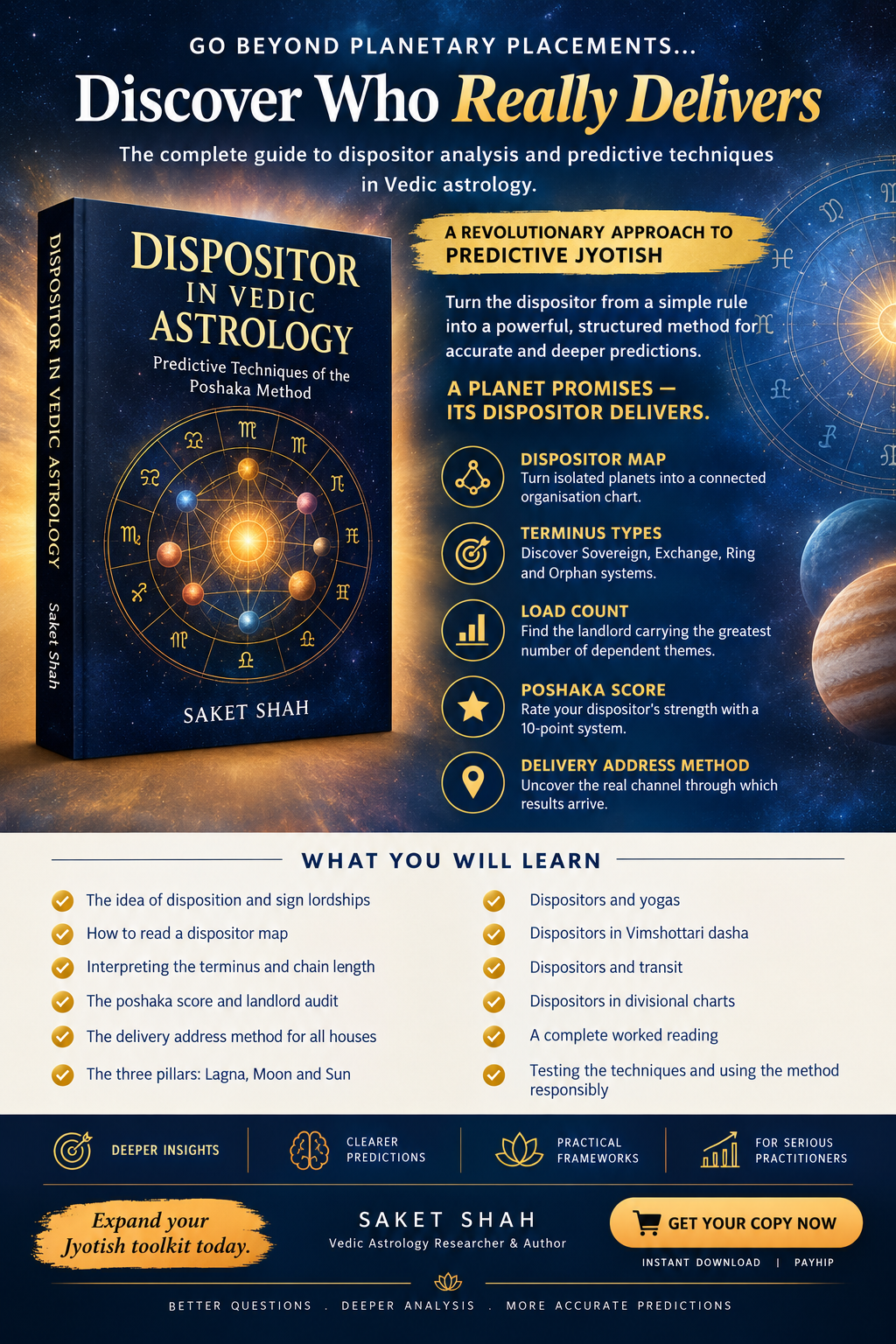
A PLANET PROMISES — ITS DISPOSITOR DELIVERS.
The book transforms the dispositor from a minor supporting consideration into a complete analytical map for predictive Jyotish.
⚡ DISCOVER THE POSHAKA METHOD
Inside this book, Saket Shah develops a systematic approach to tracing planetary dependence.
You will learn how to construct a Dispositor Map, follow planetary chains, identify their final destinations, and determine where authority ultimately concentrates.
The book introduces four proposed Terminus Types:
- Type S — Sovereign: the chain terminates in a planet occupying its own sign.
- Type X — Exchange: the chain terminates in a two-planet mutual exchange.
- Type R — Ring: three or more planets form a closed dispositor cycle.
- Type O — Orphan: a sovereign exists without other planets depending upon it.
These structures become the foundation for deeper predictive interpretation.
🪐 WHAT YOU WILL LEARN
1. The Dispositor Map
Learn how to convert apparently disconnected planetary placements into a connected organisational structure.
Instead of asking only:
“Where is Mars?”
you begin asking:
“Who controls Mars?”
Then:
“Who controls Mars's landlord?”
And finally:
“Where does the chain terminate?”
The book explains how these chains behave as functional graphs that ultimately terminate in fixed points or cycles.
2. The Terminus Types
Discover how Sovereign, Exchange and Ring systems create completely different predictive environments.
A short chain can indicate more direct results.
A long chain can indicate negotiated, delayed or redirected results.
A planetary ring can create recurring cycles in life themes.
This gives the astrologer a new structural language for reading dispositor relationships.
3. The Load Count
One of the book's most practical concepts.
Instead of looking at every planet equally, identify the landlord carrying the greatest number of dependent planetary themes.
A heavily loaded landlord becomes a potential pressure point in the horoscope.
When its dasha, antardasha or major transit becomes active, several seemingly unrelated matters can become activated together.
4. The Poshaka Score
How do you determine whether a dispositor is actually capable of supporting its tenants?
The book proposes a 10-point Poshaka Score, examining:
- Sign dignity
- House strength
- Navamsa support
- Solar condition
- Aspect quality
- Motion
- Nakshatra relationship
This creates a practical rating system rather than relying only on vague descriptions such as “strong” or “weak.”
The proposed interpretation divides landlords into:
8–10: generous landlord
5.5–7.5: dependable landlord
3–5: limited landlord
Below 3: negligent or hostile landlord
🎯 THE DELIVERY ADDRESS METHOD
This is one of the central predictive ideas of the book.
For a house whose results you want to predict:
House → House Lord → Dispositor → House occupied by Dispositor
That final house becomes the proposed Delivery Address.
The idea is that the original house shows the promise, while the dispositor's house indicates the channel through which the result may actually arrive.
For example, the book explains how a seventh lord can invest energy in one area while its dispositor can show the eventual channel through which partnership materialises.
💰 MONEY • CAREER • MARRIAGE • CHILDREN • DESTINY
The Delivery Address framework is extended across different house lords.
You can explore proposed dispositor pathways for:
- Wealth
- Career
- Marriage
- Property
- Children
- Education
- Fortune
- Transformation
- Foreign connections
- Gains
- Losses
- Hidden resources
- Service
- Research
The book also introduces a Rule of Convergence, where different house matters can become intertwined when their Delivery Addresses fall into the same house.
🌙 THE THREE PILLARS
The book gives special attention to:
Lagna
Body, identity and personal direction.
Moon
Mind, emotional response and psychological experience.
Sun
Authority, status, father and purpose.
Their dispositor chains become three important “governors” through which the horoscope can be studied.
The book then proposes comparing these governors to identify alignment, tension and dominant planetary themes.
🧿 DISPOSITORS AND YOGAS
The book doesn't stop at isolated planetary placements.
It proposes a Landlord Audit for yogas.
Before accepting a yoga at face value, examine the dispositor of every planet participating in it.
The book proposes that:
Strong participants + supportive landlords = stronger delivery
while
Weak landlords = delayed, partial or exposed results.
The method is then applied to:
- Raja Yoga
- Dhana Yoga
- Neecha Bhanga
- Parivartana Yoga
- Vipareeta Raja Yoga
- Dusthana-related configurations
⏳ DISPOSITORS + VIMSHOTTARI DASHA
This section turns the dispositor framework toward timing.
The book proposes a Three Layer Check before interpreting a mahadasha:
- Condition of the dasha lord
- Poshaka Score of its landlord
- Chain Length and Terminus
It then introduces the proposed concept of the:
POSHAKA ANTARDASHA
The antardasha of the dasha lord's landlord is treated as a potentially important release or correction period for the dasha's promises.
The book also proposes a Dasha Gate around the dasha lord's own antardasha and its Poshaka Antardasha, offering a way to narrow broad dasha periods into potentially more concentrated windows.
🪐 DISPOSITORS + TRANSITS
The method is further extended to transit analysis.
You will encounter concepts including:
- Landlord Visit
- Tenant Visit
- Landlord + Tenant activation
- Double Transit through the landlord
- Eclipse activation of high-load landlords
- Return transits of landlords
- Final dispositor transits for fine timing
The book explicitly treats several of these as proposals to be tested rather than unquestionable classical laws.
🔱 DISPOSITORS IN DIVISIONAL CHARTS
The framework is also taken into the Vargas.
The book explores:
Rashi
The basic dispositor structure.
Navamsa
The proposed Governor of Fruition.
Dashamsa
Career structure through dispositor relationships.
Saptamsa
Children-related analysis.
Hora / wealth Vargas
Financial interpretation.
A particularly interesting concept is the proposed Consistency Count — tracking whether the same planet repeatedly functions as landlord across divisional charts.
📖 A COMPLETE WORKED READING
The book doesn't leave the method in theory.
A constructed example horoscope is taken through the framework step by step.
The analysis demonstrates:
Map → Classification → Poshaka Scores → Pillar Governors → Delivery Addresses
The example includes a Sovereign Saturn system and a four-planet Ring system, creating what the book calls Dual Governance.
🧠 WHO IS THIS BOOK FOR?
This is designed primarily for astrologers who already understand:
- Signs
- Houses
- Planetary lordships
- Aspects
- Yogas
- Vimshottari Dasha
- Basic Vedic astrology
It is not intended as a beginner's introduction to Jyotish.
Instead, it is designed as a deeper predictive framework for practitioners who want to investigate what happens behind the visible planetary placement.
🔥 THIS IS NOT JUST ANOTHER BOOK ON DISPOSITORS
The book's distinctive contribution is its attempt to turn dispositor analysis into a structured workflow.
You aren't simply told:
“Check the dispositor.”
You are given a proposed sequence:
MAP → TRACE → CLASSIFY → SCORE → LOCATE → TIME → TEST
That makes the material especially useful for astrologers interested in systematic prediction.
⚠️ IMPORTANT SCHOLARLY NOTE
The author clearly distinguishes classical principles from his own working constructions.
The Terminus Types, Load Count, Poshaka Score and Delivery Address Method are presented as author's proposed frameworks for testing—not as ancient rules or statistically proven laws.
The book itself encourages readers to test these techniques against their own collections of charts.
That makes this work particularly suitable for serious students who enjoy research-oriented Jyotish rather than unquestioned formula memorisation.
📚 BOOK STRUCTURE
The book contains 15 chapters, followed by a glossary and author section.
Among the major chapters are:
The Idea of Disposition
Drawing and Reading the Dispositor Map
Interpreting the Terminus
The Poshaka Score
The Delivery Address Method
The Three Pillars: Lagna, Moon and Sun
Each Planet as Landlord
Dispositors in Yoga Analysis
Dispositors and Vimshottari Dasha
Dispositors and Transit
Dispositors in Divisional Charts
A Complete Worked Reading
Life Topics Through Dispositors
Testing the Techniques
Using the Method Responsibly
🚀 IF YOU ARE SERIOUS ABOUT PREDICTIVE JYOTISH...
Don't look at a planet in isolation.
Ask:
Who owns the sign?
Then:
Who owns that planet's sign?
Then:
Where does the chain terminate?
Then:
How strong is the final authority?
Then:
Where is the result delivered?
And finally:
When is that delivery mechanism activated?
That is the investigative philosophy behind Dispositor in Vedic Astrology: Predictive Techniques of the Poshaka Method.
✦ BY SAKET SHAH ✦
Vedic Astrology Researcher & Author
A research-oriented exploration of dispositor chains, planetary dependency, predictive structure and the proposed Poshaka framework.
READ THE FIRST 10 PAGES BEFORE YOU BUY
The Payhip preview contains strictly the first 10 pages of the original manuscript, without replacing them with promotional material.
10-page preview:
Download the 10-page Payhip preview
The preview preserves the original opening sequence, including the title page, copyright, contents, preface, introduction to disposition, sign lordships, the dispositor relationship and the central “planet promises, dispositor delivers” principle.
SEO KEYWORDS
dispositor in Vedic astrology, dispositor astrology, final dispositor, Poshaka method, Poshaka score, dispositor chain, dispositor map, Vedic astrology prediction, predictive Jyotish, planetary dispositor, sign lord astrology, final dispositor technique, Vedic astrology techniques, advanced Jyotish, dispositor dasha, dispositor transit, dispositor yoga analysis, Delivery Address Method, planetary chains, Vedic astrology research, Saket Shah, advanced Vedic astrology ebook, astrology prediction techniques