
Reading Drag Lines — A Tailor's Guide to Diagnosing Fit from Tension Alone
You can see that something is wrong with the garment. The fabric pulls, the seam twists, a fold appears where none should. But naming the cause — and knowing it from the symptom — is the work of years.
This guide is that work, written down. Twenty-six years of reading garments, distilled into a single method: how to look at a drag line and know what the fabric is actually telling you.
What’s inside — 66 pages, fully diagrammed:
– The anatomy of a drag line, and how to tell a true tension line from an ordinary fold
– A complete system for classifying what you see — by direction, intensity, length, behaviour, and likely cause
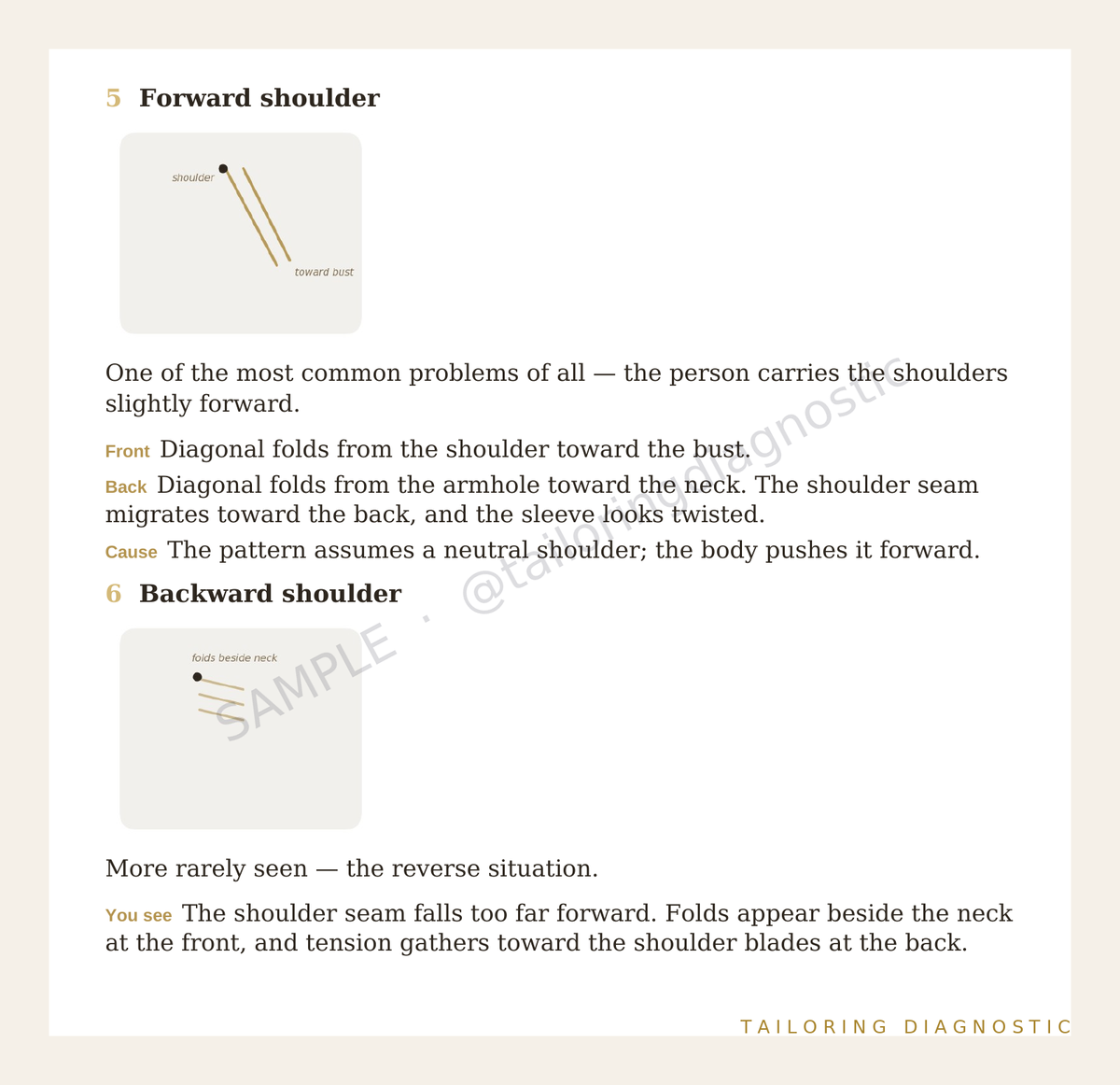
– 54 real cases across five zones of the body: shoulder, back, bust, hip, and leg — each with what you see, and what it means
– The five principles that turn diagnosis into correction
– The seven mistakes almost everyone makes — and what a trained eye sees instead
Every case is paired with a clear tension diagram — a clean schematic showing the direction and origin of each drag line, so you learn to recognise the pattern itself. These are diagnostic diagrams, not figure drawings: the focus is on reading the line, not illustrating the body.
Who it’s for:
Tailors, dressmakers, pattern cutters, and serious sewers who already know their craft — but want to read fit with more certainty. This is not a beginner’s sewing manual. It is a way of seeing, from someone who has spent a career learning to see.
A note on what this is — and isn’t:
This guide teaches you to read the cause. For the garments that refuse to resolve — the ones where the principle alone isn’t enough — that’s what a personal diagnosis is for. But most of what you’ll meet at the table, this will teach you to see for yourself.