
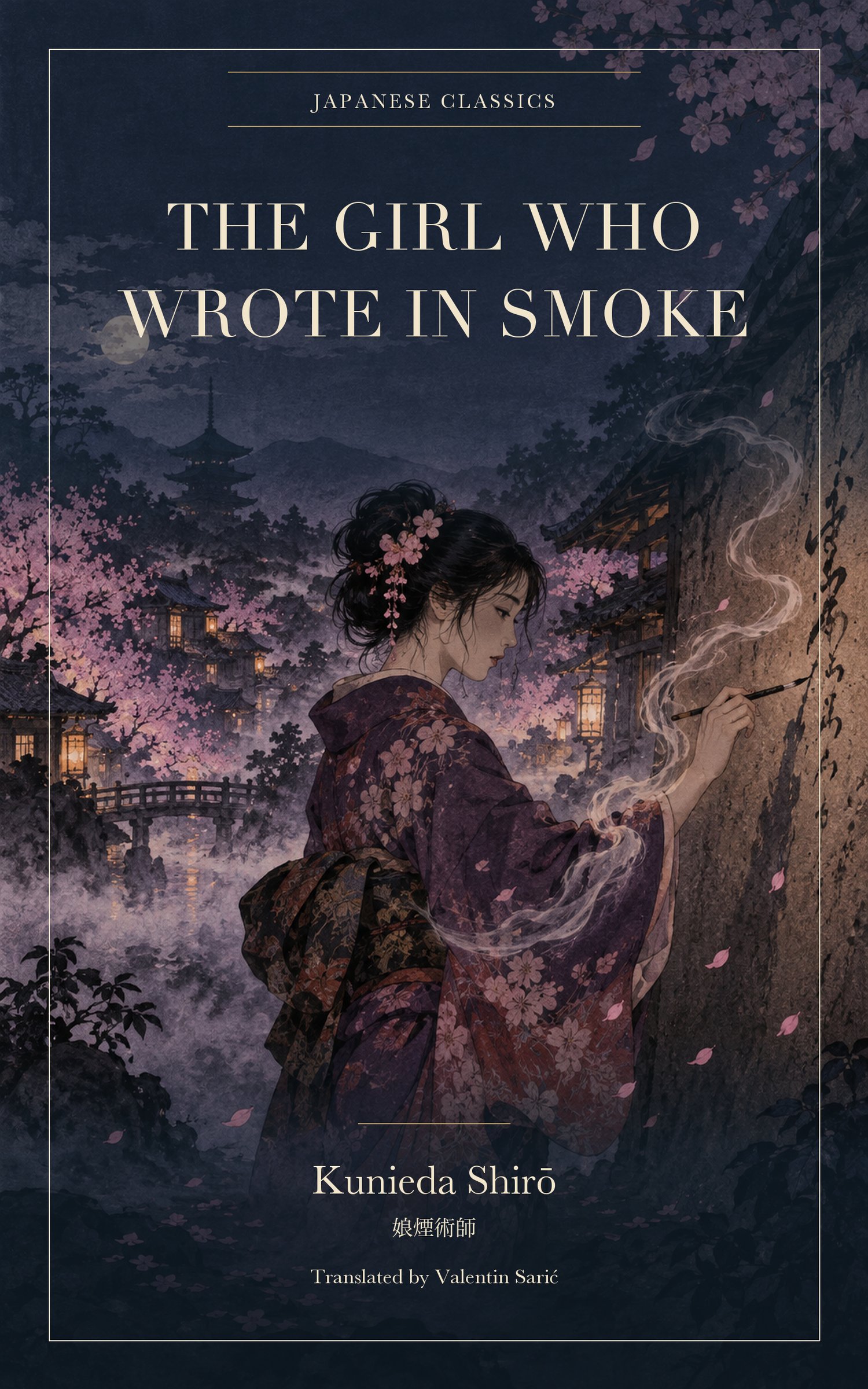
The Girl Who Wrote in Smoke
On a hazy spring night in Kyoto, a girl of nineteen goes along the earthen walls of the Kyoto shoshidai's guardsmen writing the same poem on one house after another in thick black ink. It is a death-poem, and reciting it is dangerous: the man who made it was beheaded and his head set on a pole. A court noble stops her, asks whether she knows who wrote it and in what circumstances, and gets a cool "I know it, if you please" to every question. Her name is Okume. The poet was her father, Fujii Umon, executed with Yamagata Daini in the Meiwa Affair of 1767.
The smoke art of the title is not sorcery. Chapter 19 stops to explain it: a performing skill brought over from China, in which the performer draws tobacco smoke from a five-shaku pipe and breathes it out so that pictures and written characters stand in the air — fashionable in the Genroku years, dead for a long while, revived in Meiwa. Okume works it at midnight in the daimyō quarter of Hongō, with no spectators, writing her father's forbidden poem into the sky above the walls; the act is a street trade and a cover for underground propaganda both. Then she picks the pocket of the one man who was watching — Yamagata Mon'ya, master of a Kanda fencing school, and the executed Daini's son.
What follows runs 161 chapters, and Kunieda wrote it as a daily newspaper instalment: short scenes, hard cuts, a reversal or a corpse in almost every chapter. A rolled hōsho scroll and an inrō pass from hand to hand for the length of the book. Hōjō Mimasaka, a rich hatamoto, hunts the royalists through his thief-takers; his son Sanai is in love with a kyōgen master's daughter and under the spell of something else entirely. Mon'ya's sister Suzue fights by blowing needles from her mouth and puts out a man's eye with one. Momonoi Hyōma murders a street diviner and marries the daughter under a false name, and she goes mad. A black-lacquered woman's palanquin appears in the street with green-clad guards around it and a woman inside who talks of tents of hide, watch-fires and the men she has peeled like peony petals. The empty mansion at the Mito lord's stone yard burns; the fighting spills across rooftops and through alleys; and the last stretch of the book travels the Tōkaidō to the Tenryū gorge and Kyōmaru, a hidden valley where crimson peonies grow larger than a rain-hat and Takeuchi Shikibu, supposed dead on his way to exile, lives on as the Tenryū Adept. This is a violent, erotic popular serial — attempted rape, mutilation, prostitution, class contempt, a chapter of frank sexual boasting — and the translation renders all of it as Kunieda wrote it, unsoftened.
Chapter 161 closes every thread: Hyōma dies on his own blade in his mad wife's hands, Genbei is cut down and Sonoko gives the stroke of mercy for her murdered brother, and Okume gives up her love for Mon'ya and goes on carrying men into Kyōmaru behind the smoke art. Then Kunieda steps out in his own voice, quotes a letter from a reader in Nara who says Kyōmaru really exists and that his aunt's daughter married into it, promises to go and look, and promises a sequel he never wrote. First English translation, complete and unabridged — all 161 chapters, with the author's own inconsistencies kept and footnoted rather than tidied away.
English-language digital edition. Translated by Valentin Sarić.
You receive: a 524-page PDF and an EPUB edition.
Digital download only. No physical book is shipped.