
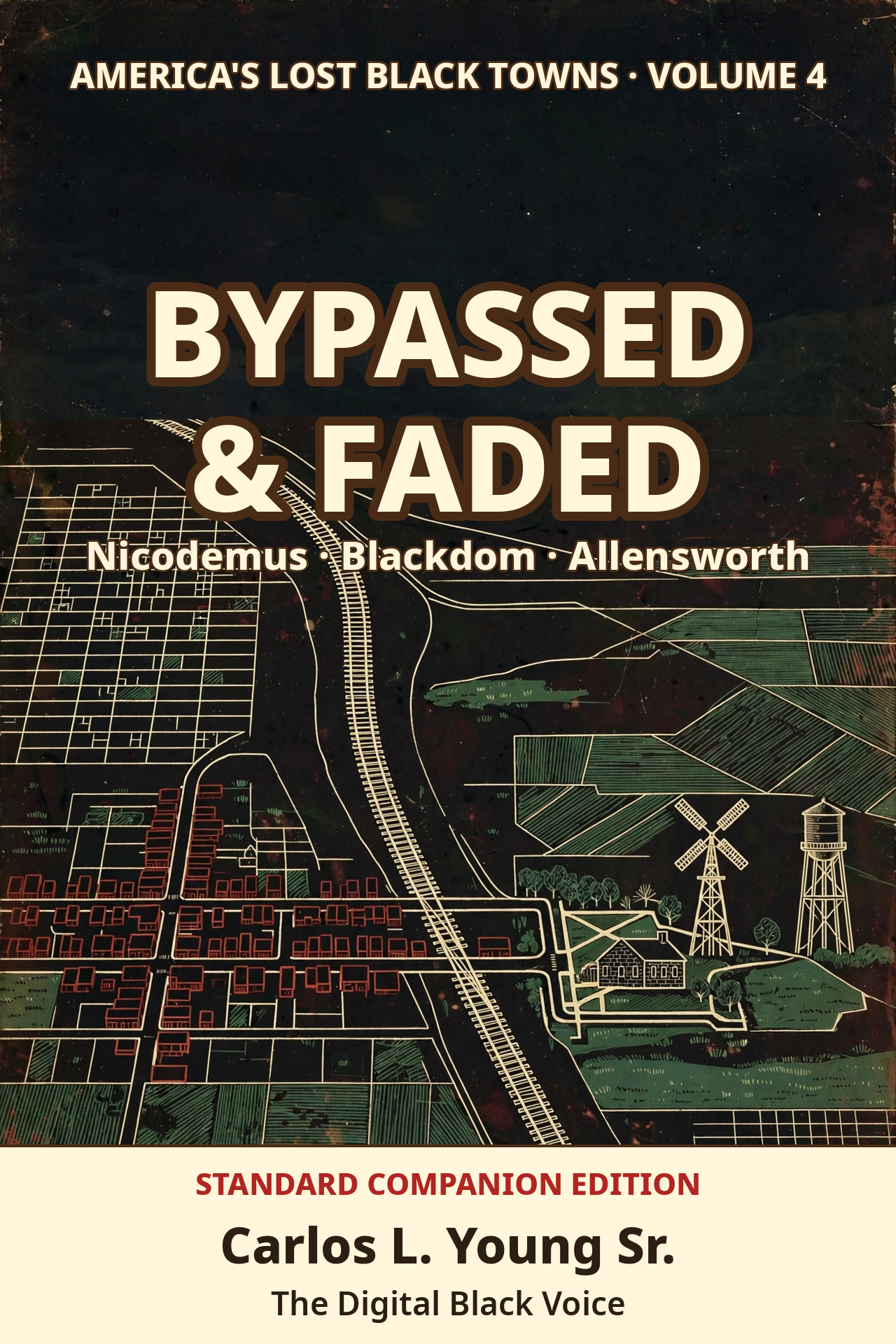
America's Lost Black Towns Vol. 4 — Bypassed & Faded (Standard Companion Edition — Interactive Edition)
The quietest erasures leave no ashes. Nicodemus, Kansas — the most famous town of the Exodusters — voted bonds and invested its own money to lure a railroad, and in 1888 both lines routed through Bogue instead; the town withered over fifty years to 14 residents in the 2020 census, and five buildings, a National Historic Site, and an unbroken Homecoming carry its memory. Blackdom, New Mexico, was built by homesteaders around Frank Boyer's vision — a settlement founded in 1901, a townsite company incorporated in 1903 — and emptied when the water did: drought, alkali, and a falling artesian basin, until nothing stood at all. (Its exact population is unknown, and this book prints that honestly, with the estimates attributed.) And Allensworth, California — the town California State Parks calls the state's first town founded, financed, and governed by Black Americans — lost its water fight, its railroad trade, and its founder in a single stretch of years, then came back as a state historic park: saved, but as a museum of itself, beside a living town that never left. No mobs, no seizures — just a line on a map drawn somewhere else, and water that stopped coming.
Inside the Interactive Edition: the complete book — all 3 chapters, full text · Recorded narration by Marcus (the Digital Black Voice narration voice) — 29.0 minutes, every chapter read aloud · Four layers per town: Then/Now, the Document, Map/Deeds, and Oral History with its carriers named · A chronological timeline that jumps to the chapter behind each date · A 10-question educator quiz drawn strictly from the text · Every chapter closes with its Receipts — the documents, counts, and oral traditions the story stands on · For educators: a TEKS correlation sheet for this volume is available with the Lost Black Towns educator materials — audited against the finished text and the adopted Texas standards, claiming only what the sheet claims. These materials make classrooms eligible, not district-adopted.