
NEBOSH IDIP DI3 Scenario Decoder
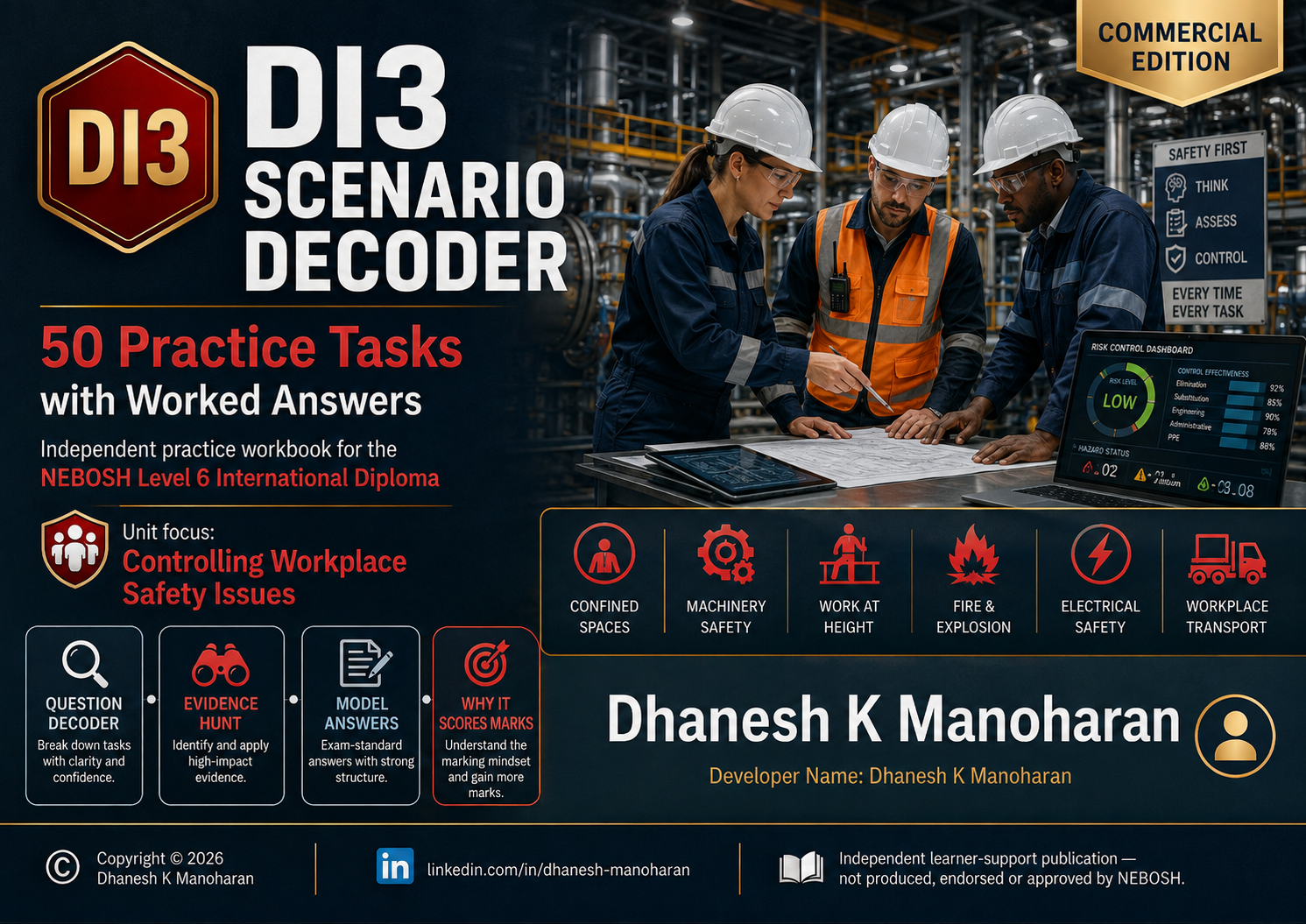
DI3 SCENARIO DECODER
50 Practice Tasks with Worked Answers
Controlling Workplace Safety Issues
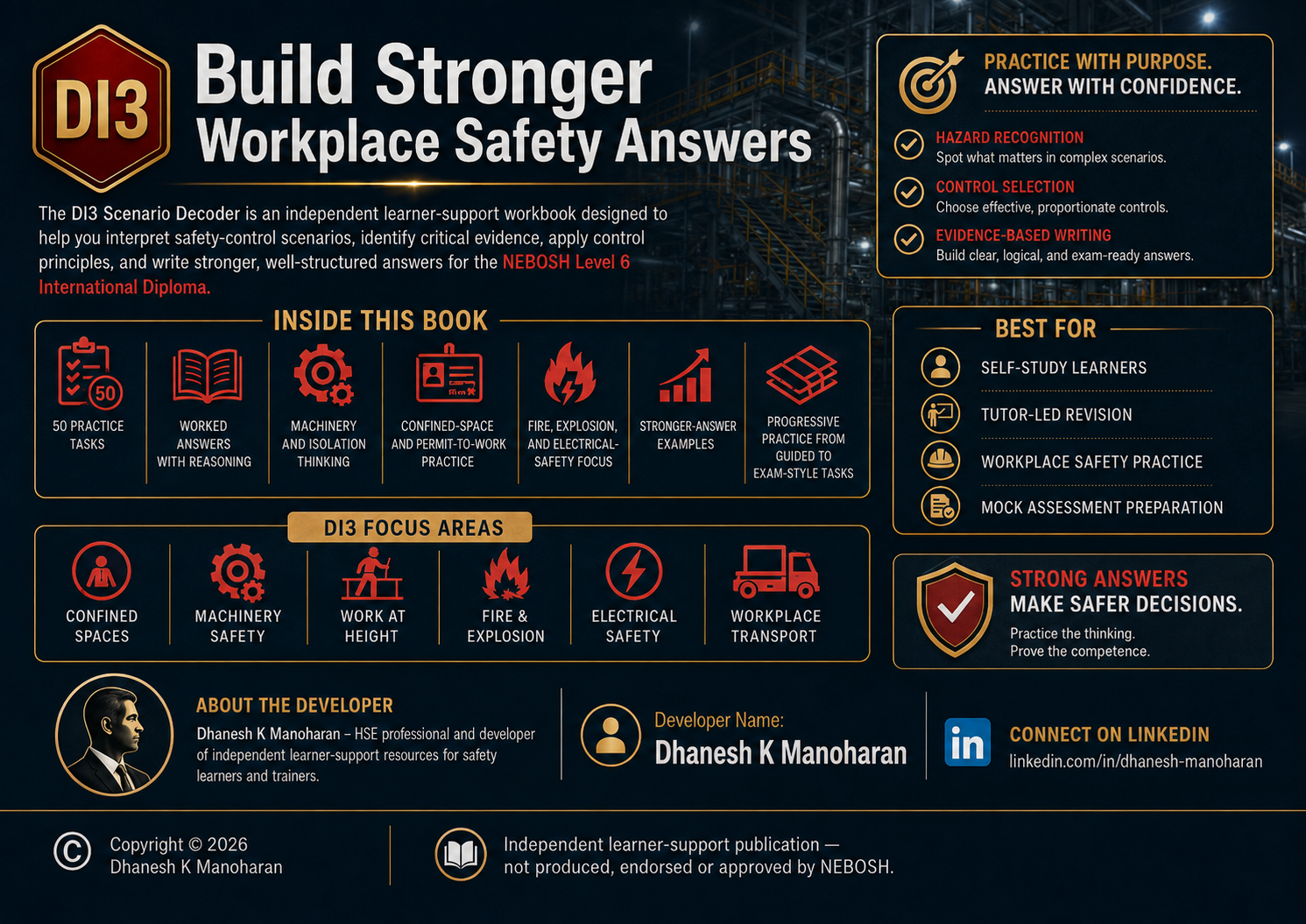
The DI3 Scenario Decoder is an independent workplace-safety practice workbook developed for learners preparing for the technical safety-control unit of the NEBOSH Level 6 International Diploma. It is designed to help learners interpret complex safety scenarios, recognise significant technical clues and develop well-structured, evidence-based answers.
DI3 frequently requires learners to identify the significance of apparently small details. A statement that a guard was bypassed, an isolation was incomplete, a permit was poorly controlled or a vehicle route was inadequately segregated may represent a major weakness in the organisation's risk controls. The learner must recognise the hazard, understand the potential failure mechanism and explain what the consequences could be.
The workbook develops the following analytical pathway:
HAZARD → INITIATING EVENT → EXPOSURE → CONTROL FAILURE → CONSEQUENCE → ADDITIONAL CONTROL → JUSTIFICATION
It contains 50 progressively structured practice tasks with worked answers, covering major workplace-safety topics such as machinery safety, maintenance, isolation and LOTO, confined spaces, permit-to-work systems, work at height, fire, explosion, electricity, workplace transport and other high-risk operational activities.
The Scenario Decoder method trains learners to start with the question rather than immediately writing everything they know about the topic. Each task encourages the learner to identify the command word, define the scope, search for scenario evidence and determine the technical significance of the facts provided.
Worked answers demonstrate how to move beyond simple observations. For example, stating that “the machine guard was damaged” may identify a problem, but a stronger response explains the resulting exposure, the potential interaction with moving parts, the consequences and the type of control needed. This development of the point is central to the workbook.
The book also helps learners understand the difference between generic control lists and controls that are properly applied to the specific scenario. A hierarchy-of-control answer is only useful when it addresses the actual hazard, failure and operating conditions described.
The progressive structure starts with guided tasks and gradually moves towards more independent assessment-style practice. This allows learners to build confidence before attempting more complex technical scenarios with reduced support.
The DI3 Scenario Decoder may be particularly valuable for experienced safety professionals who understand workplace hazards but need to strengthen the way they communicate technical reasoning in assessment answers. It can also support self-study learners, tutor-led revision, classroom discussion and mock-assessment preparation.
The ultimate aim is for the learner to read a technical scenario and immediately think:
What can go wrong? Why can it happen? Who or what may be exposed? Which control has failed? What could be the consequence? What control is needed, and why?
The workbook is therefore not designed as an answer bank. It is designed to develop the professional reasoning needed to construct stronger workplace-safety answers independently.
Independent learner-support publication. Not produced, endorsed or approved by NEBOSH.