
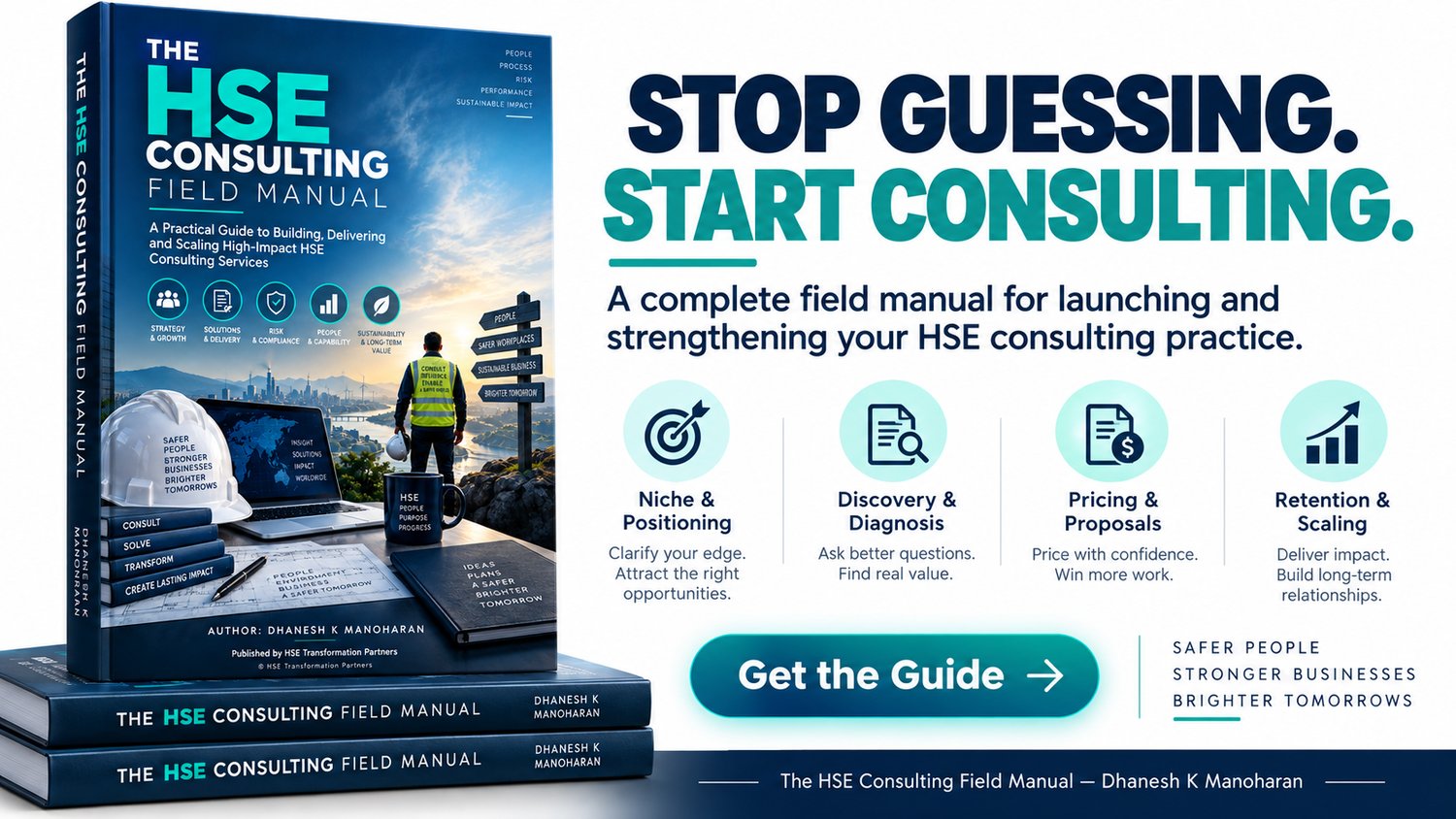
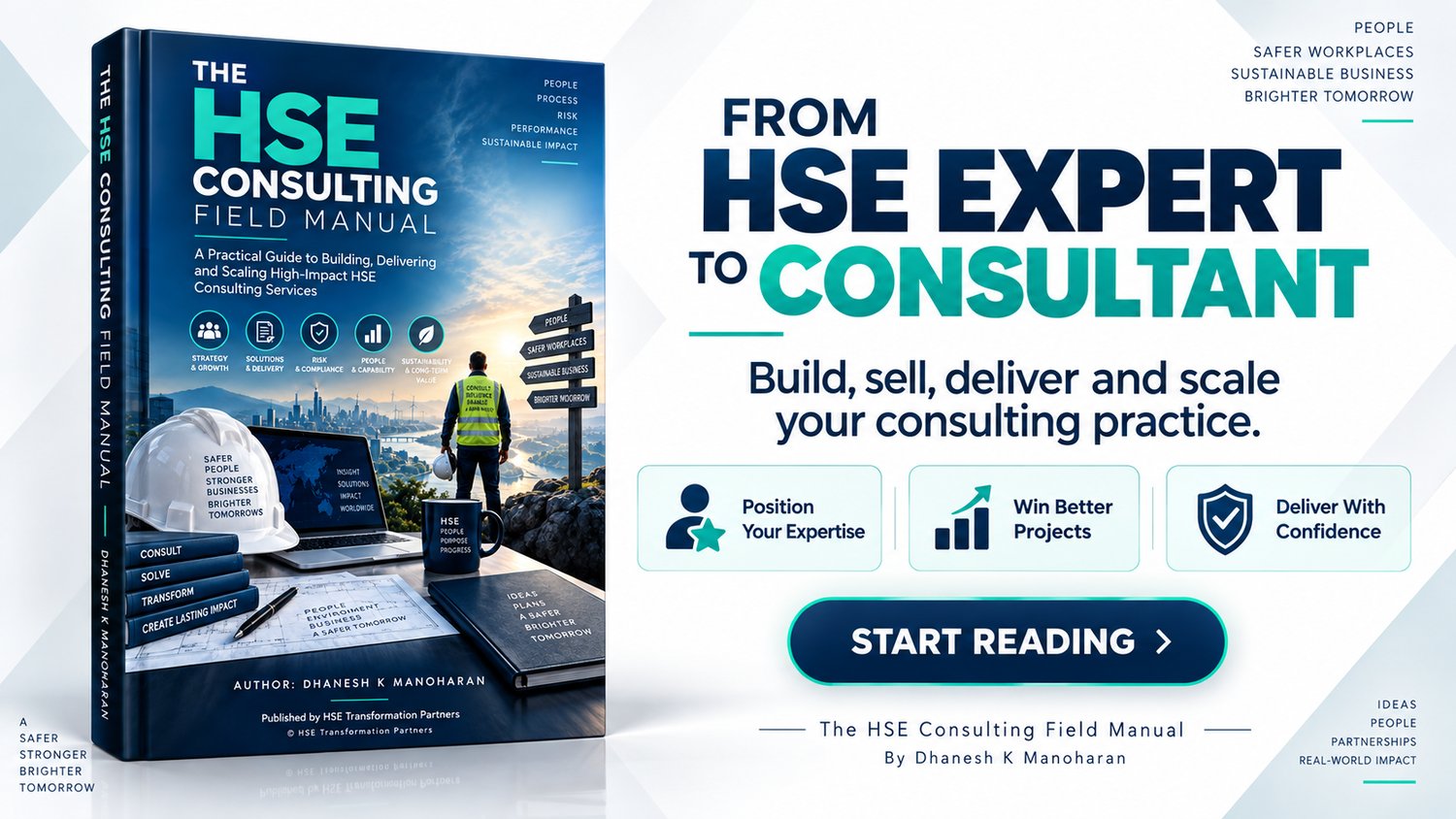
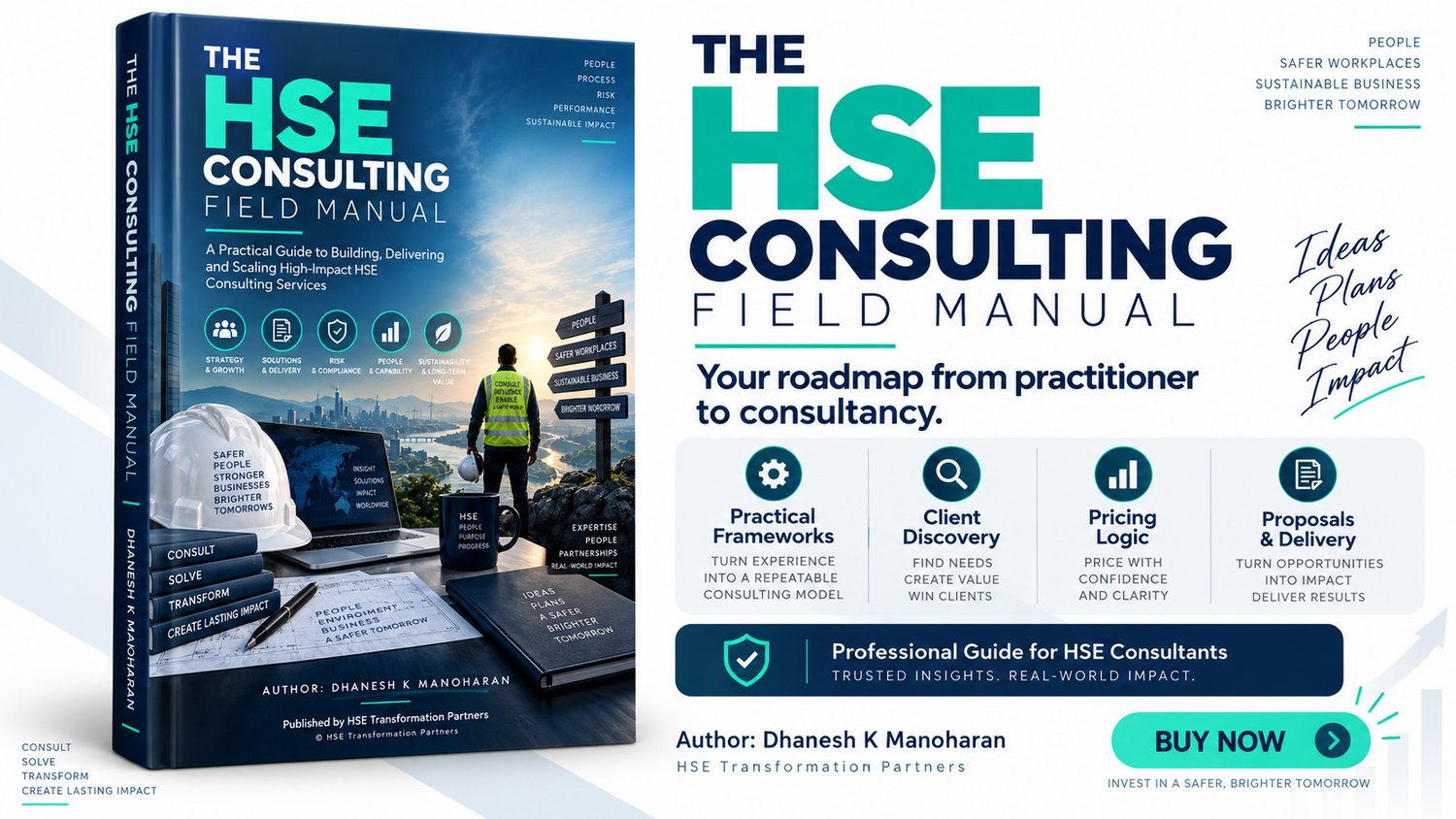
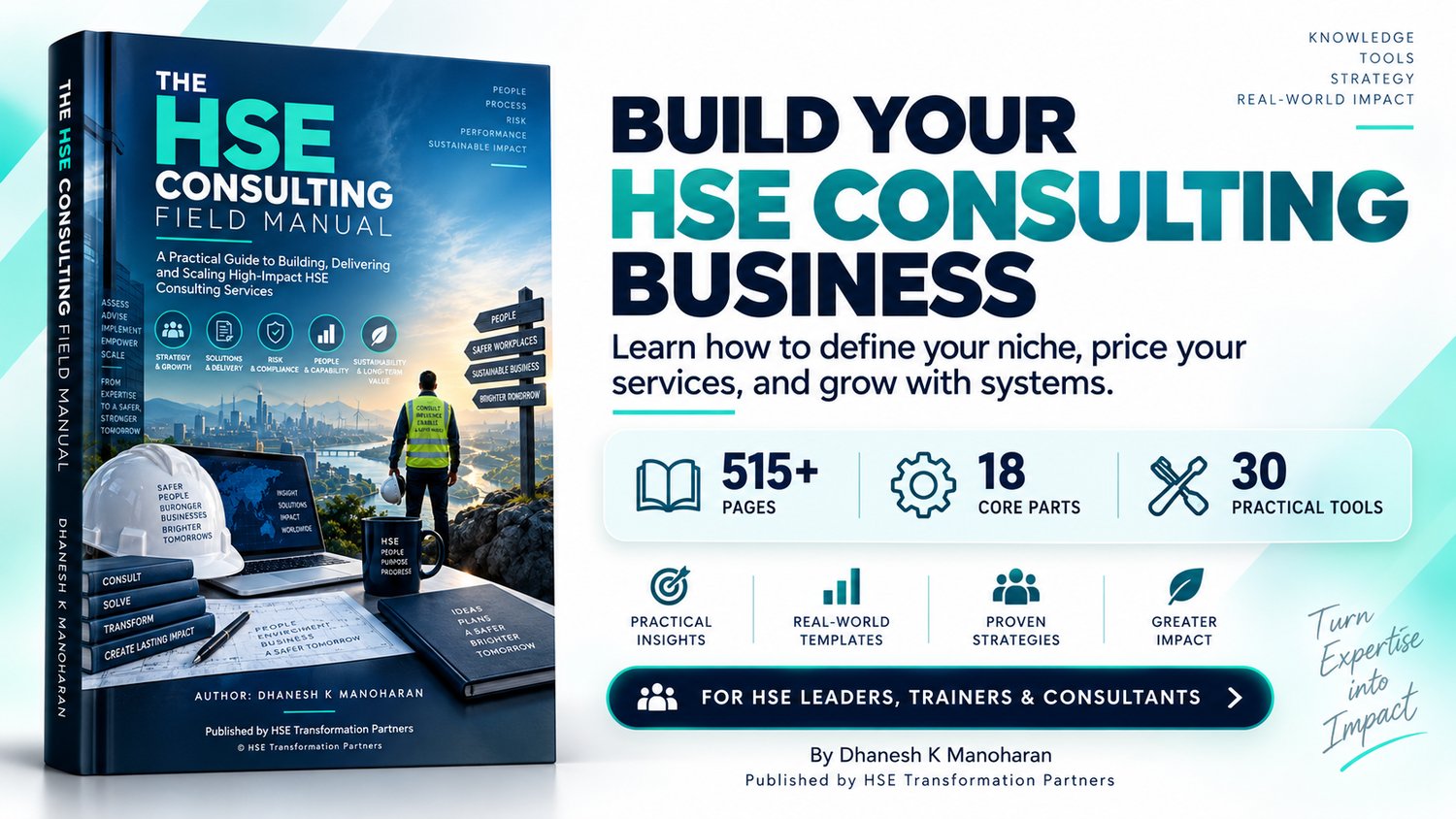


THE HSE CONSULTING FIELD MANUAL
THE HSE CONSULTING FIELD MANUAL
How Experienced HSE Professionals Build, Sell, Deliver and Scale a Domestic, International and Remote Consulting Practice
Author: Dhanesh K Manoharan
Publisher: HSE Transformation Partners
Copyright © 2026 HSE Transformation Partners
Format: Digital PDF | Amazon KDP 8 × 10 format | Approx. 515 pages
Are you ready to turn your HSE expertise into a high-value consulting practice?
Years of experience in health, safety and environment can make you technically strong—but technical knowledge alone does not automatically create a successful consulting business.
A consultant must also know how to identify a profitable niche, diagnose client problems, structure services, define scope, price assignments, prepare proposals, manage contracts, acquire clients, demonstrate value, deliver projects professionally, protect commercial risk, use digital tools responsibly and build repeat business.
The HSE Consulting Field Manual has been developed to bridge that gap.
This is not another general safety textbook.
It is a practical consulting business-building field manual designed specifically for experienced HSE professionals who want to convert accumulated technical knowledge, professional judgement and industry exposure into a structured, credible and commercially sustainable consulting practice.
Whether you want to work as an independent HSE consultant, specialist advisor, auditor, trainer, fractional HSE leader, remote consultant or build a boutique consulting company, this book provides a structured pathway from expertise to consulting impact.
WHAT THIS MANUAL WILL HELP YOU DO
The book takes you through the full consulting journey—from deciding what you should consult on to building an operating system that can support repeat clients, international assignments, partnerships and future scale.
Inside the manual you will learn how to:
- Move from HSE professional to HSE consultant by understanding the mindset, commercial responsibilities and professional boundaries that change when you begin advising external clients.
- Inventory your expertise and select a consulting niche based on industry exposure, technical depth, problem-solving experience, evidence, market access and commercial practicality.
- Position yourself clearly in the market so prospective clients understand who you help, what problems you solve and why your experience is relevant.
- Research consulting opportunities across domestic, GCC/Middle East, UK, Africa, Southeast Asian and remote markets while considering market demand, local requirements and delivery practicality.
- Use a structured HSE consulting methodology for discovery, diagnosis, design, delivery, demonstration of results and sustainable client ownership.
- Design consulting services clients can actually buy, including audits, management-system assignments, critical-risk reviews, contractor HSE, investigations, training consultancy, leadership programmes, emergency preparedness, digital consulting and advisory services.
- Conduct professional client discovery and diagnosis using interviews, document reviews, site observations, evidence triangulation, maturity assessment and problem-definition techniques.
- Establish defensible evidence and baselines so recommendations and value claims are supported rather than exaggerated.
- Translate HSE improvement into business relevance using risk reduction, operational improvement, capability development, assurance and measurable performance indicators.
- Build professional authority and a consulting portfolio through capability statements, anonymised case studies, sample deliverables, thought leadership, professional content and ethical evidence.
- Create the operating structure for a consulting business, including client records, CRM, project control, finance, document control, cyber security, partners and continuity arrangements.
- Understand contracts, liability, ethics and data responsibilities before accepting consulting assignments.
- Price consulting work professionally using day rates, project fees, packaged services, retainers, fractional leadership arrangements and international commercial models.
- Calculate sustainable fees by considering billable capacity, non-billable time, professional risk, project complexity, revisions, travel, administration and business overhead.
- Develop a practical marketing and client-acquisition system using referrals, LinkedIn, professional content, target accounts, partnerships, vendor registration and disciplined outreach.
- Qualify opportunities before investing time using structured go/no-go criteria.
- Prepare professional HSE consulting proposals and tender submissions covering client context, problem statements, objectives, methodology, scope, boundaries, deliverables, commercials and risk controls.
- Negotiate without damaging scope or profitability and recognise situations where walking away is the correct commercial decision.
- Deliver consulting projects systematically from kickoff and information gathering through implementation, verification, reporting, handover and closeout.
- Use practical HSE consulting service playbooks covering recurring consulting assignments across management systems, critical risk, assurance, capability, culture, contractor management and operational HSE.
- Deliver remote and hybrid consulting services while recognising the limitations of remote evidence and avoiding the mistake of treating a screen as the whole site.
- Use digital systems and AI responsibly while keeping technical judgement, evidence verification, ethics, confidentiality and final professional accountability with the consultant.
- Build a controlled knowledge base that captures lessons, methods, evidence and reusable consulting intellectual property.
- Develop repeat business and client retention through outcome confirmation, follow-up, implementation support, review meetings, extensions, retainers and referrals.
- Build partnerships and associate networks involving specialist consultants, local country partners, training providers, digital specialists and professional advisers.
- Assess whether your consultancy is ready to scale through eight control areas covering demand, services, delivery, people, quality, finance, systems and governance.
- Create governance and resilience systems covering risk, insurance, ethics, data, cyber security, financial controls, competence, complaints and business continuity.
- Reduce dependence on one founder or key expert by documenting methods, creating backup capability, controlling access and transferring knowledge.
- Plan succession, resilience and eventual exit so the consultancy becomes an organised professional business rather than simply a job owned by its founder.
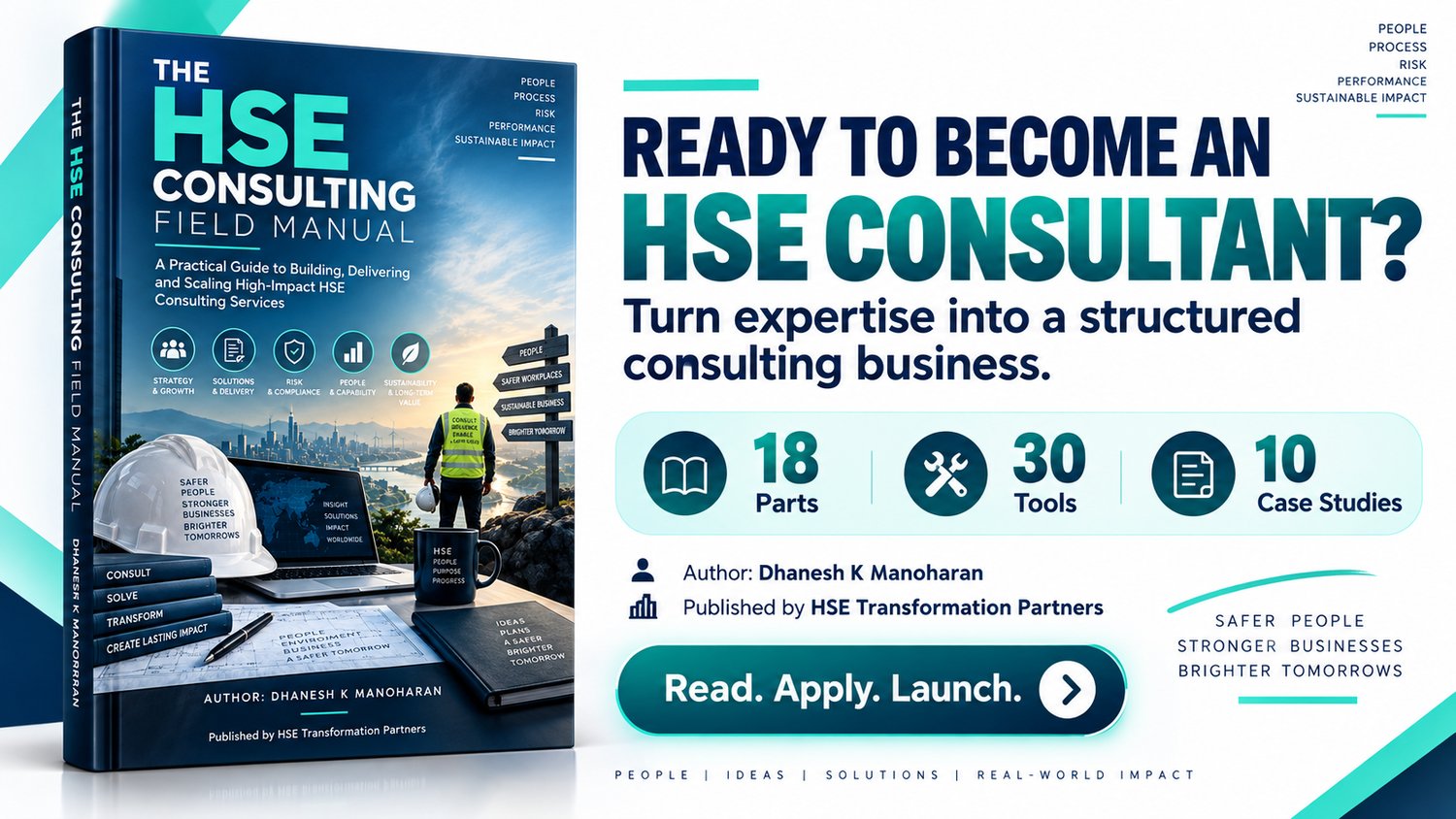
18 PARTS — FROM EXPERIENCE TO A CONSULTING BUSINESS
The manual follows a logical progression through 18 major parts:
Part 1 — From HSE Professional to HSE Consultant
Understand the transition from internal HSE responsibility to external consulting value.
Part 2 — Expertise, Niche and Consulting Position
Convert career experience into a clear specialisation and market position.
Part 3 — Market Intelligence and Opportunity
Research where demand exists and decide which markets and clients deserve attention.
Part 4 — The HSE Consulting Methodology
Develop a repeatable professional method rather than relying on personal experience alone.
Part 5 — Designing Services Clients Can Buy
Turn expertise into clearly scoped consulting products and services.
Part 6 — Client Discovery and Diagnosis
Learn how to uncover the real problem before proposing the solution.
Part 7 — Evidence, Measurement and Business Value
Use evidence, baselines, indicators and defensible value statements.
Part 8 — Authority, Brand and Portfolio
Build professional credibility beyond certificates and job titles.
Part 9 — Building the Consulting Business
Create the basic operating infrastructure required to run consulting professionally.
Part 10 — Contracts, Liability, Ethics and Data
Understand the professional controls surrounding consulting engagements.
Part 11 — Pricing, Finance and Cash Flow
Build fees from sustainable commercial logic rather than guesswork.
Part 12 — Marketing and Client Acquisition
Create visibility, conversations, qualified opportunities and a controlled sales pipeline.
Part 13 — Proposals, Tenders, Negotiation and Closing
Convert opportunities into properly scoped and commercially controlled engagements.
Part 14 — Delivering Consulting Projects
Manage consulting assignments from kickoff to implementation and closeout.
Part 15 — HSE Consulting Service Playbooks
Apply repeatable approaches to common HSE consulting services.
Part 16 — Remote Consulting, Digital Systems and AI
Use technology to extend capability without surrendering professional judgement.
Part 17 — Retention, Partnerships and Scaling
Build recurring relationships, partner ecosystems and scalable consulting capacity.
Part 18 — Governance, Resilience, Succession and Exit
Protect the business and build a consultancy that can operate beyond one individual.
PRACTICAL HSE CONSULTING PLAYBOOKS
The manual includes practical playbooks covering areas such as:
Management-system auditing and improvement, ISO 45001 consulting, integrated management systems, HSE gap assessments, permit-to-work and LOTO, working at height, scaffolding, lifting operations, confined spaces, contractor HSE, construction HSE health checks, shutdown and turnaround safety, incident investigation, emergency preparedness, leadership, behaviour-based safety, training consultancy, culture improvement, competence development and related HSE advisory services.
The objective is not to give the consultant another collection of generic templates. It is to show how to think about each assignment commercially and professionally—who buys it, what triggers the need, what discovery is required, how scope should be controlled, what methodology can be applied, what deliverables should be produced and what evidence should demonstrate value.
10 FICTIONAL / ILLUSTRATIVE CONSULTING CASE STUDIES
The book also contains ten clearly identified fictional and illustrative consulting cases designed to show how the frameworks can be applied to realistic situations.
The cases demonstrate consulting challenges involving client diagnosis, scope, pricing, evidence, project delivery, international assignments, difficult commercial situations, implementation and repeat business.
They are designed for learning and application—not as fabricated claims of actual client work.
THE HSE CONSULTANT TOOLKIT
A major section of the book is dedicated to a 30-tool practical consultant toolkit.
The tools support areas including:
Positioning and offer development, market analysis, client assessment, opportunity qualification, discovery, scope control, proposals, commercial review, contracts, project planning, delivery control, evidence, business-value assessment, risk management, governance and consulting-business decisions.
A decision map is included to help the reader identify which tool to use first depending on the consulting problem being controlled.
30-DAY, 90-DAY AND 12-MONTH IMPLEMENTATION PLANS
Knowledge only creates value when it is applied.
The manual therefore finishes with implementation pathways designed to move the reader from learning into action.
The 30-Day Challenge focuses on clarifying your expertise, niche, positioning and initial offer.
The 90-Day Launch Plan helps develop market presence, consulting assets, prospecting activity, discovery conversations and the first structured pipeline.
The 12-Month Roadmap provides a longer-term structure for building authority, improving delivery systems, creating repeat business, strengthening commercial controls and preparing for sustainable growth.
WHO SHOULD BUY THIS BOOK?
This manual is especially suitable for:
Senior HSE professionals, HSE managers and heads of function; safety engineers and advisors; EHS/HSE consultants; ISO consultants and auditors; incident investigators; HSE trainers; fire and safety professionals; contractor HSE specialists; construction and project HSE professionals; process and operational safety practitioners; retired or semi-retired HSE professionals; NEBOSH, IOSH, CSP and other professionally qualified practitioners; independent consultants seeking stronger business systems; HSE training organisations expanding into consultancy; and professionals planning to create a boutique HSE consultancy.
It is particularly relevant to professionals with substantial practical experience who already understand HSE but need a clearer system for converting that expertise into a marketable and professionally managed consulting practice.
THIS BOOK IS DIFFERENT
The HSE Consulting Field Manual is not designed to teach basic workplace safety.
Its central question is different:
How does an experienced HSE professional convert technical competence into a consulting service that clients can understand, trust, buy, implement and continue to value?
The book therefore connects:
Technical expertise → Client problem → Consulting methodology → Service design → Evidence → Positioning → Pricing → Proposal → Delivery → Results → Retention → Scale
That connection is the foundation of a sustainable consulting practice.
INTERNATIONAL AND REMOTE CONSULTING PERSPECTIVE
The manual has been designed with both domestic and international consulting in mind.
It addresses issues that become increasingly important when working across borders, including:
international commercial models, currency and banking, withholding tax considerations, work permissions, insurance, professional licensing, local partnerships, confidentiality, data protection, contracts, travel requirements, remote evidence, cross-cultural client environments and country-entry due diligence.
Readers are reminded throughout that laws, standards, tax requirements, licensing obligations and professional requirements differ between jurisdictions and must always be verified for the particular assignment.
RESPONSIBLE USE OF DIGITAL TOOLS AND AI
The book also addresses one of the biggest changes affecting modern consulting: AI-assisted professional work.
Digital tools can accelerate research, analysis, document preparation, reporting, knowledge management and data processing.
However, the manual maintains a clear principle:
AI supports. The consultant decides.
Professional judgement, evidence verification, technical review, confidentiality, competence, ethical boundaries and final sign-off remain human responsibilities.
WHAT YOU SHOULD HAVE BUILT BY THE END
By working through the manual rather than simply reading it, you should be able to develop the first working version of your own:
consultant readiness assessment, expertise inventory, consulting niche, positioning statement, ideal client profile, consulting methodology, service catalogue, discovery questionnaire, diagnostic method, capability statement, portfolio, pricing logic, proposal structure, contract-review checklist, CRM pipeline, client acquisition plan, project-control system, evidence framework, remote-consulting workflow, AI governance approach, partner controls, retention framework and 12-month consulting-business roadmap.
The goal is therefore not simply to finish a book.
The goal is to finish with a functioning consulting operating system.
PRODUCT FORMAT
Digital Product — PDF
Designed in an approximately 515-page, Amazon KDP 8 × 10 professional book format, with extensive diagrams, flowcharts, decision maps, tables, checklists, frameworks, worksheets, practical tools, consulting playbooks and case studies.
Suitable for reading on desktop, laptop and tablet, or for personal printing subject to the licence conditions.
PROFESSIONAL NOTICE
This book is an educational and professional-development resource. It does not replace competent professional judgement, engineering advice, legal advice, tax advice, insurance advice or jurisdiction-specific regulatory requirements.
Consultants must operate within their competence and verify applicable legislation, standards, licences, insurance requirements and contractual obligations before undertaking client work.
Pricing examples, commercial approaches and business-development models are illustrative. Actual fees, demand, profitability and business outcomes depend on geography, market conditions, expertise, positioning, scope, risk and execution.
COPYRIGHT AND LICENCE
Copyright © 2026 HSE Transformation Partners. All Rights Reserved.
Author: Dhanesh K Manoharan
Publisher: HSE Transformation Partners
The purchase is for the buyer's personal professional use.
Worksheets, frameworks and tools may be adapted for use within the purchaser's own consulting practice. The book or its contents may not be resold, redistributed, republished, uploaded, sublicensed, converted into a competing template library or represented as another person's original work without written permission from HSE Transformation Partners.
Turn experience into structure.
Turn structure into client value.
Turn client value into a sustainable HSE consulting practice.
The HSE Consulting Field Manual — from expertise to consulting impact.