

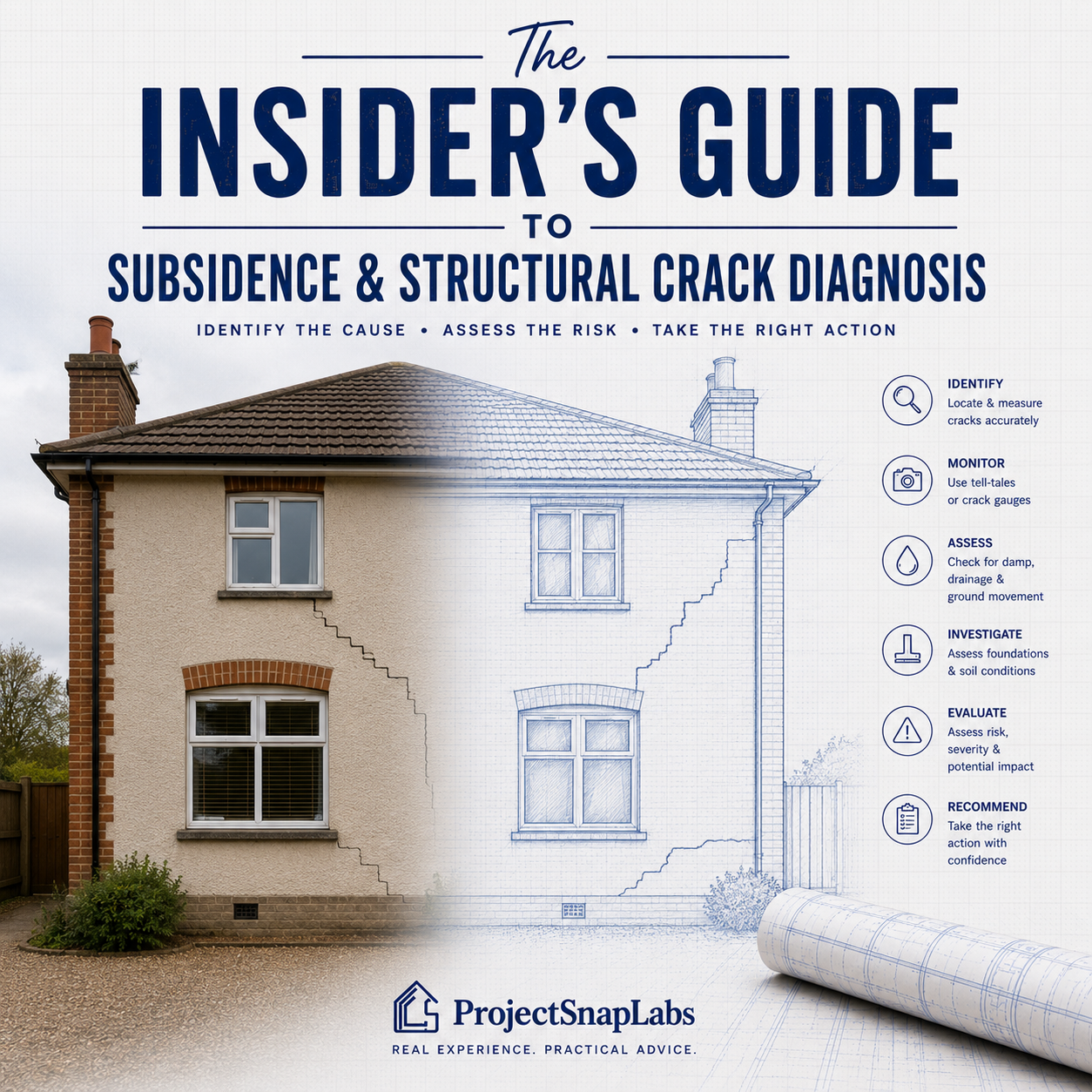
The Insider's Guide to Subsidence & Structural Crack Diagnosis
The Insider's Guide to Subsidence & Structural Crack Diagnosis
Practical knowledge from 42 years in construction
You've just found a crack you didn't notice before — and you've probably already spent an evening scrolling through forum threads of other people's crack photos, none of which quite look like yours.
That's normal. Cracks are one of the most anxiety-inducing things a homeowner can find, because the range of outcomes is so wide: at one end, it's a five-minute filler job; at the other, it's a five-figure structural repair and a fight with your insurer. Most homeowners have no way to tell which end of that range they're on — so they either panic and spend money they didn't need to, or ignore something that needed attention months ago.
This guide won't turn you into a structural engineer, and it isn't trying to. What it gives you is the same framework professionals actually use to make the first call: is this cosmetic, is it worth watching, or does it need someone qualified to look at it. Every technical claim is sourced to a named body — BRE, RICS, the Association of British Insurers, the Financial Ombudsman Service, or UK legislation — and where sources genuinely disagree, or a figure comes from a vendor rather than an independent body, the guide says so rather than smoothing it over.
What's included:
- A one-page Homeowner Decision Tree — the whole framework at a glance, from "found a crack" through to monitor, engineer, or insurer
- The BRE damage-severity scale, translated out of surveyor-speak into plain English
- Reading the pattern: five real crack photographs — horizontal, diagonal, stair-stepped, and vertical — showing you exactly what to look for and why each shape means something different
- The simple on-site test to work out whether a crack is still moving or has already stopped
- A ready-to-use crack-monitoring log and photo record template
- The three-step decision framework: monitor it yourself, call a structural engineer, or notify your insurer
- How to make an insurance claim without accidentally weakening it — including where common online advice directly conflicts with official ABI/BIBA guidance
- Underpinning explained honestly: what it actually involves, what usually gets tried first, and why RICS puts genuine underpinning cases at under 5% of subsidence claims
- A quick-reference checklist and a one-page myths-debunked summary, sourced straight back to the guide itself
Scope: England, correct as of 2026. Costs are typical UK ranges from trade sources — always get current local quotes.
This guide is intended to help you have an informed first conversation with a professional — it is not a substitute for a structural engineer's assessment of your specific property, and it is not insurance or legal advice.