
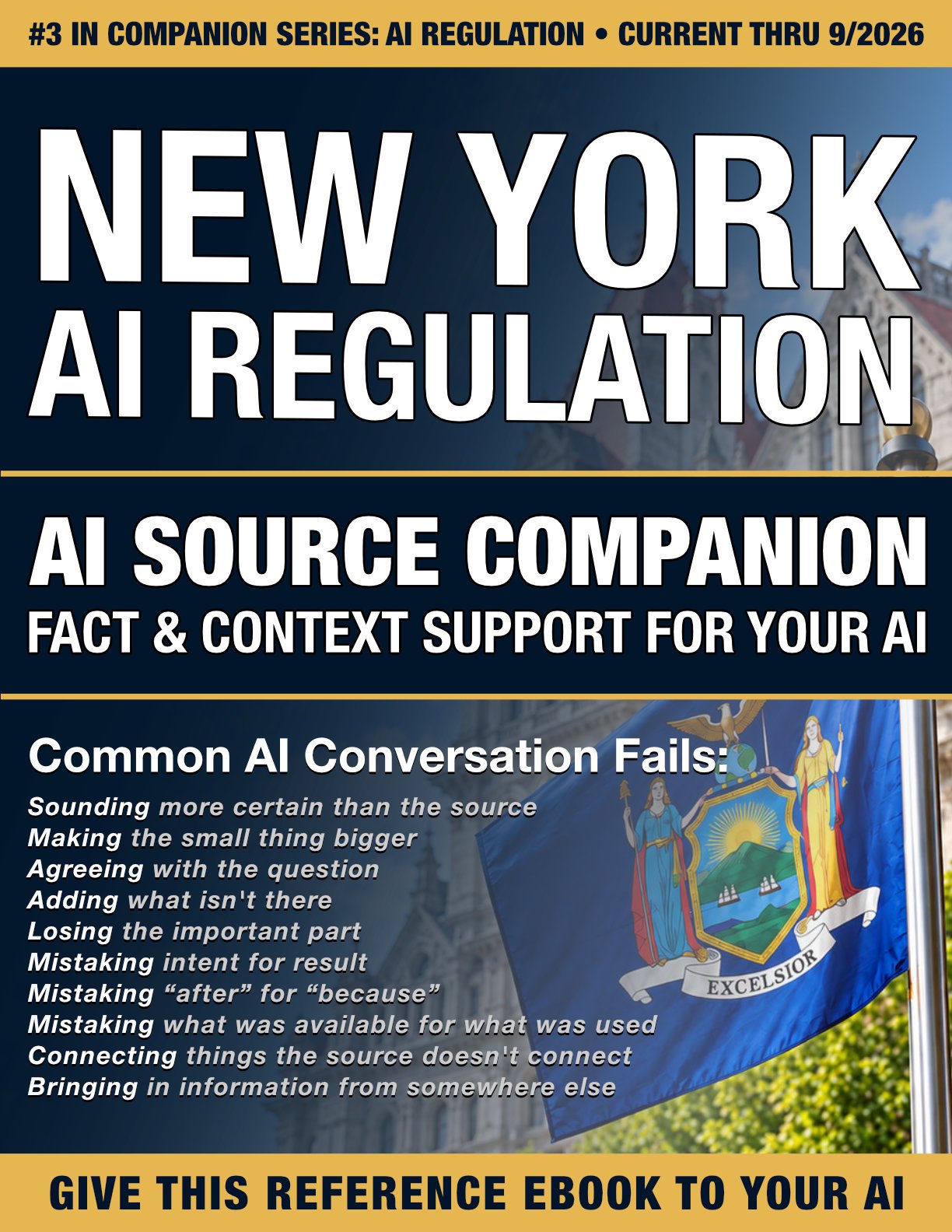
AI Regulation: New York • AI SOURCE COMPANION (PDF)
New York Artificial Intelligence Regulation • AI SOURCE COMPANION (PDF)
Structured analytical reference material for working with New York artificial intelligence regulation in ChatGPT, Claude, Gemini, NotebookLM, and other document-capable AI systems.
New York’s artificial intelligence regulation addresses frontier AI development, safety frameworks, transparency, critical-safety incidents, applicability boundaries, disclosure requirements, enforcement, and related obligations.
This edition is built around the Responsible AI Safety and Education (RAISE) Act, enacted through New York Senate Bill S.8828 and signed into law March 27, 2026 as Chapter 96. NYSenate.gov
Working with that material in an AI system involves more than finding the right passage.
The AI may also need to distinguish what a provision actually establishes, how far a conclusion can extend, which qualifications govern it, whether provisions are genuinely related, and when an interpretation has moved beyond the available evidence.
The New York Artificial Intelligence Regulation — AI Source Companion provides structured analytical material designed to support sustained source-based work with the legislation.
The legislation remains the primary source.
The Companion adds two prepared analytical layers:
AI Reasoning Instructions for guiding how the AI handles source material, analytical records, inference, uncertainty, relationships among provisions, newly introduced information, and unsupported conclusions.
14 Source Snapshot Records preserving bounded analyses of selected structures identified in the RAISE Act.
What the 14 Source Snapshot Records cover
The records examine selected structures involving:
Act effectiveness and applicability
frontier AI framework and transparency-report relationships
critical-safety incident reporting and review
Article 44-B applicability boundaries
civil-penalty enforcement
large-developer disclosure prerequisites
administrative consequences
federal-equivalency incident-reporting pathways
frontier-model qualification and risk definitions
deployment transparency
internal-risk reporting
exclusions and legal boundaries
civil-enforcement and remedy constraints
effective-date relationships
The Companion contains both Overview Resolution and Standard Resolution records, allowing broader statutory arrangements and more detailed structures to remain analytically distinct.
These are not chapter summaries or simplified restatements of the legislation.
Each Source Snapshot Record is a bounded analytical reference tied to identified source material and a defined analytical boundary.
A record may preserve a supported relationship, classification, constraint, qualification, applicability condition, reporting arrangement, enforcement linkage, unresolved issue, or other analytically significant distinction.
The objective is to give later AI conversations access to analytical work that has already been separated, bounded, and documented rather than requiring every relationship to be reconstructed from scratch.
Built for sustained AI-assisted research
A single question about a regulation can often be answered by locating a relevant passage.
Longer conversations create additional challenges.
As questions accumulate, earlier interpretations become part of the conversational context. Material from different provisions can begin to blur together. A qualification established in one section may be carried into another. A reporting requirement may be treated as though it establishes an enforcement consequence. An intended effect may gradually be restated as an achieved effect. An inference may be repeated until it begins to resemble a source fact.
The Companion provides additional structure for that environment.
Its AI Reasoning Instructions distinguish among source material, Source Snapshot Records, current analytical reasoning, newly researched information, uncertainty, and unsupported extensions.
Its Source Snapshot Records preserve selected analytical findings within documented boundaries so later reasoning can refer to them without silently expanding what they establish.
Official source material remains primary
The Companion is designed for use with the official New York source document identified for this edition:
Responsible AI Safety and Education (RAISE) Act — New York Senate Bill S.8828
The official source document is obtained separately from the New York State Legislature.
The Companion does not replace the legislation.
When a question extends beyond the existing Source Snapshot Records, the underlying source material remains available for direct examination.
This allows the AI to work with both prepared analytical structure and the original evidence rather than forcing one to replace the other.
Designed to preserve regulatory boundaries
The RAISE Act contains multiple kinds of provisions that should not be collapsed merely because they appear within the same law.
Definitions, applicability conditions, disclosure requirements, safety frameworks, incident-reporting provisions, enforcement mechanisms, federal-equivalency provisions, exclusions, and effective-date relationships perform different functions.
The Companion preserves those distinctions.
This supports questions such as:
Which provision supports this conclusion?
What entities or circumstances does it apply to?
Is the relationship between these provisions actually established?
Is a requirement being confused with an intended effect or enforcement consequence?
Where does an exception, qualification, or applicability boundary begin and end?
How far does the available support extend?
The objective is not to force the RAISE Act into one universal representation.
It is to preserve multiple supported structures while keeping their boundaries and relationships visible.
Multiple analytical resolutions
The Companion contains records constructed at defined analytical resolutions.
The Overview Resolution records address broader arrangements such as Act effectiveness, framework-to-transparency relationships, incident reporting, applicability, enforcement, disclosure prerequisites, and federal-equivalency pathways.
The Standard Resolution records examine more detailed structures involving frontier-model definitions, framework and disclosure constraints, critical-safety and internal-risk reporting, applicability and legal boundaries, enforcement and remedies, developer disclosure and assessment, and effective-date linkage.
A broad record should not automatically inherit every lower-level detail contained elsewhere in the legislation.
A detailed record should not automatically become a characterization of the Act as a whole.
Preserving analytical resolution allows different levels of examination to coexist without silently collapsing them into one another.
How to use the Companion
Obtain the official source document identified for this edition.
Upload the source document and this Companion to a document-capable AI, AI project, or AI workspace.
Apply the Compressed AI Reasoning Instructions beginning on page 5 to the system’s instruction field when available.
Then begin asking questions normally.
The Companion can remain available while you compare provisions, examine regulatory relationships, trace applicability conditions and exclusions, investigate frontier-model definitions, examine disclosure and transparency requirements, analyze critical-safety incident reporting, examine enforcement and remedy structures, test interpretations, or conduct extended source-based research.
An optional setup check is included in the publication.
What this publication is — and what it is not
The New York Artificial Intelligence Regulation — AI Reasoning Companion is a working implementation of the AI Source Analysis Framework.
It is designed to make analytical boundaries, evidentiary standing, relationships, uncertainty, and limits on conclusions more explicit during AI-assisted work.
It does not guarantee accuracy, eliminate hallucinations, certify AI output, or replace professional legal advice.
Its Source Snapshot Records are bounded analytical references, not independent legal opinions.
The underlying legislation remains the primary evidence.
The underlying proposition is straightforward:
Analytical information about consequential source material can be prepared in advance, preserved as structured records, and supplied to a later AI conversation alongside the original evidence