
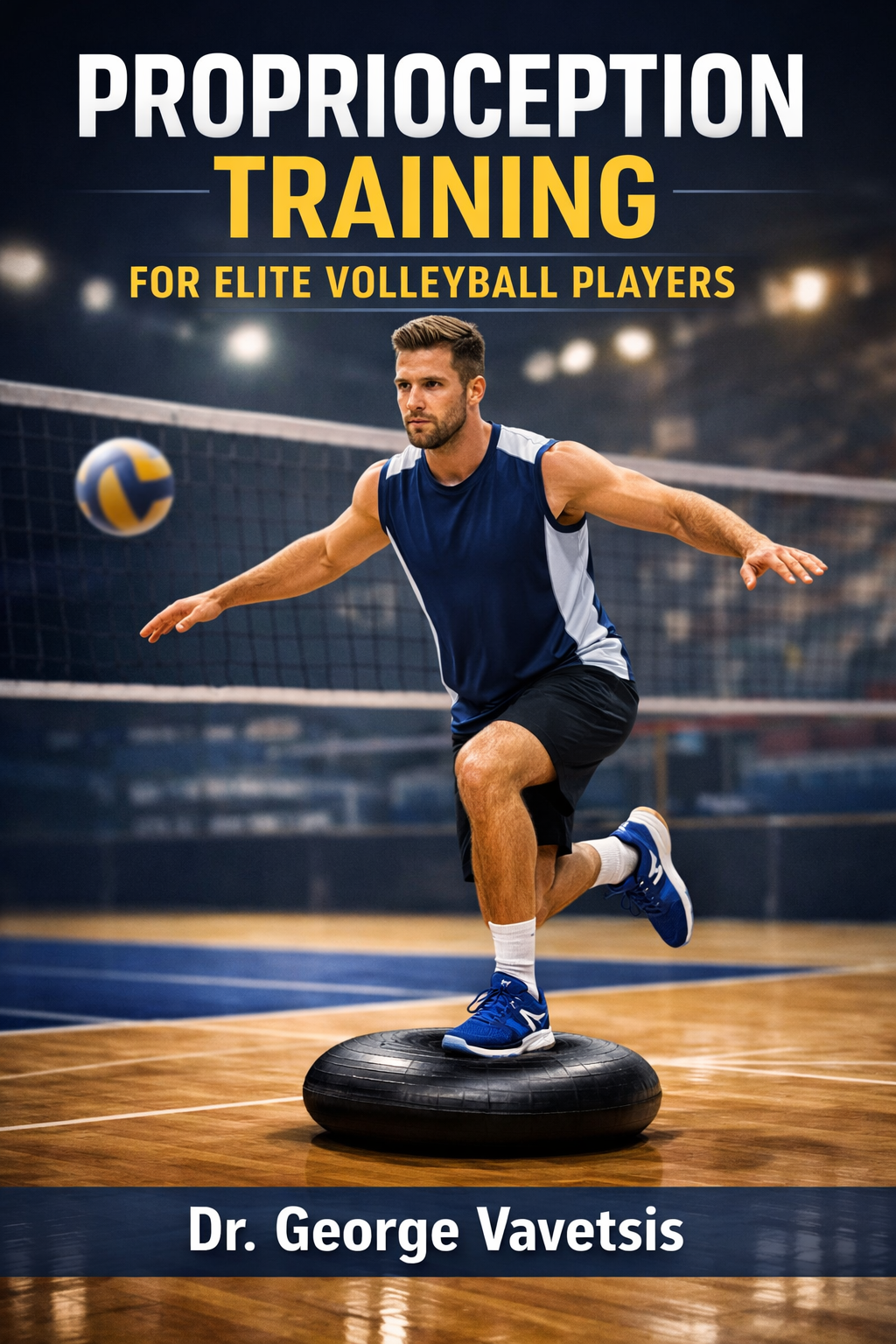
Proprioception Training for Elite Volleyball Players
Pages: 425
Performance in elite volleyball is often evaluated through visible outcomes—jump height, spike velocity, block timing, and match statistics. Yet beneath these observable expressions lies a deeper and more decisive layer of performance: the invisible architecture of neuromuscular control. This book was written to explore that hidden layer. It is not simply a book about proprioception, nor solely about volleyball. It is about how the nervous system organizes movement under pressure, how the body perceives itself in space, and how elite performance emerges from the precise synchronization between sensory input and motor output.
At the highest level of sport, victory is rarely determined by who is stronger in absolute terms. Instead, it is determined by who can express strength with the greatest precision, under the greatest speed, and in the most unstable conditions. Volleyball is a sport of constant transitions—approach to jump, jump to landing, defense to attack, fatigue to re-activation. Every one of these transitions requires the nervous system to recalibrate the body’s position, tension, timing, and direction within fractions of a second. This recalibration is governed by proprioception—the internal sense that informs the brain where the body is, how fast it is moving, and how much force is being applied.
Proprioception is often misunderstood as a simple “balance” or “joint awareness” concept. In reality, it is a complex neurophysiological system involving muscle spindles, Golgi tendon organs, joint receptors, vestibular structures, visual processing, and central sensorimotor integration. These systems operate simultaneously and continuously, allowing elite athletes to execute explosive movements without conscious calculation. The spike, the block, and the landing are not merely mechanical actions—they are neurophysiological events shaped by afferent signaling, spinal reflex modulation, and cortical control.
In elite volleyball, proprioception is not optional; it is foundational. The difference between a controlled landing and a knee injury, between a perfectly timed block and a delayed reaction, between a powerful spike and a mistimed take-off, often lies in the efficiency of proprioceptive processing. The nervous system must constantly filter noise, interpret sensory information, and generate coordinated motor responses while fatigue, speed, and external pressure attempt to disrupt this process.
This book was designed for coaches, sport scientists, physiotherapists, and performance specialists who seek to understand and train this invisible dimension of performance. It bridges neurophysiology with applied strength and conditioning, translating complex neural mechanisms into practical training strategies. Each chapter moves from theory to application, from neural signal to movement execution, from receptor behavior to exercise prescription.
A central theme of this work is that proprioception is trainable—but only when training respects the principles of neural specificity. The nervous system adapts not merely to load, but to the quality of sensory information. Exercises must challenge timing, stiffness regulation, reflex control, and sensory integration—not just muscular strength. The most effective training does not simply increase force production; it improves the body’s ability to detect, organize, and apply force in unstable and time-constrained environments.
Another key concept explored in this book is variability. Elite performance is not built on rigid repetition, but on controlled adaptability. Volleyball is inherently unpredictable—ball trajectories change, opponent actions vary, fatigue fluctuates. The proprioceptive system must therefore remain flexible yet precise, capable of maintaining stability while adjusting to ever-changing conditions. Training must reflect this reality by incorporating perturbations, dual-task demands, reactive stimuli, and complex movement sequences.
Fatigue plays a critical role in proprioceptive function. As matches progress, neural signaling becomes noisier, reaction timing shifts, and motor coordination deteriorates. The athlete who can preserve proprioceptive accuracy under fatigue maintains movement efficiency, reduces injury risk, and sustains performance deep into competition. Understanding how fatigue interacts with neural control—and how training can protect against this decline—is a core objective of this book.
This work also emphasizes the integration of monitoring and technology. Modern performance environments allow us to measure contact times, impulse variability, stiffness, and neuromuscular consistency. These metrics provide insight into proprioceptive function and readiness, allowing coaches to move beyond subjective observation toward objective neural-performance profiling. The future of high-performance training lies in understanding not only how much force an athlete produces, but how consistently and precisely the nervous system regulates that force.
Ultimately, this book is about control—control of the body, control of force, control of timing, and control under chaos. Elite volleyball is a sport of explosive beauty, but beneath that beauty is a silent conversation between the brain and the body, between sensation and action. When this conversation is clear, movement becomes efficient, powerful, and resilient. When it is disrupted, performance falters.
My goal in writing this book is to provide a framework that allows coaches and practitioners to train this hidden system deliberately and scientifically. By understanding the neurophysiological foundations of proprioception and translating them into structured training methodologies, we can elevate performance, enhance durability, and unlock a deeper level of athletic expression.
Performance is not only what the athlete does. It is how precisely the nervous system allows the athlete to do it.
And that precision can be trained.