
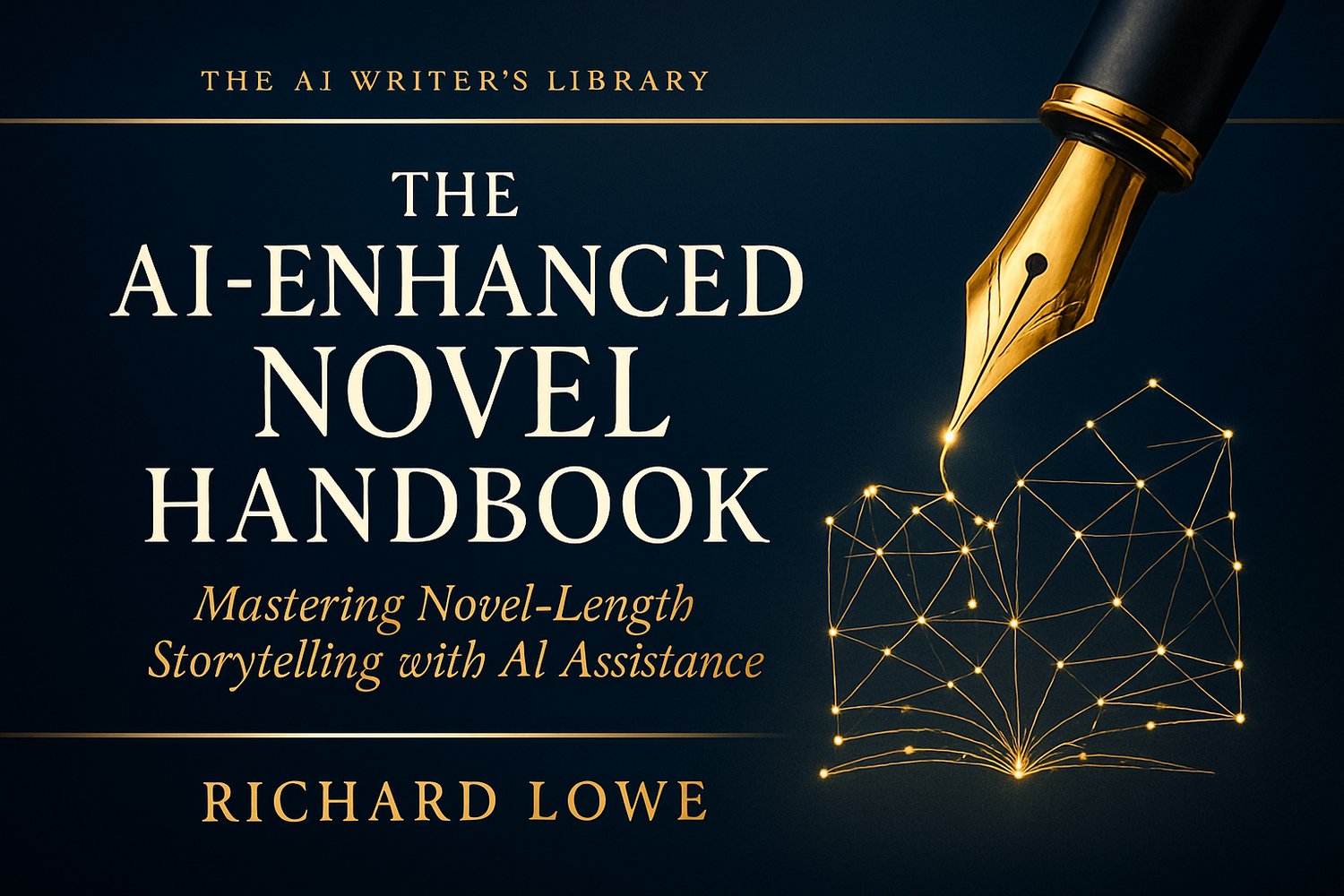
Ai-Enhanced Novel Handbook
Stop Writing Expanded Short Stories and Start Writing Novels
You can write a killer short story in a weekend. Scene construction? You've got that. Character voice? Nailed it. Tension in a single chapter? No problem.
Then you try to sustain it across 80,000 words and everything falls apart around page 150.
Your characters start strong then slowly become different people by chapter fifteen. Your middle feels like something to push through rather than territory worth exploring. Your ending arrives without earning its weight because the groundwork wasn't laid properly.
You're not writing novels. You're writing expanded short stories. And the expansion is killing them.
Novel-length storytelling isn't scene writing at scale. It's a fundamentally different discipline requiring systems for character consistency, tension sustainability, and thematic development that short fiction never demands. The skills overlap, but the execution requires completely different muscles.
Short Fiction vs. Novel-Scale Writing
The skills overlap. The execution doesn't.
In short fiction, character consistency is intuitive. At novel scale, character consistency requires tracking systems. In short fiction, tension sustains naturally. At novel scale, tension requires architectural planning. In short fiction, theme emerges organically. At novel scale, theme needs deliberate development. In short fiction, revision fits in your head. At novel scale, revision requires systematic approaches. In short fiction, the middle is brief. At novel scale, the middle is where novels go to die.
The handbook teaches you to build novel-scale infrastructure that supports your scene-writing skills.
The Middle: Where Novels Go to Die
The middle isn't just longer than you expected. It's structurally different from beginnings and endings, and most advice ignores this completely.
Your opening promises. Your ending delivers. Your middle has to sustain interest without the momentum of promise or the payoff of delivery. It's the graveyard of abandoned manuscripts.
The handbook teaches complications that inject momentum. Subplot timing that carries energy when main plots need to breathe. Transformation midpoints that shift the story's nature so readers feel they're in a new book. Techniques for making your middle territory worth exploring, not something to push through.
Every reader who abandons your novel abandons it in the middle. Every "this could have been a short story" review is a middle that failed. Fix your middle, and you've fixed most of what kills novels.
What's Inside
The handbook covers why novel writing is different from everything else, explaining the fundamental shift from scene-scale to novel-scale thinking. The novel concept teaches finding story cores strong enough to sustain 80,000+ words. Novel architecture provides structures that support full length without sagging middles or rushed endings. Character systems for novel-length fiction explains why consistency requires methodology, not just intention. The middle chapter explains why middles collapse and exactly how to build ones that sustain momentum. AI collaboration strategies covers real partnership for novel-length projects, not replacement. The revision process for long works provides systematic approaches when manuscripts are too large to hold in your head.
Plus 14 more chapters covering world-building at scale, plot and subplot integration, pacing the long form, dialogue across a novel, tension sustained, POV consistency, theme development, showing and telling at novel scale, series planning, endings that earn their weight, genre-specific considerations, and troubleshooting novel problems.
Four Deep-Dive Case Studies
Peacekeeper analyzes a sixteen-book science fiction epic showing how novel-scale systems compound across an entire series. Shield of Ashes demonstrates how escalation sustains middle momentum in a nuclear war thriller when everything is actively on fire. Grim shows how non-linear structure sidesteps traditional middle problems in a horror anthology with cosmic backstory. Killer Cuts & Dead Letters demonstrates how character transformation creates midpoint momentum in a dark comedy about serial killers.
Built for Writers Who Use AI
AI can accelerate novel writing. It can also generate competent scenes that don't accumulate into coherent manuscripts.
The problem isn't the AI. It's scale. AI doesn't maintain character consistency across months of writing. AI doesn't track subplot threading across twenty chapters. AI doesn't remember what you established in chapter three when you're writing chapter seventeen.
The handbook shows you how to use AI as analytical partner for novel-length projects. Consistency checking catches character drift before it compounds. Structural mapping identifies where your middle sags. Troubleshooting prompts diagnose novel problems systematically.
AI is your analytical partner, not your novelist.
From an Author With 113 Published Books
My ghostwriting clients have secured over $30 million in venture capital with books that sustained reader investment from first page to last. My brain doesn't accept "just keep writing" as methodology. When I realized my novels kept dying in the middle despite strong openings and clear endings, I dug until I found the systems underneath.
I've spent forty-five years working on a single sixteen-book science fiction series because apparently I don't know when to quit. That obsession taught me things about novel-length storytelling that quick projects never reveal. Character consistency across years of writing. Tension sustainability across thousands of pages. Thematic development that accumulates instead of repeating.
247 pages of novel-scale craft. 21 chapters from concept to revision. 4 case studies showing systems in action. AI collaboration strategies for long-form fiction.
The novel you've always wanted to write is waiting. Stop writing expanded short stories. Start building novels that work.