

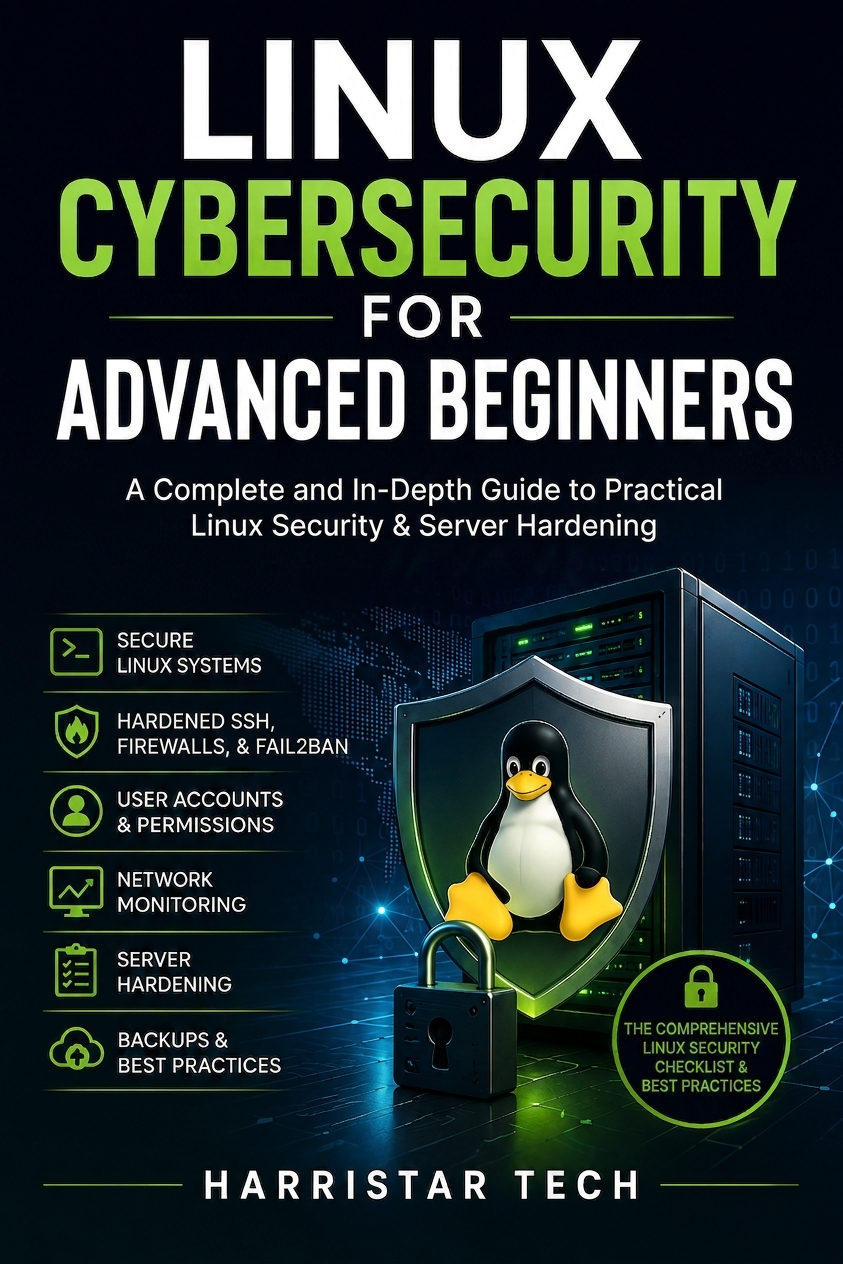
Linux Cybersecurity for Advanced Beginners: Practical Linux Security & Server Hardening
Linux Cybersecurity for Advanced Beginners: Practical Linux Security & Server Hardening
You've learned the fundamentals of Linux security. Now it's time to go deeper.
Linux Cybersecurity for Advanced Beginners is a practical guide for Linux users, system administrators, IT professionals, and aspiring cybersecurity practitioners who already understand basic Linux commands and want to develop stronger defensive security skills.
This book moves beyond basic permissions and firewall configuration into practical Linux security administration, server hardening, monitoring, auditing, and incident-response techniques.
What You'll Learn
- Advanced Linux security concepts
- Linux server hardening
- Secure user and group management
- Advanced file permissions
- SSH hardening
- SSH key management
- Firewall configuration and security rules
- UFW and firewalld
- Fail2ban configuration
- Linux security logs
- Log monitoring and analysis
- Network connection monitoring
- Open-port analysis
- Service security
- Process monitoring
- File integrity concepts
- Security auditing
- System activity monitoring
- Secure configuration practices
- Backup and recovery strategies
- Basic incident-response procedures
- Common Linux attack indicators
- Defensive security techniques
Practical Server Hardening
The book takes you through a practical approach to strengthening Linux servers.
You'll learn how to review a system, identify unnecessary exposure, reduce attack surfaces, secure remote access, configure defensive controls, monitor activity, and respond to suspicious events.
Security Workflow
The book introduces a practical defensive workflow:
Assess → Harden → Monitor → Detect → Investigate → Respond → Recover
This helps you approach Linux security as an ongoing process rather than a one-time configuration task.
Who Is This Book For?
This book is designed for:
- Linux administrators
- System administrators
- IT support professionals
- DevOps engineers
- Cybersecurity beginners
- Linux users with basic experience
- Students studying cybersecurity
- Developers managing Linux servers
- Anyone preparing for practical Linux security work
You should have basic Linux command-line knowledge before starting this book.
What's Included
📕 Complete PDF book
🛡️ Linux server hardening techniques
🔐 SSH security guidance
🔥 Firewall configuration examples
📊 Security monitoring techniques
📋 Linux security checklists
🔎 Practical auditing exercises
🚨 Incident-response fundamentals
🐧 Real-world Linux security scenarios
Build Stronger Linux Security Skills
Linux security isn't about installing as many security tools as possible.
It's about understanding your system, reducing unnecessary exposure, monitoring what happens, recognizing suspicious activity, and responding effectively.
Take the next step beyond basic Linux security with Linux Cybersecurity for Advanced Beginners from Harristar Tech.