
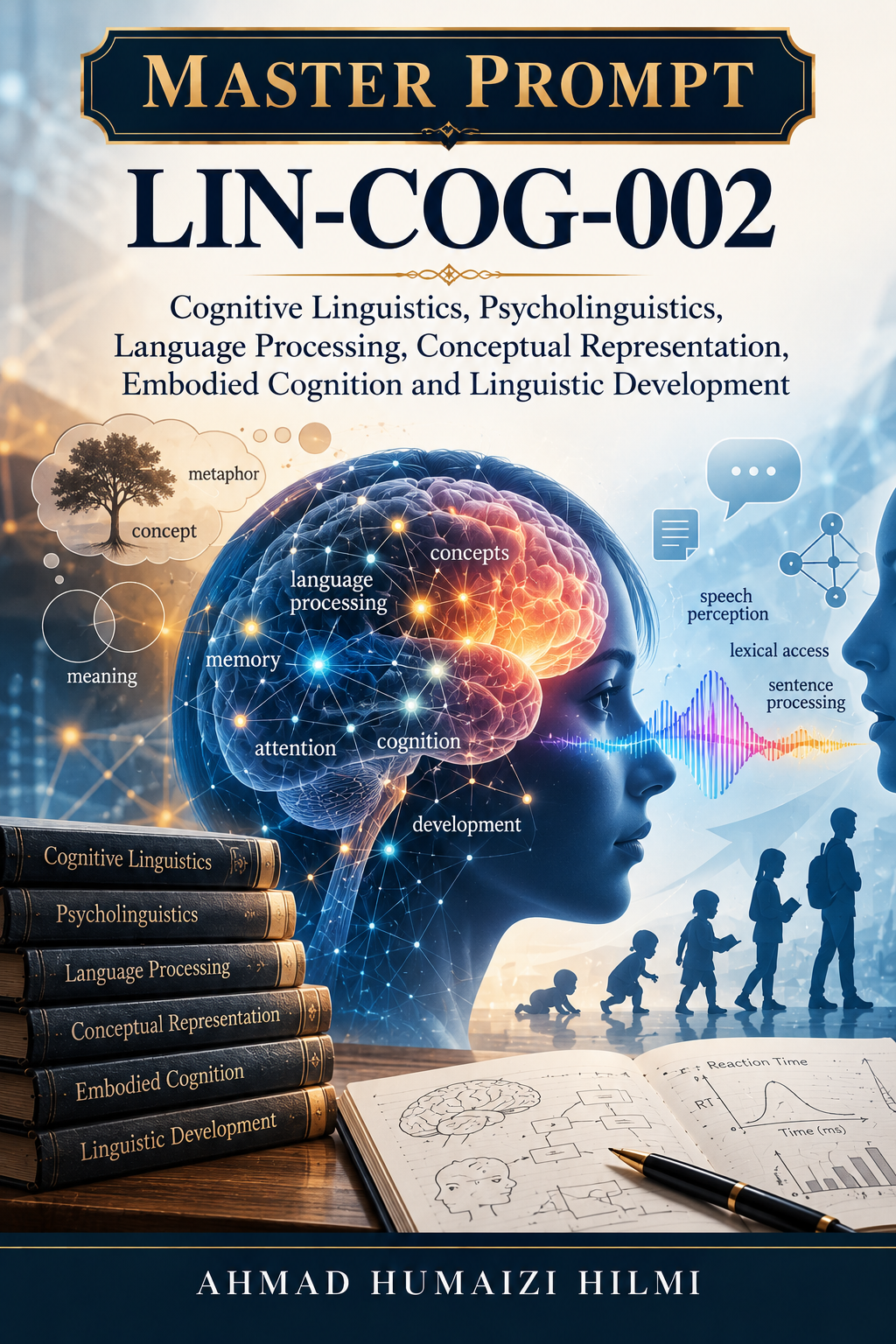
2. LIN-COG-002 — Cognitive Linguistics, Psycholinguistics, Language Processing, Conceptual Representation, Embodied Cognition and Linguistic Development
Description
This Master Prompt focuses on the cognitive and psychological mechanisms underlying language comprehension, production, acquisition, memory, reasoning, and conceptual representation. It explores how linguistic knowledge interacts with attention, working memory, executive functions, conceptual categorization, mental imagery, embodied experience, and cognitive development across different stages of human life. Major theoretical perspectives include conceptual metaphor theory, conceptual blending, construction grammar, usage-based linguistics, psycholinguistic processing models, linguistic relativity, and embodied cognition. Particular attention is given to linguistic framing, conceptual enrichment, language-mediated perception, lexical access, sentence processing, speech planning, language linearization, and the relationships between linguistic structures and cognitive representations. The framework incorporates experimental psycholinguistics, reaction-time measurement, eye-tracking, behavioral experiments, developmental assessments, computational cognitive modeling, and longitudinal research designs. Researchers are guided in investigating how linguistic experience influences cognitive performance, how cognitive mechanisms shape linguistic behavior, and how language processing differs across developmental, multilingual, and sociocultural contexts. It also supports the development and validation of cognitive-linguistic models through empirical evidence, statistical analysis, and interdisciplinary theoretical integration.