





Pullbacks Explained — Measured (PDF Guide)
Everybody tells you to buy the pullback and nobody tells you how deep to let it go. Enter early and your stop is miles away; wait for a better price and half the time the move never resumes. It feels like a judgement call because the two halves of it have never been put on the same page.
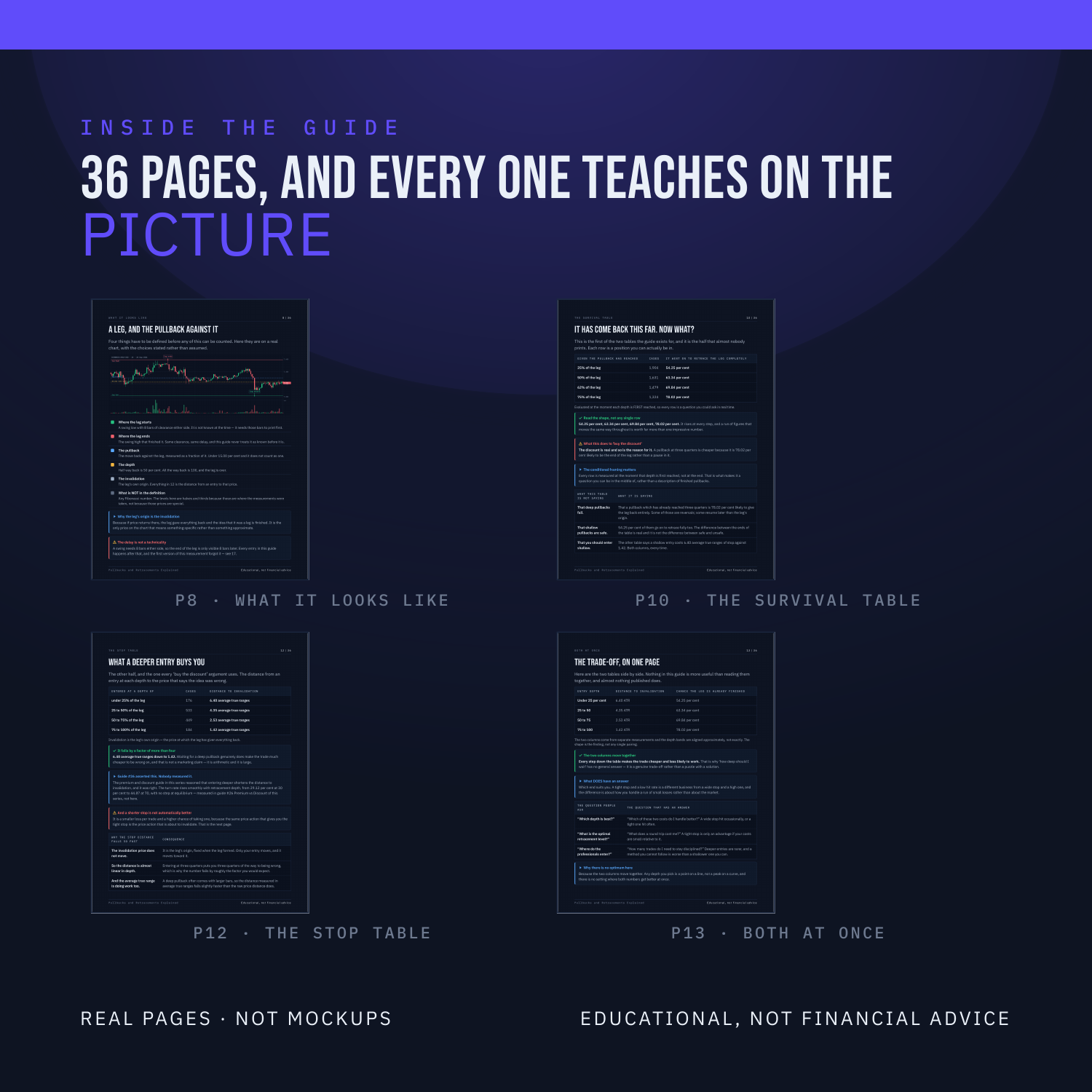
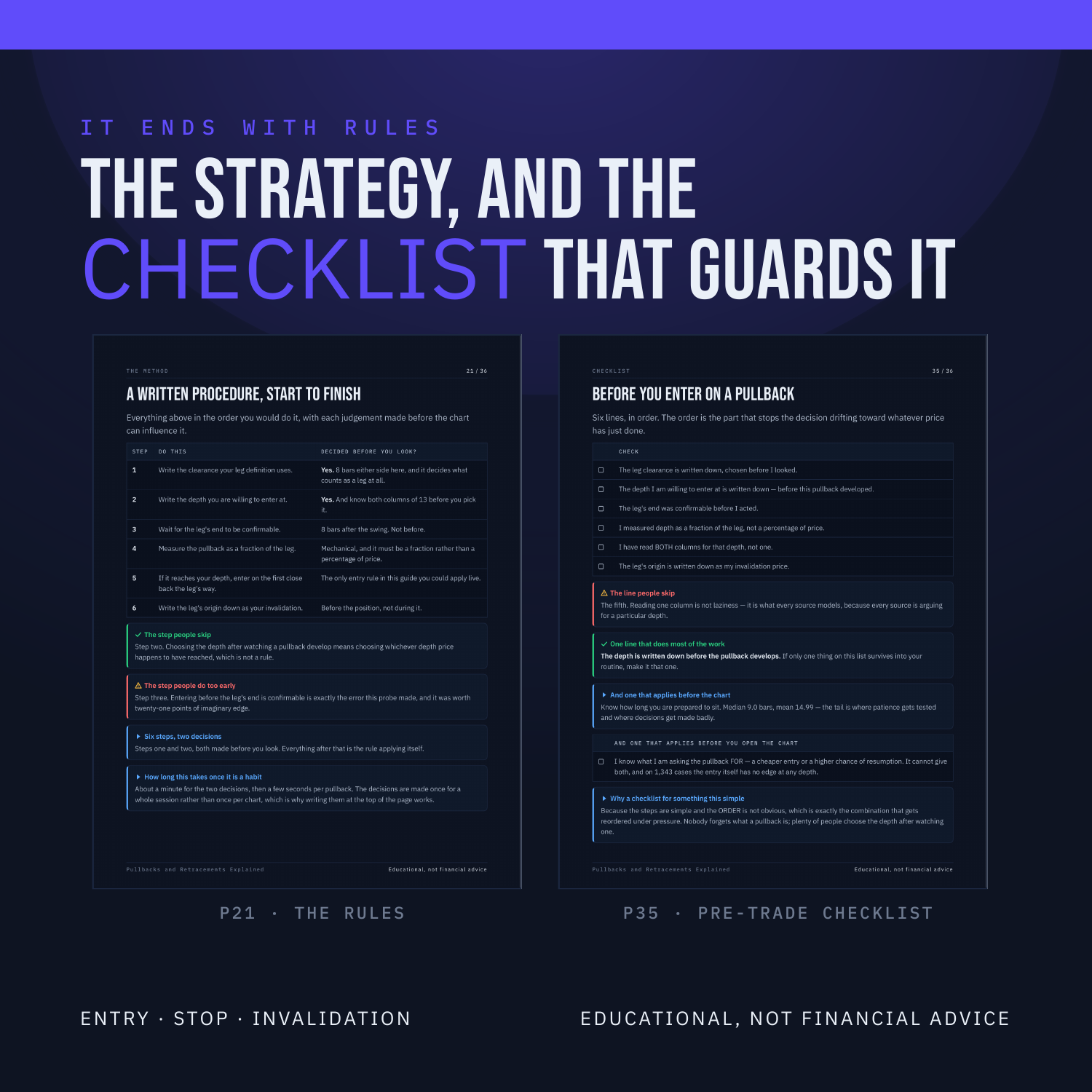
Both halves, measured on 1,928 pullbacks across 35,944 bars. One table says how often a pullback that has reached a given depth goes on to retrace the leg completely. The other says how far your invalidation sits from an entry at that depth. Read together they turn a feeling into a trade-off with numbers on it. This is a 36-page PDF that teaches Pullbacks and Retracements from the first thing you see on the screen through to a written strategy with an entry, a stop and an explicit rule for when the trade is wrong.
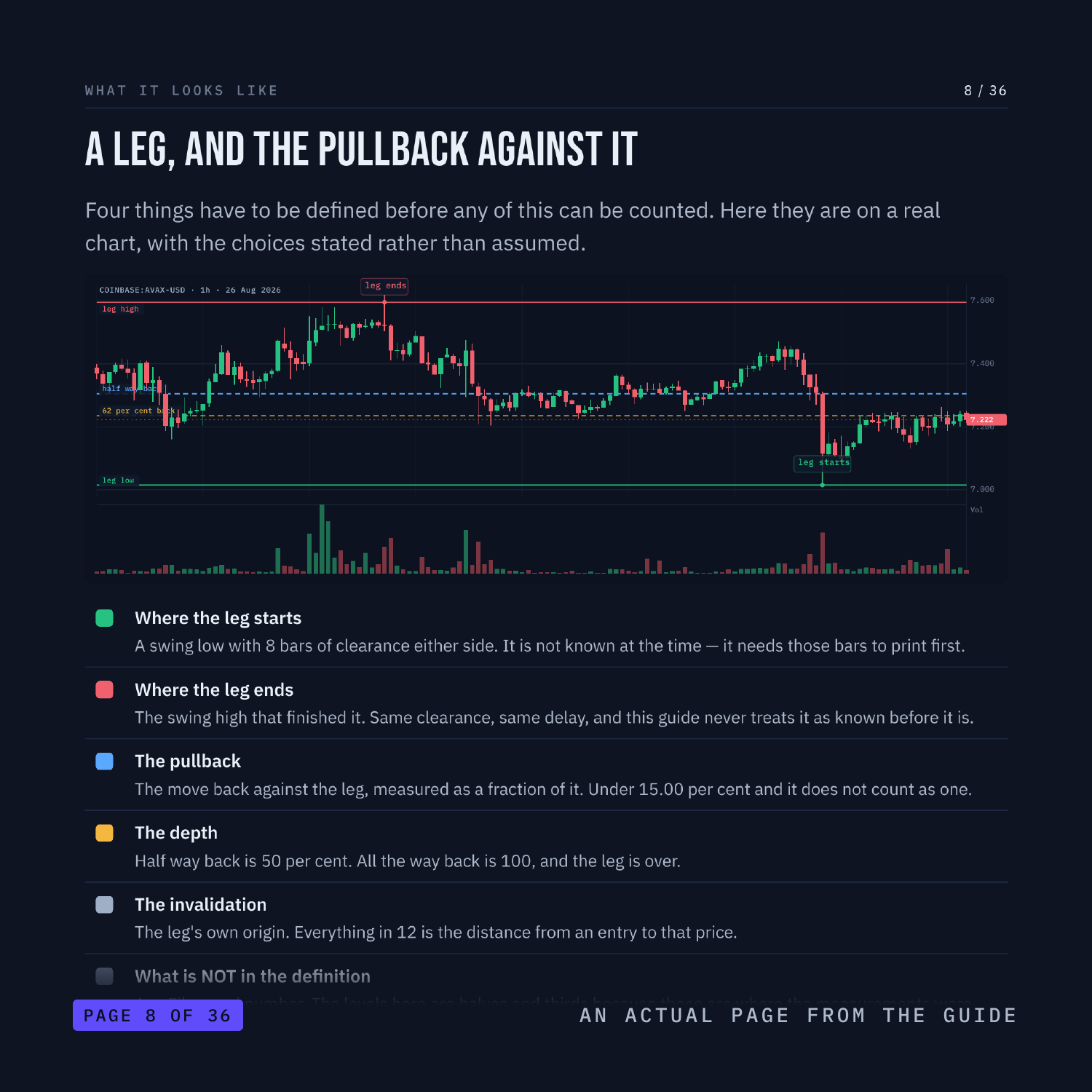
Nothing is taught underneath a chart. Every label sits on the candle, the line or the level it is describing, on real BTC, ETH, SOL and LINK charts. There are three quizzes on real charts, each followed by the same chart re-shown annotated with the reasoning, plus faded practice pages where the first steps are filled in and you finish the rest.
WHAT'S INSIDE
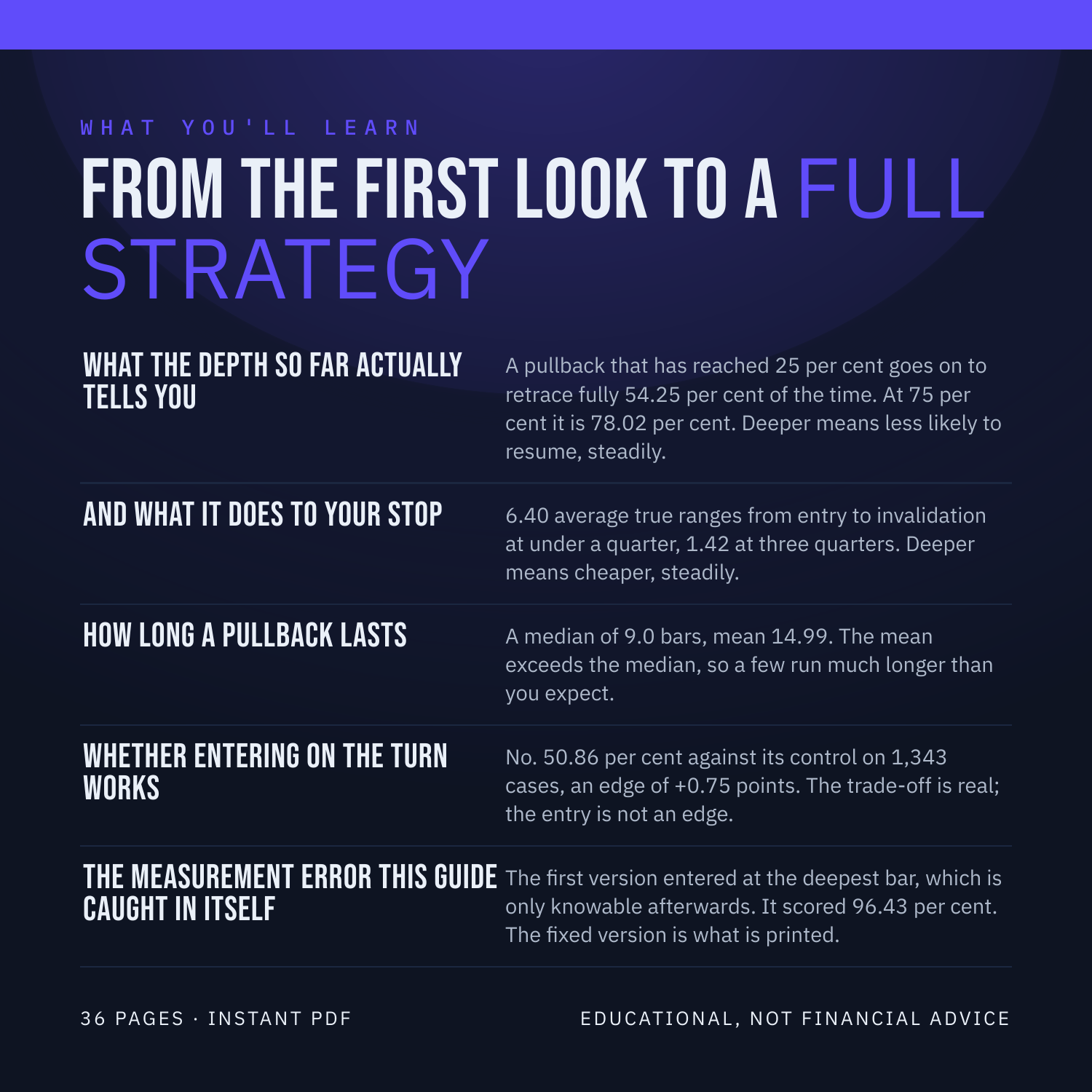
What the depth so far actually tells you - A pullback that has reached 25 per cent goes on to retrace fully 54.25 per cent of the time. At 75 per cent it is 78.02 per cent. Deeper means less likely to resume, steadily.
And what it does to your stop - 6.40 average true ranges from entry to invalidation at under a quarter, 1.42 at three quarters. Deeper means cheaper, steadily.
How long a pullback lasts - A median of 9 bars, mean 14.99. The mean exceeds the median, so a few run much longer than you expect.
Whether entering on the turn works - No. 50.86 per cent against its control on 1,343 cases, an edge of +0.75 points. The trade-off is real; the entry is not an edge.
The measurement error this guide caught in itself - The first version entered at the deepest bar, which is only knowable afterwards. It scored 96.43 per cent. The fixed version is what is printed.
WHAT YOU'LL BE ABLE TO DO
Read depth as a survival probability, not a discount.
State what waiting for a deeper entry costs and buys.
Say how long a pullback usually lasts before it resolves.
Spot an entry rule that could only be applied afterwards.
Explain why 'buy the dip' is half an argument.
AN HONEST NOTE
A pullback is a clue, not a crystal ball. It describes what price has already done. This guide contains no win-rates, no backtest results and no promises about what you will make, because nobody can verify those and you should not trust anyone who prints them. What it hands you instead is a set of rules you can test yourself on TradingView in an afternoon. Educational, not financial advice.
Instant download. 36 pages, PDF.