
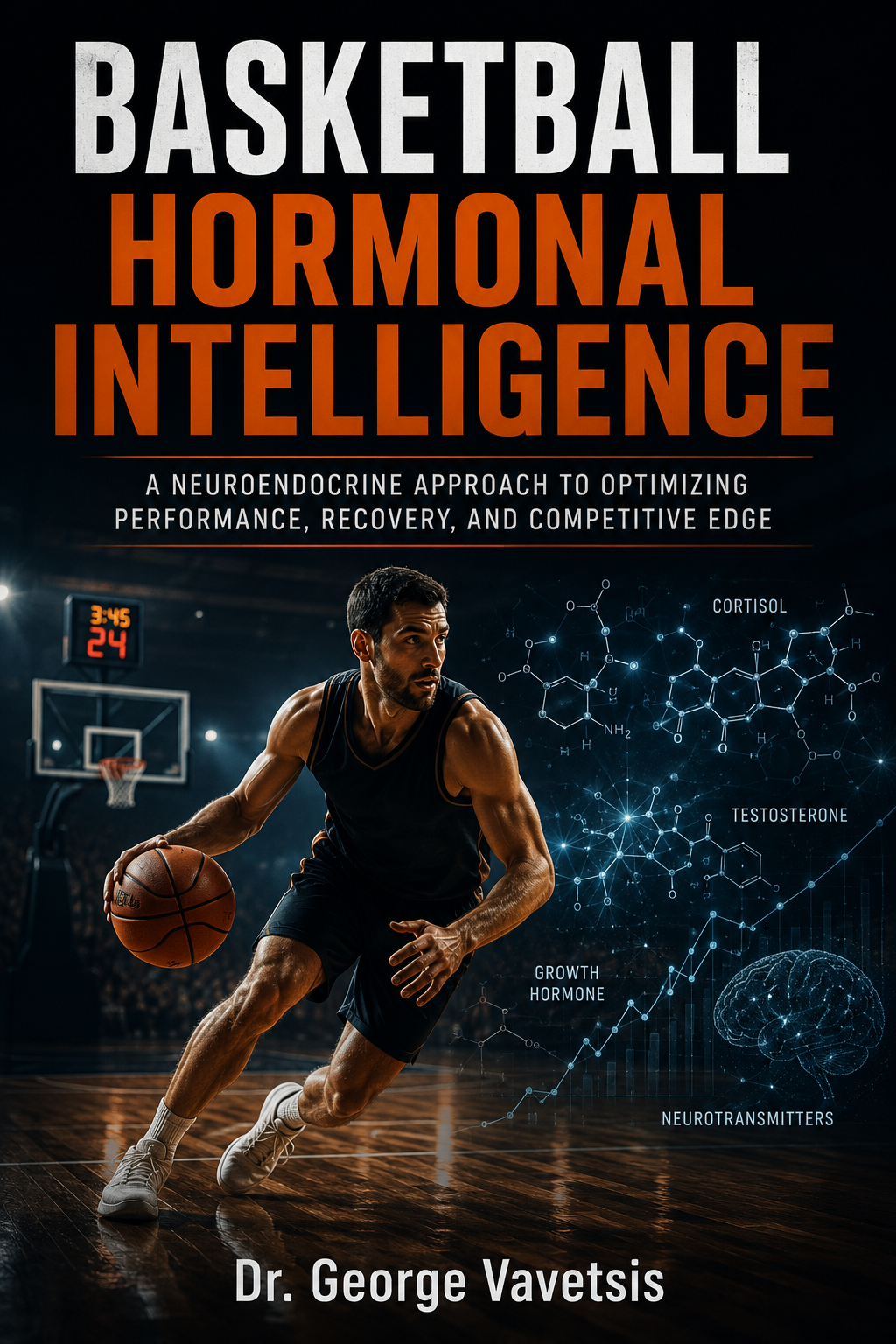
Basketball Hormonal Intelligence
Pages: 839
Basketball performance has traditionally been interpreted through the visible dimensions of the sport: speed, power, skill execution, tactical intelligence, biomechanics, and conditioning. Yet beneath every acceleration, every explosive vertical jump, every defensive rotation, and every cognitive decision under pressure lies a hidden physiological network that ultimately governs readiness, fatigue, adaptation, resilience, and recovery. That network is the endocrine system.
This book, Basketball Hormonal Intelligence, was written to bridge the gap between modern basketball performance science and advanced neuroendocrine physiology. It is designed for strength and conditioning coaches, sports scientists, performance directors, physiotherapists, medical staff, and elite basketball practitioners seeking a deeper understanding of how hormonal regulation shapes athletic performance across training, competition, recovery, travel, stress exposure, and long competitive seasons.
Basketball is one of the most physiologically chaotic sports in the world. It combines repeated sprint exposure, multidirectional acceleration and deceleration, high-force eccentric braking, rapid cognitive processing, emotional pressure, tactical unpredictability, and congested competition schedules. Unlike linear endurance sports or isolated strength disciplines, basketball constantly fluctuates between explosive neural demands and severe metabolic stress. Consequently, the endocrine system must continuously adapt in real time.
Hormonal intelligence in basketball does not merely refer to measuring testosterone or cortisol. It represents the ability to understand, interpret, and strategically manipulate endocrine responses to optimize performance outcomes. It is the science of identifying how hormonal oscillations influence neuromuscular readiness, recovery kinetics, emotional regulation, tissue adaptation, cognitive sharpness, sleep quality, immune resilience, and fatigue accumulation.
Throughout modern basketball, practitioners have increasingly recognized that external-load metrics alone are insufficient for understanding the total physiological burden placed upon athletes. GPS metrics, jump counts, sprint distance, player load, and heart-rate monitoring provide valuable information, but they cannot fully explain why two athletes exposed to the same workload recover differently, adapt differently, or experience distinct fatigue profiles. The missing layer often exists within neuroendocrine regulation.
The chapters within this text examine the complex interaction between the hypothalamic–pituitary–adrenal axis, the hypothalamic–pituitary–gonadal axis, catecholaminergic activation, circadian biology, autonomic nervous system regulation, inflammatory responses, and basketball-specific training stress. The objective is not to transform coaches into endocrinologists, but to provide a practical framework that allows basketball practitioners to integrate hormonal intelligence into applied performance systems.
Elite basketball athletes rarely fail because of a lack of motivation. More often, performance deterioration emerges from accumulated physiological dysregulation. Excessive cortisol exposure, suppressed testosterone:cortisol ratios, catecholamine depletion, autonomic imbalance, sleep disruption, chronic inflammatory load, impaired glycogen restoration, and maladaptive stress responses collectively influence performance readiness. In many cases, these dysfunctions remain invisible until they manifest through decreased explosiveness, altered decision-making, prolonged recovery, emotional instability, injury susceptibility, or competitive underperformance.
The modern basketball calendar intensifies these challenges. Professional and collegiate players frequently experience congested game schedules, extensive travel, circadian disruption, emotional pressure, media exposure, academic or social stressors, and insufficient recovery opportunities. The endocrine system becomes the biological mediator between environmental stress and performance output.
Understanding hormonal behavior allows practitioners to make more intelligent decisions regarding training density, conditioning structure, recovery sequencing, nutritional support, sleep interventions, and load management. The integration of hormonal markers with neuromuscular testing, heart-rate variability, subjective wellness monitoring, countermovement-jump analysis, and recovery profiling creates a more complete athlete-management ecosystem.
One of the fundamental philosophies presented throughout this book is that hormonal responses should never be interpreted in isolation. Endocrine markers acquire meaning only when contextualized within basketball-specific realities. Elevated cortisol after a playoff game differs profoundly from elevated cortisol during a low-load training week. A reduced testosterone:cortisol ratio may reflect productive functional overreaching in one athlete yet indicate maladaptive endocrine suppression in another. Hormonal intelligence therefore requires contextual interpretation rather than simplistic numerical thresholds.
This book also emphasizes the importance of individualized adaptation. Basketball athletes possess unique endocrine signatures influenced by genetics, sex, age, positional role, playing time, psychological characteristics, recovery capacity, nutritional habits, sleep behavior, and training history. Guards exposed to high-transition workloads and repeated accelerative stress may demonstrate different endocrine profiles compared to centers operating under greater contact and force-absorption demands. Female basketball athletes also exhibit unique hormonal interactions related to menstrual-cycle physiology, energy availability, stress responses, and recovery kinetics.
The integration of hormonal intelligence into basketball preparation is not intended to replace traditional coaching principles. Rather, it enhances them. Strength development, tactical execution, skill acquisition, conditioning, and psychological preparation remain foundational pillars of elite basketball performance. Hormonal monitoring simply provides a deeper biological lens through which these processes can be optimized.
Importantly, this text approaches endocrine science from an applied perspective. The intention is not to produce theoretical endocrinology detached from the court environment. Every concept within this book is connected to basketball performance realities: repeated sprint ability, congested fixtures, neuromuscular fatigue, transition chaos, tactical decision-making, travel stress, recovery-day architecture, sleep optimization, hydration, nutritional timing, and high-performance periodization.
Special attention is also devoted to practical decision-making for strength and conditioning coaches. Coaches operate under real-world constraints where immediate decisions must be made regarding training intensity, conditioning exposure, deload insertion, recovery prescription, and athlete readiness. Hormonal intelligence provides an additional framework for understanding when to push, when to maintain, and when to recover.
Basketball is ultimately a sport of adaptation. Teams that sustain performance deepest into the season are often those that best manage physiological stress. Championships are not determined exclusively by talent, tactical sophistication, or athleticism; they are also determined by recovery efficiency, biological resilience, and the capacity to repeatedly regenerate high-level performance under extreme stress.
The future of basketball performance science will increasingly involve integrated physiological ecosystems where endocrinology, biomechanics, neuroscience, recovery science, nutrition, data analytics, and tactical preparation operate together rather than independently. Coaches and practitioners capable of understanding these interactions will possess a major competitive advantage.
This book was created with the belief that hormonal intelligence represents one of the next major frontiers in basketball performance optimization. The purpose is not merely to collect hormonal data, but to transform biological information into actionable basketball decision-making.
Ultimately, the endocrine system is not separate from basketball performance—it is embedded within every movement, every recovery process, every emotional response, and every adaptation pathway.
To understand basketball deeply, one must also understand the physiology that silently drives it.