
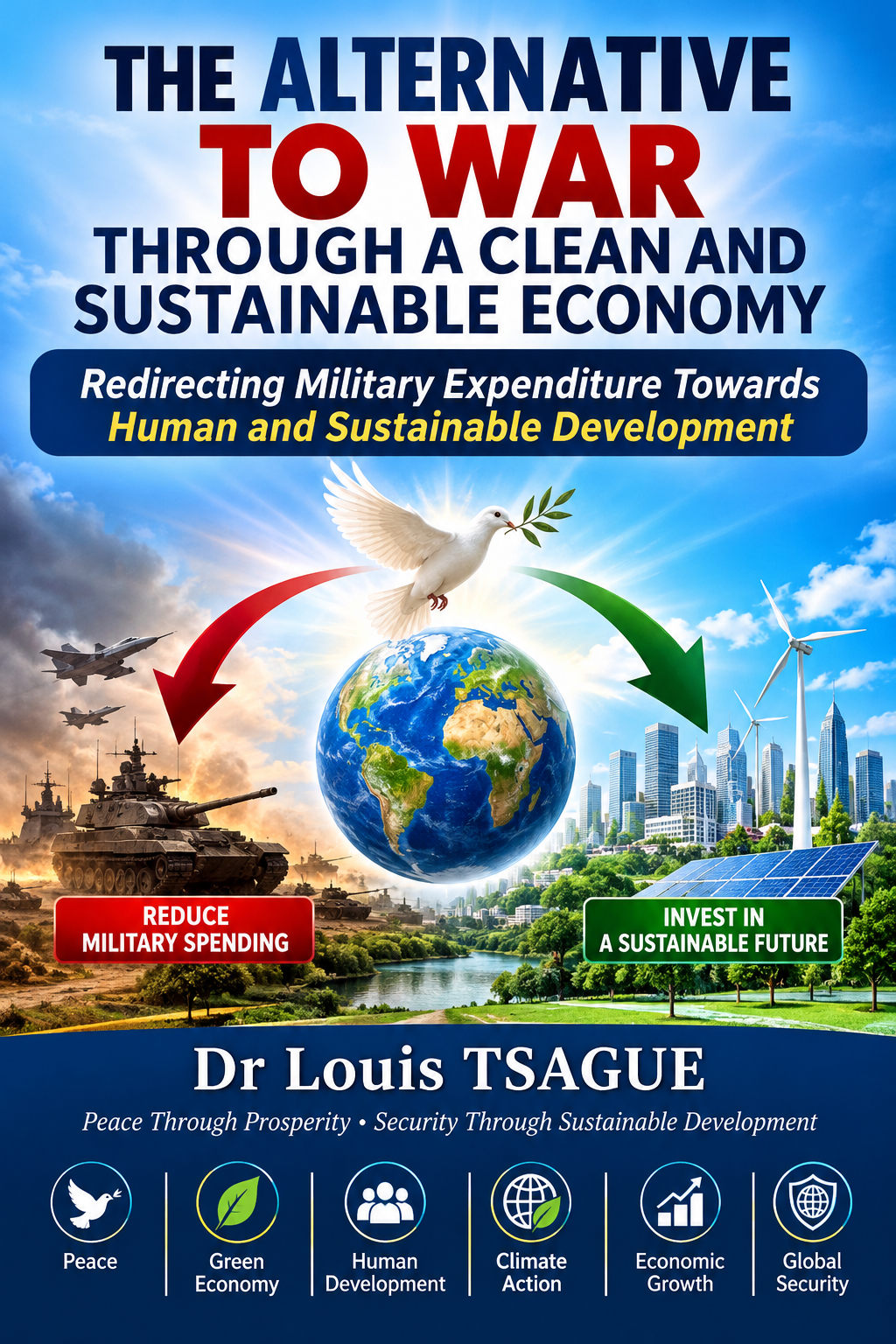
THE ALTERNATIVE TO WAR THROUGH A CLEAN AND SUSTAINABLE ECONOMY Subtitle: Redirecting Military Expenditure Towards Human and Sustainable Development
War is one of the most costly forms of destruction of human, economic, social and environmental resources. Beyond the immediate loss of life and material damage, armed conflicts consume enormous financial resources that could otherwise help meet people's essential needs and create the foundations for lasting prosperity.
This book explores an alternative approach to economic and budgetary priorities: reconsidering the role of military expenditure in national and international strategies and examining how a portion of these resources could be progressively redirected towards investments that support peace and human development.
The author examines the connections between military budgets, defence industries, technological research, nuclear weapons and the environmental consequences of armed conflict. These commitments are considered alongside the substantial needs associated with the energy transition, renewable energy, access to clean water, food security, healthcare, education, ecosystem protection and climate change adaptation.
The book also explores the potential for gradually converting certain industrial and scientific capabilities towards clean, sustainable civilian production. Such a transformation requires responsible political choices, transparent financing mechanisms, international cooperation and due consideration of legitimate security and defence requirements.
The proposal is not based on the assumption that peace can be achieved simply by reducing military budgets, nor does it disregard geopolitical realities. Rather, it calls for a broader understanding of security: protecting people also depends on access to energy, food, healthcare, education, a healthy environment and stable economic opportunities.
The central proposition of this book is that resources devoted to competition and destruction can, when political commitment and appropriate conditions are in place, contribute more effectively to cooperation, reconstruction and shared progress. Making a clean and sustainable economy an instrument of conflict prevention is therefore a path worth exploring in the pursuit of greater human security and a shared future.