
Subwoofer & Amplifier Wiring Cheat Sheet | Bump Bump
🔊 SUBWOOFER & AMPLIFIER CHEAT SHEET
The No-Guesswork Guide to Building, Wiring & Setting Up Your Bass System
Stop guessing. Stop wiring by trial and error. Stop buying equipment that doesn't work together.
Whether you're completely new to car audio or you've been building systems for years, this cheat sheet is designed to put the information you actually need in one place.
Instead of digging through dozens of forum posts, videos, wiring diagrams, calculators, and conflicting advice, you get a practical reference you can keep beside you while you're planning, wiring, installing, and tuning your system.
---
🔥 WHAT MAKES THIS DIFFERENT?
This isn't meant to be a giant textbook full of technical terminology.
It's a quick-reference tool built around the questions people actually ask when building bass systems.
What amp do I need?
What impedance will my subs present?
How do I wire these voice coils?
What happens when I wire them in series?
What happens in parallel?
Can my amplifier handle the final load?
What size power wire should I use?
Where should I fuse it?
How do I set my gains?
Why isn't my system getting as loud as it should?
The goal is simple:
Understand the system BEFORE you turn the key.
---
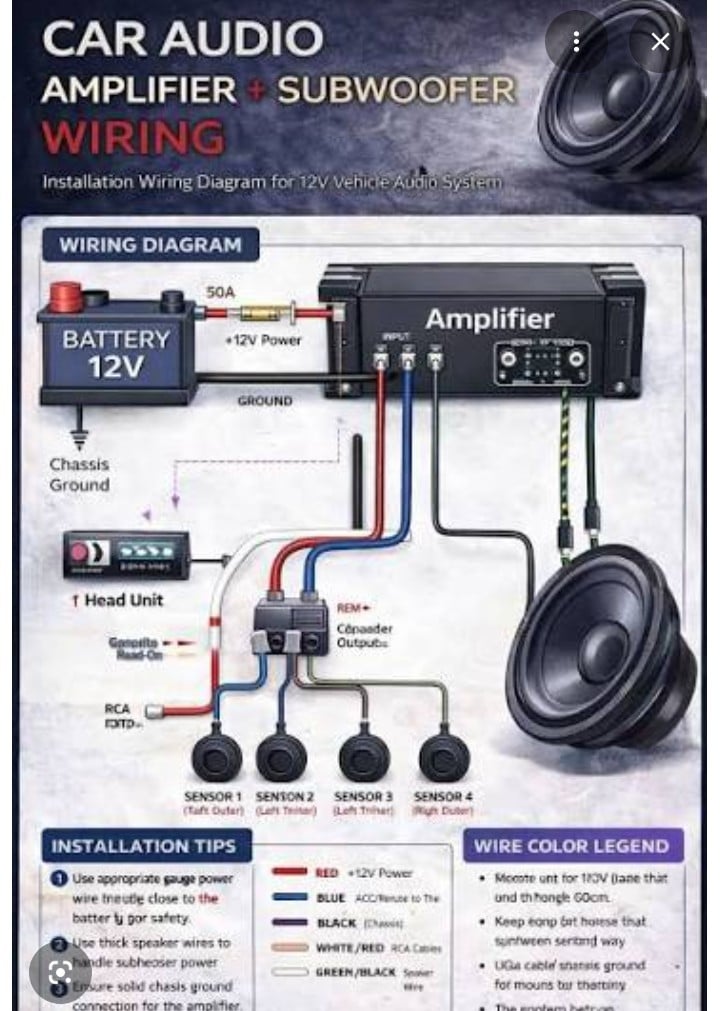
⚡ SUBWOOFER WIRING MADE SIMPLE
One of the most confusing parts of car audio is figuring out final impedance.
This guide breaks down the fundamentals of:
- Single voice coil subwoofers
- Dual voice coil subwoofers
- Series wiring
- Parallel wiring
- Multiple subwoofer configurations
- Final impedance
- Matching subwoofer impedance to amplifier capability
- Common wiring combinations
- Understanding what your amplifier actually sees
No more looking at a pile of terminals and wondering:
“Which wire goes where?”
---
🔌 AMPLIFIER MATCHING
Choosing an amplifier isn't just about finding the biggest number on the box.
You'll learn how to think about:
- RMS power
- Peak/max power
- Subwoofer RMS ratings
- Amplifier RMS ratings
- Impedance requirements
- Matching amplifier power to the speakers
- Understanding different amplifier load ratings
- Why “more watts” isn't automatically better
- How wiring changes the load your amplifier sees
Power numbers only matter when you understand what they mean.
---
🔋 POWER & GROUNDING
A powerful amplifier is only as good as the electrical system feeding it.
The cheat sheet covers important installation fundamentals including:
- Power-wire sizing
- Ground-wire considerations
- Fuse placement
- Fuse selection basics
- Battery connections
- Electrical-system considerations
- Grounding fundamentals
- Why poor connections can create problems
- Planning your electrical system before adding serious power
This section helps you avoid one of the most common mistakes:
Building the audio system first and figuring out the electrical system afterward.
---
🎛️ AMPLIFIER SETTINGS
Getting everything wired correctly is only half the battle.
A system can have expensive subs and a powerful amplifier and still sound terrible if the settings aren't right.
The guide covers the fundamentals behind:
- Gain
- Low-pass filtering
- Subsonic filtering
- Bass boost
- Phase
- Crossover settings
- Signal considerations
- Basic tuning strategy
- Avoiding unnecessary distortion
The goal isn't simply “turn everything up.”
The goal is getting the equipment working together.
---
📐 OHMS & WIRING — WITHOUT THE HEADACHE
Electrical formulas can look intimidating.
This cheat sheet breaks the important concepts down into practical car-audio applications so you can understand why a particular wiring configuration produces a particular final load.
You'll have a reference you can return to whenever you change:
Subwoofers → Voice coils → Wiring → Amplifier → Final impedance
That means if you upgrade your system later, you don't have to start from zero.
---
🧠 BUILD SMARTER BEFORE YOU SPEND MONEY
One of the biggest advantages of understanding your system is being able to plan it before buying equipment.
Use the information inside this guide to help you think through:
SUBS
What impedance and configuration make sense?
AMP
What power and load capability do you need?
ELECTRICAL
Can the vehicle support the system?
WIRING
What cable and fuse setup makes sense?
ENCLOSURE
Is the box appropriate for the subwoofer?
TUNING
How will you get everything working together?
---
🚗 FOR BEGINNERS & EXPERIENCED BUILDERS
You don't need to be an electrical engineer to understand car audio.
This guide is designed to be useful whether you're:
🔰 Building your first system
🔧 Replacing an amplifier
🔊 Adding another subwoofer
⚡ Upgrading your electrical system
📦 Designing a new enclosure
🎛️ Learning how to tune your amplifier
💪 Planning a higher-powered build
🧰 Troubleshooting an existing system
---
📲 KEEP IT WITH YOUR BUILD
Save it to your phone.
Keep it on your computer.
Print it for your garage.
Pull it up while you're wiring.
Use it when you're shopping for equipment.
Refer back to it when you're upgrading.
Your car audio setup can change. Your reference guide stays with you.
---
💥 THE BOTTOM LINE
You don't need more random information.
You need the right information organized in a way that makes sense.
The Subwoofer & Amplifier Cheat Sheet was created to give you a practical car-audio reference you can actually use while planning and building your system.
Wire it right.
Match it right.
Power it right.
Tune it right.
BASS WITH A PLAN. 🔊💥
Download it once. Keep it. Use it on your next build — and every upgrade after that.