
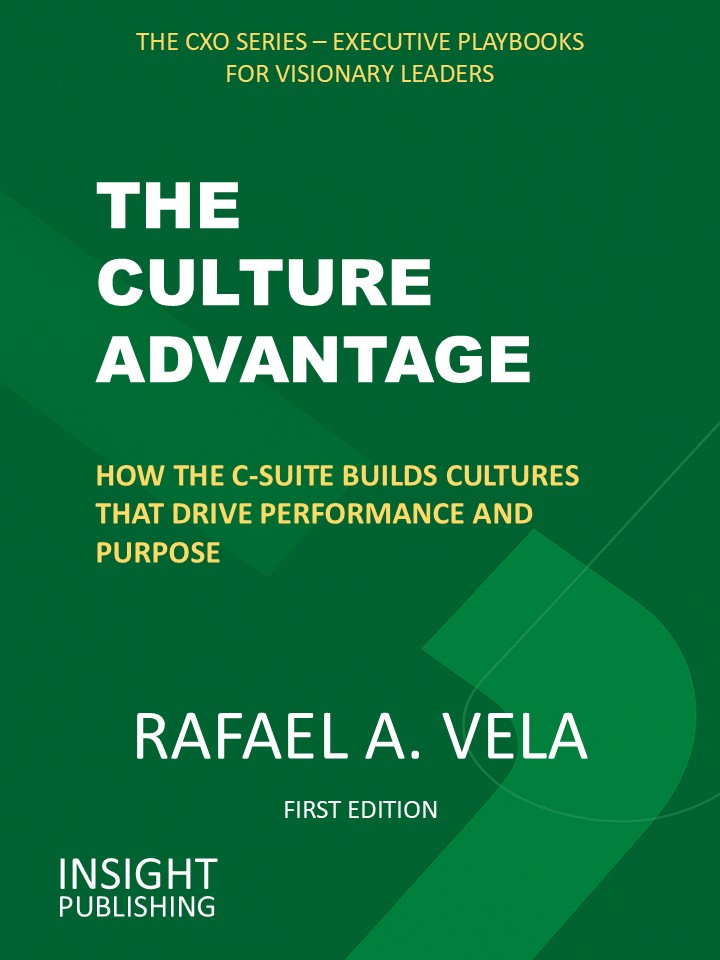
The Culture Advantage - How the C-Suite Builds Cultures that Drive Performance and Purpose
In The Culture Advantage, Rafael A. Vela shows how the C-suite deliberately builds cultures that drive execution, accountability, and long-term purpose.
This book reframes culture as a strategic asset. One that shapes decisions, behaviors, and results under pressure.
Written for senior leaders, it moves beyond values statements and engagement slogans to focus on the real levers of culture. Governance, leadership behavior, incentives, and the signals executives send every day.
You will learn how to:
• Shape culture through decisions, structure, and leadership conduct
• Align culture with strategy, performance, and accountability
• Sustain cultural coherence during growth, disruption, and transformation
This is not culture as aspiration. It is culture as advantage.
TABLE OF CONTENTS
PART I — The Foundations of Cultural Leadership
Chapter 1 — Culture as a Strategic Advantage - 17
• Why culture outperforms strategy - 17
• Culture as a behavioral execution system - 21
• Misalignment and the hidden cost of cultural drift - 24
• How high-performance cultures shape enterprise results - 27
Chapter 2 — The C-Suite as Architects of Organizational Identity - 29
• How leaders set the tone, pace, and behavioral expectations - 29
• The executive shadow: what people copy, not what leaders say - 34
• Removing contradictions at the top - 37
• The psychological infrastructure of trust - 40
Chapter 3 — Defining the Cultural Intent - 42
• What the organization must become to deliver its strategy - 42
• Clarifying the behaviors that matter - 43
• Prioritizing cultural imperatives - 44
• Eliminating ambiguity in “who we are” and “how we operate” - 47
• Cultural Intent as an Executive Contract - 47
PART II — Leading by Example: The Executive Behavioral Model
Chapter 4 — The Weight of Example - 50
• Why employees mirror executive behavior - 50
• Modeling discipline, clarity, and consistency - 51
• Eliminating leadership noise - 52
• Embedding credibility through daily conduct - 56
Chapter 5 — Building Leadership Teams That Embody the Culture - 58
• Creating a unified executive front - 58
• Behavioral alignment across diverse personalities - 61
• Addressing ego, conflict, and hidden agendas - 65
• How leadership teams become cultural engines - 65
• Leadership Teams as the bridge between Intent and Execution - 66
Chapter 6 — Communication as a Cultural Accelerator - 71
• Executive communication disciplines - 71
• Reducing ambiguity and organizational noise - 72
• The tone, frequency, and rhythm of cultural messaging - 73
• Language that reinforces meaning - 73
• Communication as reinforcement, not persuasion - 74
PART III — Systematizing Culture: Embedding Behaviors into the Organization
Chapter 7 — Hardwiring Culture into Processes and Decisions - 77
• Turning cultural intent into operational behavior - 77
• Embedding norms in hiring, performance, and promotion - 78
• Decision-making frameworks that reinforce values - 79
• The mechanics of cultural consistency - 80
Chapter 8 — Developing Leaders Who Amplify the Culture - 83
• Leadership pipelines as culture protection mechanisms - 83
• Coaching and capability building - 84
• Behavioral accountability - 85
• Scaling cultural expectations across layers - 85
Chapter 9 — Cultural Governance and Accountability Systems - 87
• Measuring cultural adherence - 87
• Governance structures that reinforce standards - 88
• Detecting early cultural drift - 89
• Role clarity in sustaining cultural integrity - 93
PART IV — Culture in Action: Driving Execution and Navigating Change
Chapter 10 — Culture as an Execution Engine - 96
• Cultural traits that accelerate performance - 96
• Removing friction from the operating system - 100
• Creating teams that execute with clarity and purpose - 103
• Culture’s role in cross-functional alignment - 107
Chapter 11 — Leading Cultural Change from the C-Suite - 109
• Resetting expectations and norms - 109
• Managing resistance with clarity and empathy - 113
• How to shift deeply embedded behaviors - 116
• Embedding new cultural patterns through practice - 117
Chapter 12 — Sustaining Culture at Scale - 121
• Reinforcement mechanisms - 121
• Protecting culture through leadership transitions - 122
• Institutionalizing behaviors - 123
• Culture as the enduring legacy of executive leadership - 126
Conclusion — The Executive Responsibility to Shape Culture With Intention - 128
Appendix A — The Executive Cultural Assessment. A diagnostic tool for evaluating cultural strengths, gaps, and priorities
Appendix B — Leadership Behavior Modeling Framework. A structured guide for aligning executive conduct with cultural intent
Appendix C — Culture Communication Playbook. Messaging structures, tone guidelines, and clarity mechanisms
Appendix D — Cultural KPI Dashboard. Metrics to monitor adoption, alignment, and behavioral consistency
Appendix E — Organizational Cultural Risk Map. A framework for identifying vulnerabilities, contradictions, and drift