
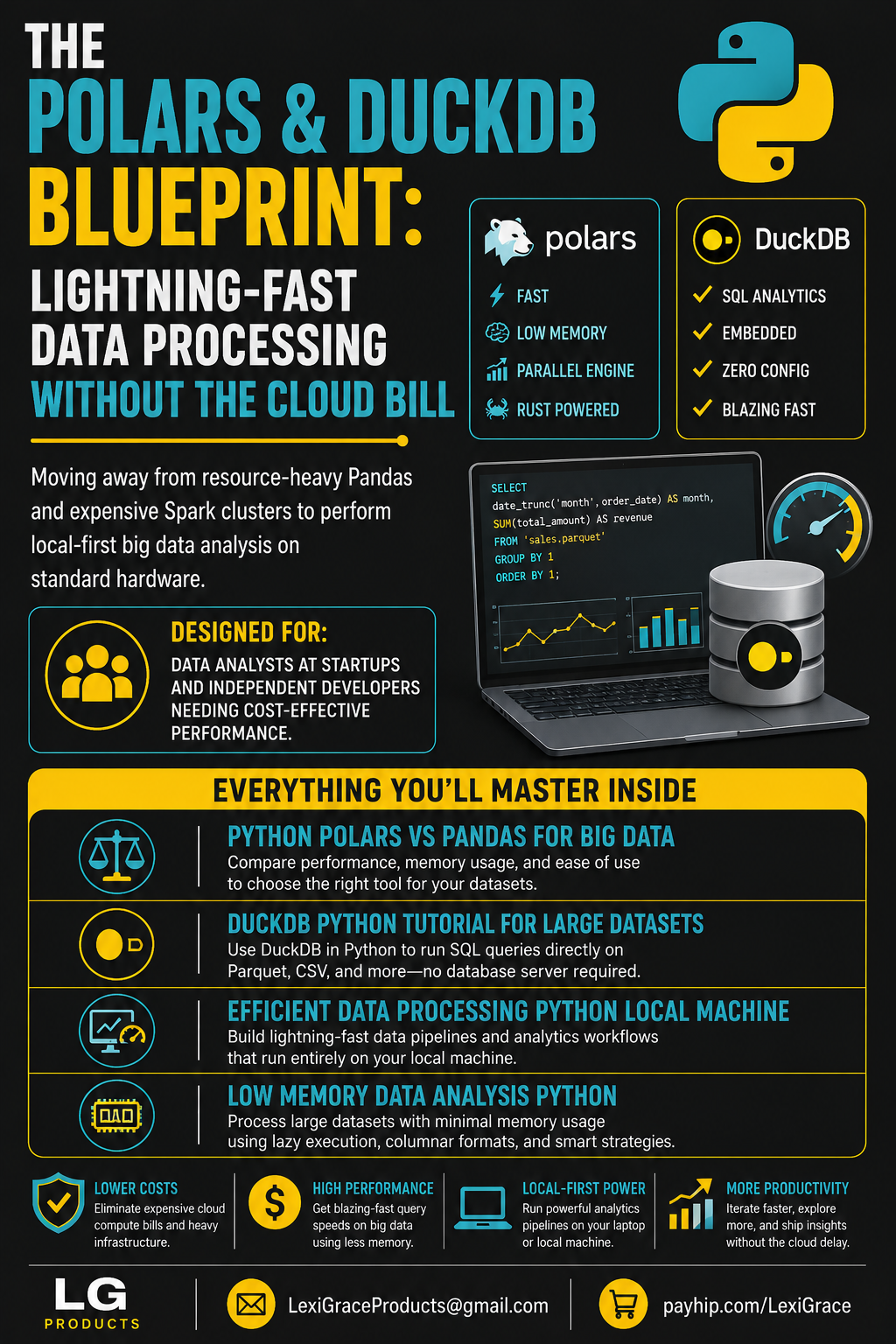
The Polars & DuckDB Blueprint: Lightning-Fast Data Processing Without the Cloud Bill — The Complete Local-First Analytics Guide
Your Pandas workflows are too slow. Your cloud bill is too high. Polars and DuckDB fix both — on your laptop.
A 10GB CSV that takes 45 minutes to process in Pandas takes 90 seconds in Polars. A SQL aggregation over 50 million rows that costs $12 on BigQuery runs in 8 seconds with DuckDB on your local machine. A Spark cluster that costs $200 per day to run can be replaced entirely for workloads under 500GB — with zero infrastructure cost and dramatically faster iteration.
This is the local-first data processing stack. And this guide teaches you to build it.
The Polars & DuckDB Blueprint is the complete technical guide for data analysts at startups and independent developers who want to process large datasets faster, cheaper, and with less complexity — moving away from resource-heavy Pandas and expensive cloud infrastructure to perform big data analysis on standard hardware using Python.
Every benchmark is real. Every code example is production-ready. Every technique runs on your laptop today.
What's Inside:
✅ Introduction — The local-first advantage comparison table showing Pandas, Polars/DuckDB, and cloud costs side by side across 6 real scenarios — including a 10GB groupby that costs $0 in 90 seconds locally versus $15-50 on cloud clusters
✅ Chapter 1 — Python Polars vs Pandas for big data — three live benchmark comparisons showing GroupBy aggregation (34x faster), filter and compute (28x faster), and multi-table join (14.6x faster) with working code for each, plus a complete 12-criterion feature comparison table showing which tool wins on speed, memory, lazy evaluation, null handling, string operations, and ecosystem
✅ Chapter 2 — Polars deep dive — eager vs lazy execution with predicate pushdown reducing actual file I/O by up to 90 percent, the complete Polars expression reference covering conditional logic, string operations, date operations, window functions, and rolling statistics, plus SQL-style running totals and rankings using Polars over() syntax
✅ Chapter 3 — DuckDB Python tutorial for large datasets — zero-configuration SQL directly on Parquet files, CSV files, and in-memory Pandas and Polars DataFrames, complex analytical queries with CTEs and window functions running in under 2 seconds on 10 million rows, and the persistent database pattern for creating views that survive between sessions
✅ Chapter 4 — Efficient data processing on your local machine — CSV to Parquet conversion achieving 19x file size reduction, dtype optimization reducing DataFrame memory by 70 percent through integer downcasting and categorical encoding, and psutil memory profiling showing Polars using 62 percent less memory than Pandas on the same dataset
✅ Chapter 5 — Low memory data analysis Python — Polars streaming with collect(streaming=True) processing 50GB files on a 16GB laptop, DuckDB memory-limited processing with automatic disk spill configured via SET memory_limit, and Pandas chunked reader for legacy workflows requiring 500K row processing windows
✅ Chapter 6 — Polars and DuckDB together — zero-copy data sharing via Apache Arrow with no memory duplication penalty, and a complete three-stage production ETL pipeline combining DuckDB for CSV ingest, Polars for business logic transformation, and DuckDB for analytical aggregations — processing 10 million rows in under 2 minutes
✅ Chapter 7 — Real-world use cases — Apache and Nginx log analysis parsing 5GB log files directly with DuckDB regex, high-frequency trading OHLCV bar generation from 100 million tick records in 47 seconds using Polars group_by_dynamic with VWAP calculation, and e-commerce customer cohort retention analysis with month-over-month retention rates in pure SQL on Parquet
✅ Chapter 8 — Replacing Spark — the Spark cost table showing $50,000 to $200,000 in annual cloud savings for typical startup workloads, a direct PySpark vs Polars code comparison showing 53 seconds versus 1.2 seconds for identical operations, and an honest assessment of when you genuinely need Spark versus when local-first wins decisively
✅ Bonus — Complete Code Reference — a 15-row Pandas to Polars syntax translation cheat sheet covering every common operation, a DuckDB SQL template library with 8 essential patterns including SUMMARIZE, PIVOT, glob queries, and approximate distinct count, and a full 10-operation benchmark table with Pandas, Polars, and DuckDB times side by side
This guide is perfect for:
- Data analysts at startups who are paying cloud bills for Spark or BigQuery workloads that would run faster locally
- Independent developers and freelancers doing client data work who want to eliminate infrastructure overhead
- Python developers moving from Pandas who need a structured transition to modern high-performance data tools
- Data engineers building local ETL pipelines who want to replace slow Pandas workflows with production-grade code
- Anyone who has ever waited more than 5 minutes for a groupby to finish or received a surprising cloud bill for a query
The cloud is a tool — not a requirement.
For the vast majority of real-world analytics workloads — anything under 500GB — your laptop with Polars and DuckDB is faster than a cloud cluster, costs nothing per query, and requires zero infrastructure management. The data you need to analyze is already sitting on your machine. The only thing missing was the right tools.
Now you have them.
Process Faster. Spend Less. Ship Sooner.
Instant digital download. Start processing your data at full speed today.
Note: Requires Python 3.10+ with polars and duckdb installed (pip install polars duckdb). No cloud accounts, no cluster configuration, no additional setup required.
© 2026 Lexi Grace Products | LexiGraceProducts@gmail.com | payhip.com/LexiGrace