
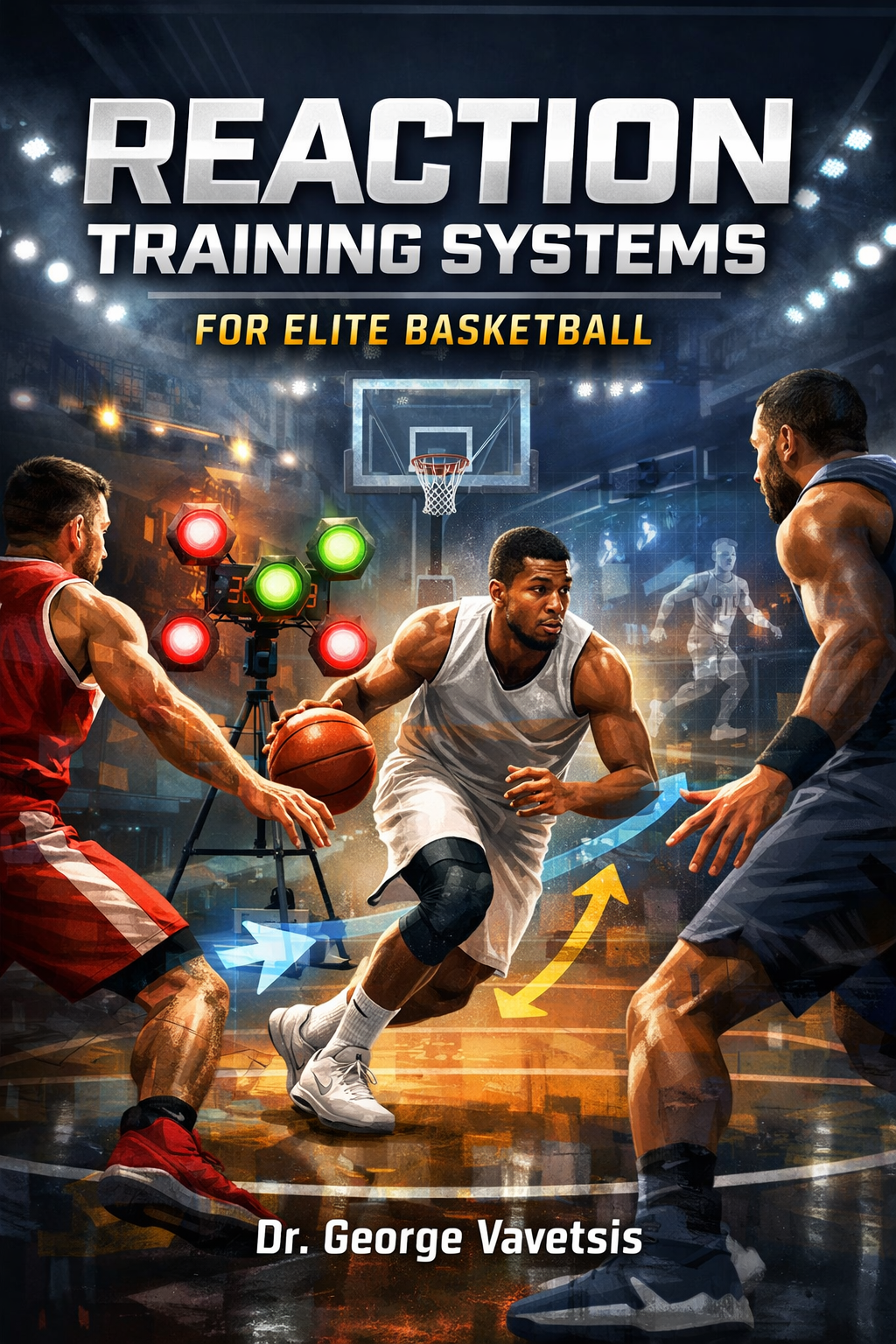
Reaction Training Systems for Elite Basketball
Pages: 1673
Basketball is a sport of milliseconds. Victory and defeat are often determined not by who runs faster or jumps higher, but by who perceives, interprets, and reacts first. In the modern era of elite basketball—characterized by explosive transitions, rapid ball circulation, and complex tactical interactions—the ability to react effectively under extreme temporal pressure has become one of the most decisive performance factors.
Reaction is not a simple reflex. It is the product of an extraordinarily complex interaction between sensory perception, neural processing, motor planning, and muscular execution. Every defensive closeout, interception, change of direction, or shot contest emerges from a cascade of neurophysiological events that unfold within fractions of a second. Understanding and training these processes represents one of the most exciting frontiers in high-performance basketball preparation.
Traditional conditioning programs in basketball have historically focused on physical qualities such as strength, speed, endurance, and power. While these components remain fundamental, modern performance science increasingly recognizes that athletic success in team sports depends equally on perceptual-cognitive abilities and sensorimotor integration. Reaction training therefore lies at the intersection of neuroscience, biomechanics, motor learning, and strength and conditioning.
The scientific foundation of reaction performance begins with sensory detection. Visual perception plays the dominant role in basketball decision-making. The retina detects motion, light contrast, and spatial orientation, transmitting this information through specialized neural pathways toward cortical processing centers. The magnocellular pathway, in particular, allows the rapid detection of moving stimuli—such as an opponent cutting toward the basket or the trajectory of a fast pass—while peripheral vision provides critical environmental awareness during dynamic multi-player interactions. The speed with which these visual signals are detected directly influences the initiation of motor responses in the athlete.
Following sensory detection, the brain must interpret the incoming information. This stage involves cortical processing within visual, parietal, and frontal regions responsible for pattern recognition, tactical evaluation, and decision-making. In elite players, this process is accelerated by experience-driven neural efficiency. Through years of competition, athletes develop sophisticated predictive models that allow them to anticipate opponent actions before they fully unfold. Consequently, elite players often appear to “react” faster not because their neural conduction speeds are dramatically different, but because their brains have learned to anticipate the most probable outcome of a given situation.
Once a decision has been formed, motor planning and execution begin. Neural signals travel from cortical and subcortical regions through descending motor pathways to activate the relevant muscle groups. During high-speed basketball situations, this perception–action coupling must occur seamlessly and with minimal delay. The efficiency of this sensorimotor loop determines whether a defender successfully intercepts a pass, contests a shot, or prevents a drive to the basket.
Importantly, reaction ability is not fixed. It can be trained.
Advances in sports science, neuroscience, and technology have revealed that reaction performance responds to targeted training interventions. Neurocognitive drills, perceptual training environments, reactive agility tasks, and decision-based conditioning exercises can enhance the efficiency of neural pathways involved in stimulus detection and response execution. Training methods such as LED-based visual systems, reactive agility platforms, stochastic movement drills, and game-specific decision simulations are increasingly used within elite basketball programs.
However, many reaction training approaches remain poorly integrated into strength and conditioning systems. Too often, perceptual training is isolated from the physical demands of the sport, leading to limited transfer to actual game situations. True performance enhancement requires that reaction training be embedded within the broader framework of athletic development—linking perceptual cues, tactical recognition, and explosive movement execution.
The goal of Reaction Training Systems for Elite Basketball is to provide a comprehensive framework for developing reaction capabilities in elite players. It integrates neurophysiology, biomechanics, perceptual science, and strength and conditioning methodology into a unified training system designed for high-performance environments.
Throughout the chapters that follow, readers will explore the underlying neural mechanisms of reaction, including visual detection latency, cortical processing speed, and perception–action coupling. These scientific foundations are then translated into practical training strategies specifically tailored to basketball. Coaches will find detailed frameworks for developing visual perception, anticipation skills, reactive agility, decision-making speed, and neural readiness under fatigue conditions.
Special emphasis is placed on applied training design. Each concept is presented not merely as theoretical knowledge, but as a practical tool for improving on-court performance. Strength and conditioning coaches, sport scientists, and basketball practitioners will discover methods for integrating reaction training into warm-ups, agility drills, strength sessions, and tactical practices.
Ultimately, reaction training represents a shift in how we understand athletic preparation. The fastest athlete is not always the one who moves first. The most explosive jump is meaningless if the player reacts too late. The modern basketball player must therefore develop a nervous system that is as powerful and adaptable as the muscles it controls.
Elite performance emerges when perception, cognition, and movement operate as a unified system.
This book is dedicated to advancing that system—helping coaches and athletes train the brain and body together to perform faster, smarter, and more effectively in the demanding environment of elite basketball.