
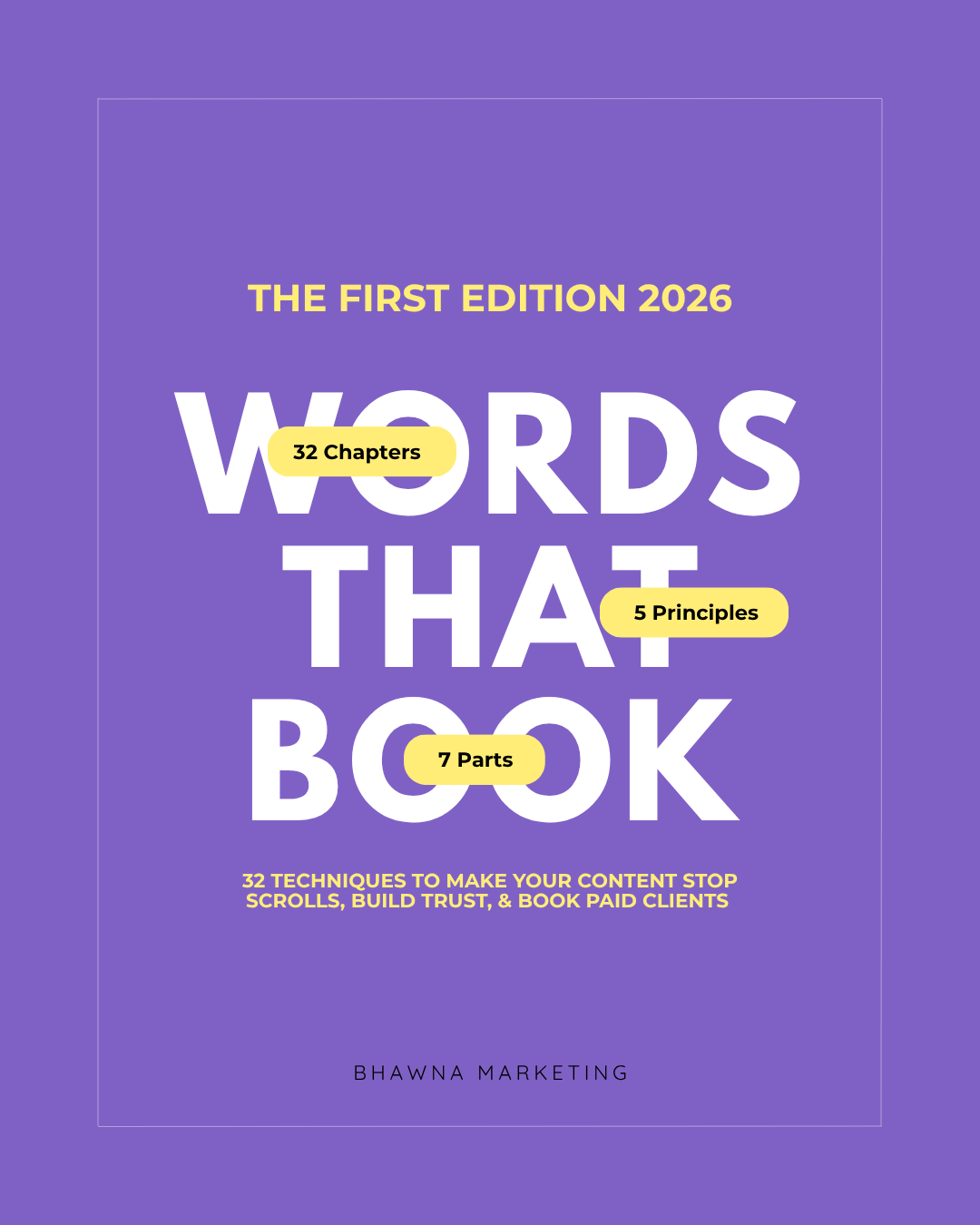
Words That Book Workbook
If Someone Removed Your Name From Your Last 10 Posts
Would Anyone Know It Was You?
32 Named, Replicable, Immediately Usable Techniques For Writing Content That Sounds Unmistakably Like You And Books Calls.
A Workbook. $27.
(For Indian residents: Use this link to purchase the workbook: https://rzp.io/rzp/wUAklFR)
Not a course. Not a coaching programme. Not a membership. A precision toolkit you work through once and return to every time you sit down to write.
Instant access. Yours permanently. No recurring fees.
The Problem Isn't That You're Not Trying.
You're posting.
Maybe not every day, but consistently enough that the gap between your effort and your results has started to feel personal.
Your engagement is real.
The saves are real. The comments are real. The DMs that say "this is exactly what I needed" are real.
And the calls aren't coming in.
Not at the rate the effort suggests they should. Not from the audience you've spent months building. Not despite the content strategy you've been following, the value you've been adding, the consistency you've been maintaining.
Here's what most content advice will tell you at this point:
Post more. Be more consistent. Add more value. Try a different format. Use this hook formula. Optimise for the algorithm.
Here's what most content advice won't tell you:
None of those things address the actual problem.
The actual problem is not volume. Not consistency. Not format. Not the algorithm.
The actual problem is that your content — good as it is — is communicating something you didn't intend.
It's communicating:
"This person is helpful."
When what closes high-ticket clients is content that communicates:
"This person understands my specific situation at a depth that makes me trust them with it."
Those are different messages. They require different content. And the difference between them is not talent, effort, or time.
It's structure.
Specifically — 32 named, replicable structural techniques that produce the second message instead of the first.
Every single one of them is inside this workbook.
The Gap Between Your Expertise and Your Income Is Not A Knowledge Problem.
In five years of working with coaches and service professionals across five countries —
Life coaches. Business coaches. Mindset coaches. Health coaches. Sales coaches. Career coaches. Mental health coaches. Lifestyle coaches.
SMMs. Copywriters. Consultants. Content writers. Digital marketers. Personal brand experts. Lead generation specialists.
I have almost never met someone whose income gap was caused by a lack of expertise.
Almost never.
The coaches who struggle to fill their programmes are not, in most cases, less skilled than the ones who don't.
They are less precise.
Not less intelligent. Not less hardworking. Not less worthy of the clients they're trying to attract.
Less precise — in how they describe the problem they solve, who they solve it for, and what changes when they do.
Precision in content is not a writing skill.
It is not something you're born with or not. It is not something that takes years to develop.
It is a structure.
A specific, named, learnable structure that turns the expertise you already have into words that make the right person stop scrolling, feel seen, and take the next step.
That structure has 32 names.
Each one is a technique. Each technique is a chapter. Each chapter is immediately usable.
That's Words That Book.
What Words That Book Actually Is
Words That Book is a 40-chapter content technique workbook for coaches and service professionals who are done writing content that gets engagement but never gets clients.
It is not a content calendar. It is not a caption template pack. It is not a course with video modules you'll watch once and never finish. It is not "101 hooks to go viral." It is not advice to "show up authentically and the clients will come."
It is a precision toolkit.
32 specific, named techniques — each one a different structural method for writing content that moves a reader from passive consumption to active enquiry.
5 advanced psychological principles — the architecture beneath every technique, explained with enough depth that you start seeing them everywhere: in the content that moves you, in the decisions you make, in the gap between what you write and what converts.
Every technique chapter is built the same way:
The Name — what the technique is called, so you can refer to it, teach it, and recognise it when you see it working in other people's content
The Skeleton — the fill-in framework. The exact structural pattern with brackets where your specific details, niche, and voice go
The Psychology — why it works. Not because you need a neuroscience degree to use it — but because understanding the mechanism means you can adapt it intelligently rather than copy it blindly
Three Live Examples — each technique demonstrated across three different professional types, so regardless of your niche, you see exactly what this looks like when it's working
Your Turn — a blank space with a specific prompt. Don't skip this. The coaches and service professionals who implement immediately are the ones who book calls
Where To Use This — which formats this technique works best in, which stage of the buyer journey it's most effective at, and when specifically to reach for it
The Complete Table of Contents
Why most content advice is optimised for reach, not revenue and what precision content looks like instead
PART 1 — CONVICTION TECHNIQUES
8 techniques that create realisations your reader cannot unfeel.
Once they've read content built on these techniques — they cannot go back to seeing their situation the way they saw it before.
The Cascade Consequence — makes your system feel non-negotiable by showing exactly what breaks without each part of it
The Mirror Flip — validates everything your audience has been trying, then shows them exactly why it's been working against them
The Named Villain — gives your audience's invisible obstacle a name, and makes you the only person who saw it clearly enough to name it
The Slow Zoom — starts where your audience is, then zooms in so precisely they feel personally diagnosed
The False Binary Break — frees your reader from the either/or trap they've been choosing between — and positions you as the person who found the door out
The Receipt — lets the evidence make the claim so you never have to
The Uncomfortable Agreement — agrees with everything your audience believes, then adds the one sentence that makes the agreement complicated
The Loaded Question — makes your audience confront the uncomfortable truth themselves, so you never have to confront them directly
PART 2 — IDENTITY TECHNIQUES
5 techniques that don't just change what your reader thinks — they change how they see themselves.
High-ticket decisions are never purely logical. They are identity decisions. These techniques answer the identity question before the reader has consciously asked it.
The Identity Gap — names the distance between who your reader is and who they're performing in their content, specifically enough that they can't go back to performing
The Future Self Confrontation — makes your reader's future self speak directly to their present self — and makes inaction feel like a choice they're making against themselves
The Membership Test — defines the specific quality shared by people getting the result your audience wants, and lets them self-select into that group
The Miscast Role — names the character your audience has been playing in their own brand, and introduces the one they were actually built for
The Before They Were Known — humanises the people your audience aspires to, and uses their starting point as a mirror for where your reader is right now
PART 3 — TENSION TECHNIQUES
4 techniques that make it neurologically difficult to stop reading.
These techniques create open loops the brain physically cannot close without finishing the content — and coming back for more.
The Incomplete Sentence — uses grammatical incompletion to make the next slide, line, or post feel neurologically necessary
The Withheld Name — describes something so specifically that the reader needs to know what you call it, and keeps reading until they find out
The Contradiction — opens by directly contradicting something you've previously said — and uses the contradiction to go deeper than the original post could
The Cliffhanger Sequence — turns a single post into a multi-part arc that trains your audience to come back
PART 4 — CREDIBILITY TECHNIQUES
5 techniques that make your expertise impossible to question — without saying a word about your credentials.
The Differential Diagnosis — demonstrates expertise by showing not just what the problem is, but how to tell it apart from the three other problems it's commonly mistaken for
The Prediction — demonstrates expertise by naming what's coming before it arrives, and positioning your audience to be ready for it
The Anatomy — dissects something your audience uses every day at a level of granularity that makes your expertise impossible to question
The Live Audit — demonstrates expertise in real time by thinking through a real example out loud, so the reader experiences your diagnostic process as it happens
The Contrarian Data Point — uses one specific number to dismantle a widely held belief, stated so coldly that the data does all the work
PART 5 — RELATIONSHIP TECHNIQUES
5 techniques that build the specific kind of trust that makes conversion feel inevitable.
The Shared Enemy — builds instant belonging by naming the institution, broken system, or bad advice that failed both you and your reader — together
The Confession — builds permanent trust by naming something you got wrong — without a redemption arc, without a lesson, without turning the mistake into a marketing moment
The Inside Joke — creates belonging by writing content only your specific audience would fully understand — and letting everyone else know this one isn't for them
The Callback — rewards loyal readers by referencing something from a previous post, creating the feeling of an ongoing conversation rather than isolated broadcasts
The Direct Address — writes to one specific person in enough detail that everyone reading it feels individually addressed
PART 6 — CONVERSION TECHNIQUES
5 techniques engineered to make the next step feel like the reader's own idea.
The Soft Inevitability — makes the next step feel like the only logical conclusion of everything the reader just experienced, without naming it as a call to action
The Permission Slip — removes the last internal barrier to action by giving the reader explicit permission to be exactly where they are — and move anyway
The Social Mirror — uses a peer's words, question, or decision to make the reader see their own situation more clearly than your words alone could produce
The Reverse CTA — converts by telling people not to take the next step, and filtering for exactly the right person in the process
The Single Domino — identifies the one shift that makes every other problem easier or irrelevant, and makes that shift feel accessible right now
THE BASEMENT — ADVANCED PSYCHOLOGICAL PRINCIPLES
5 principles operating beneath every technique — the architecture beneath the words.
These are not techniques. They are the forces the techniques are built from.
Loss Aversion — people are approximately twice as motivated to avoid losing something they have than to gain something they don't. Here's how that wires into every piece of content you write.
Identity-Consistent Behaviour — people don't make decisions that contradict how they see themselves. Here's how to shift the identity before asking for the decision.
The Zeigarnik Effect — the brain assigns unfinished tasks to working memory and keeps them active until completion. Here's how to leave the right files open.
Commitment and Consistency — once a person has committed to a position, even a small one, they experience psychological pressure to remain consistent. Here's how to design the ladder.
Social Proof Cascades — the perception that others are taking an action is one of the most powerful predictors of individual behaviour. Here's how to create the conditions where trust becomes visible.
What Happens When These Techniques Get Applied
A business coach — 4 years in, active DMs, consistent content, genuine expertise — came to me because Instagram wasn't working for her business. She was attracting free-loaders who would download her freebie, take free clarity calls, take free advice in her DMs and would never buy.
We identified the pattern: her content had no withhold. Every post answered the question her paid offer was supposed to answer.
We rebuilt her content using The Named Villain, The Cascade Consequence, and The Reverse CTA.
Within 30 days: DM enquiries shifted from advice-seekers to buyers. Within 50 days: her highest revenue month since starting her business.
A life coach with 2,200 followers — beautiful engagement, 800 saves on one post about her divorce — had never once been asked about her paid offer.
Her content was creating emotional safety. Emotional safety, without a bridge, becomes a destination rather than a doorway.
We rebuilt her content using The Identity Gap, The Soft Inevitability, and The Direct Address.
Within 30 days: story replies up, DM enquiries up, discovery calls booked for the first time in three months.
A client's Instagram comment — written in 40 seconds as a throwaway response — became a reel hook using The Withheld Name.
47 leads in 11 days.
Not because the production was better. Because the content finally said the thing the audience had been waiting for someone to name.
This Workbook Is For You If —
- You are a coach or service professional with real expertise and real results — whose content doesn't yet reflect either.
- You have been posting consistently and your follower count moves but your DMs and discovery calls don't.
- You know your offer is strong but explaining it in a caption feels harder than it should.
- You are tired of generic content advice that doesn't account for how your specific audience actually thinks.
- You want to understand why certain content converts — not just what to copy.
- You are willing to implement immediately rather than save for later.
This Workbook Is Probably Not For You If —
- You are in the first three months of your business and still figuring out your offer — build the offer first, come back to this when you have something worth saying.
- You want someone to do it for you — this workbook teaches you to do it yourself. If you want it done for you, BOO is the right fit instead.
- You are looking for a formula to copy without understanding — every skeleton in this workbook requires your specific voice, your specific observations, your specific client stories to work. The structure is replicable. The voice is yours.
What You're Getting
Words That Book — Full Workbook
32 content techniques across 6 parts 5 advanced psychological principles 40 complete chapters Fill-in skeletons for every technique Your Turn sections throughout Where To Use This guidance for every technique The Basement — the psychological architecture beneath every word
Format: Digital workbook — designed for immediate use and permanent reference
Access: Instant, upon purchase — yours permanently, no expiry, no subscription
Price: $27
(P.S.: For Indian residents, use this link to purchase the workbook: https://rzp.io/rzp/wUAklFR)
This is the entry point. The techniques inside it are the same ones applied inside BOO — the done-for-you service that starts at significantly more than $27. The difference: BOO applies them for you. Words That Book teaches you to apply them yourself. Both produce the same result. One just requires more of your time and less of your budget.
The Questions Worth Answering Before You Decide
"$27 is small but I've bought things at this price point and never used them."
Fair. Most resources at this price point are built to impress at the point of purchase and disappoint at the point of use.
Words That Book is built differently — specifically because the Your Turn sections are designed to be completed before you move to the next technique.
The coaches who get results from this workbook are the ones who open it, read Technique 1, fill in the Your Turn section, and post something before they read Technique 2.
Not the ones who read all 32 techniques in one sitting and wait for inspiration to strike.
If you are the first kind of person — this is worth significantly more than $27.
If you are the second kind — no workbook will fix that, and this one won't either.
"I've seen content frameworks before. What makes these different?"
Most content frameworks tell you what to write.
The techniques in Words That Book tell you what your content needs to produce in the reader's brain — and give you the specific structure that produces it.
That's a different level of understanding.
It's the difference between following a recipe and understanding why the ingredients work together — which means you can adapt, improvise, and create from scratch rather than being dependent on the recipe every time you sit down to write.
"I'm not sure my niche is covered."
Every technique in this workbook is demonstrated across three different niches — spanning life coaches, business coaches, health coaches, mindset coaches, sales coaches, career coaches, mental health coaches, lifestyle coaches, SMMs, copywriters, consultants, content writers, digital marketers, personal brand experts, and lead generation specialists.
If you sell expertise through content — regardless of what that expertise is — the techniques work.
Because they're built on how human psychology responds to precision in language.
And human psychology doesn't have a niche.
"Can I get a refund if it doesn't work for me?"
The honest answer: the techniques work when applied.
They don't work when downloaded, skimmed, and saved for later — which is how most digital resources fail, and which has nothing to do with the resource itself.
For this reason there is no refund policy — not because the workbook isn't worth it, but because "it didn't work" almost always means "I didn't use it," and refunding unused work doesn't serve either of us.
What I can tell you: if you open this workbook, complete the Your Turn section for the first three techniques, and post the content — you will see a different response from your audience.
Not because I'm promising a specific outcome.
Because precision in content produces a different reader response than generic content does.
Every time.
Your Expertise Was Never The Problem.
The Words Were.
Not because they weren't good enough.
Because they weren't precise enough — specific enough, structured enough, built with enough intention about what they needed to produce in the reader who encountered them.
32 techniques fix that.
Not by changing your voice.
Not by making you sound like anyone else.
By giving your voice a structure beneath it that was designed — specifically, deliberately, with the full understanding of how human psychology responds to precision in language — to turn a reader into a booked call.
That structure is $27.
It is yours permanently.
It works the first time you use it.
And it compounds — because every technique you learn changes how you see every piece of content you'll ever write after it.
[GET WORDS THAT BOOK — $27]
(P.S.: For Indian residents, use this link to purchase the workbook: https://rzp.io/rzp/wUAklFR)
Instant access. 32 techniques. 5 principles. 40 chapters. Yours permanently. No recurring fees. No expiry.
— Bhawna Founder, Bhawna Marketing Creator of the BOO Method
P.S. — If you've already downloaded the free edition and used the first three techniques — you already know what the other 29 feel like to work with. This is the rest of them.
© Bhawna Marketing 2026
Questions? DM me on Instagram or email [bhawnaotwarofficial@gmail.com or hellobhawnamarketing@gmail.com]
Words That Book is a digital workbook. Upon purchase, you will receive instant access. This is a non-refundable digital product.