
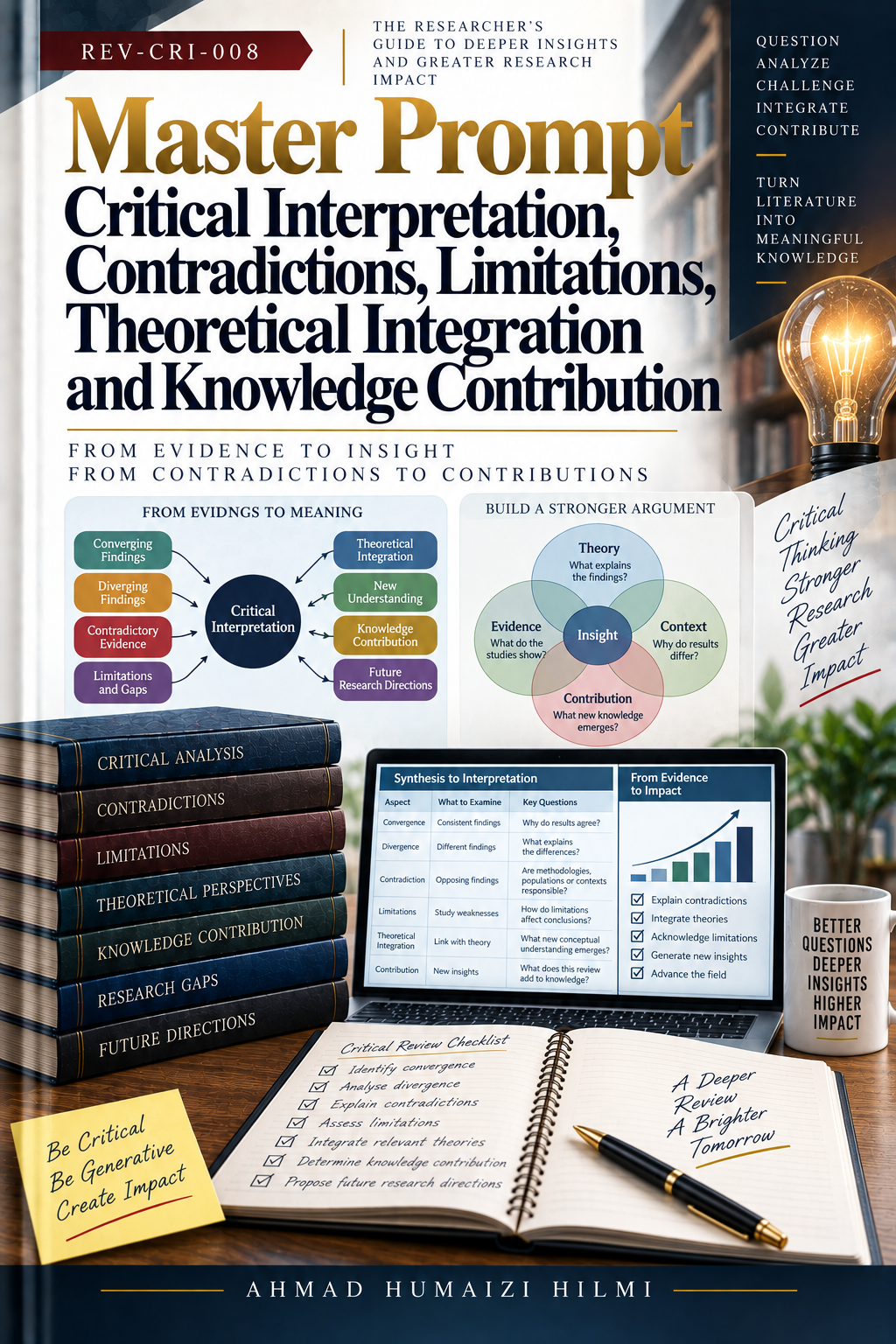
8. REV-CRI-008 — Critical Interpretation, Contradictions, Limitations, Theoretical Integration and Knowledge Contribution
Description
This Master Prompt focuses on moving a review beyond descriptive synthesis toward critical, explanatory and generative scholarship. It guides researchers in interrogating the synthesized evidence to determine not merely what patterns, relationships and findings have been reported, but why they may have emerged, under what conditions they hold, why apparently comparable studies reach different conclusions, which methodological and contextual features shape those conclusions, and what level of interpretation is justified by the available evidence. This progression is particularly important because the uploaded literature demonstrates that apparently inconsistent evidence may reflect genuine substantive differences, but may also arise from variations in definitions, populations, samples, measurement systems, analytical approaches, technologies, model assumptions, geographical settings, institutional environments or research quality. For example, the reviewed literature includes evidence in which findings vary across reading conditions and digital enhancements, studies in which promising technological performance is constrained by small samples and non-standardized protocols, and reviews comparing modeling approaches with distinct capabilities, assumptions and limitations.
A major emphasis is placed on preserving convergence, divergence, contradiction, heterogeneity, uncertainty, sparse evidence and unresolved mechanisms rather than forcing the literature into an artificially coherent narrative. Researchers are guided to distinguish empirical disagreement from differences produced by research design, operational definitions, population characteristics, contextual conditions, technological maturity, theoretical assumptions or analytical choices; separate plausible explanations from explanations directly demonstrated by evidence; consider alternative interpretations; and maintain appropriate boundaries around causal claims. The uploaded papers reinforce the importance of this restraint: the paper-mill study explicitly limits its findings to descriptive patterns within already retracted records rather than treating them as estimates of broader prevalence, while the empty scoping review demonstrates that an absence of empirical studies can itself become an object of critical discussion without being converted into evidence that does not exist.
The Master Prompt also guides researchers from critical interpretation toward conceptual and theoretical integration and defensible knowledge contribution. Existing theories, frameworks and logic models should be compared against the accumulated evidence, including their explanatory coverage, assumptions, mechanisms, contextual applicability and boundary conditions. Where justified, researchers may reconcile competing explanations, refine an existing theory, integrate complementary frameworks, formulate propositions or construct a new conceptual model that is explicitly traceable to the review evidence. This approach is reflected in the uploaded collection: logic models are presented as tools for representing mechanisms, contextual moderators and causal pathways, while the university-engagement review demonstrates how contextual differences and limitations of existing frameworks can motivate an integrated conceptual model rather than merely another descriptive summary. The overall interpretive architecture should therefore follow: