
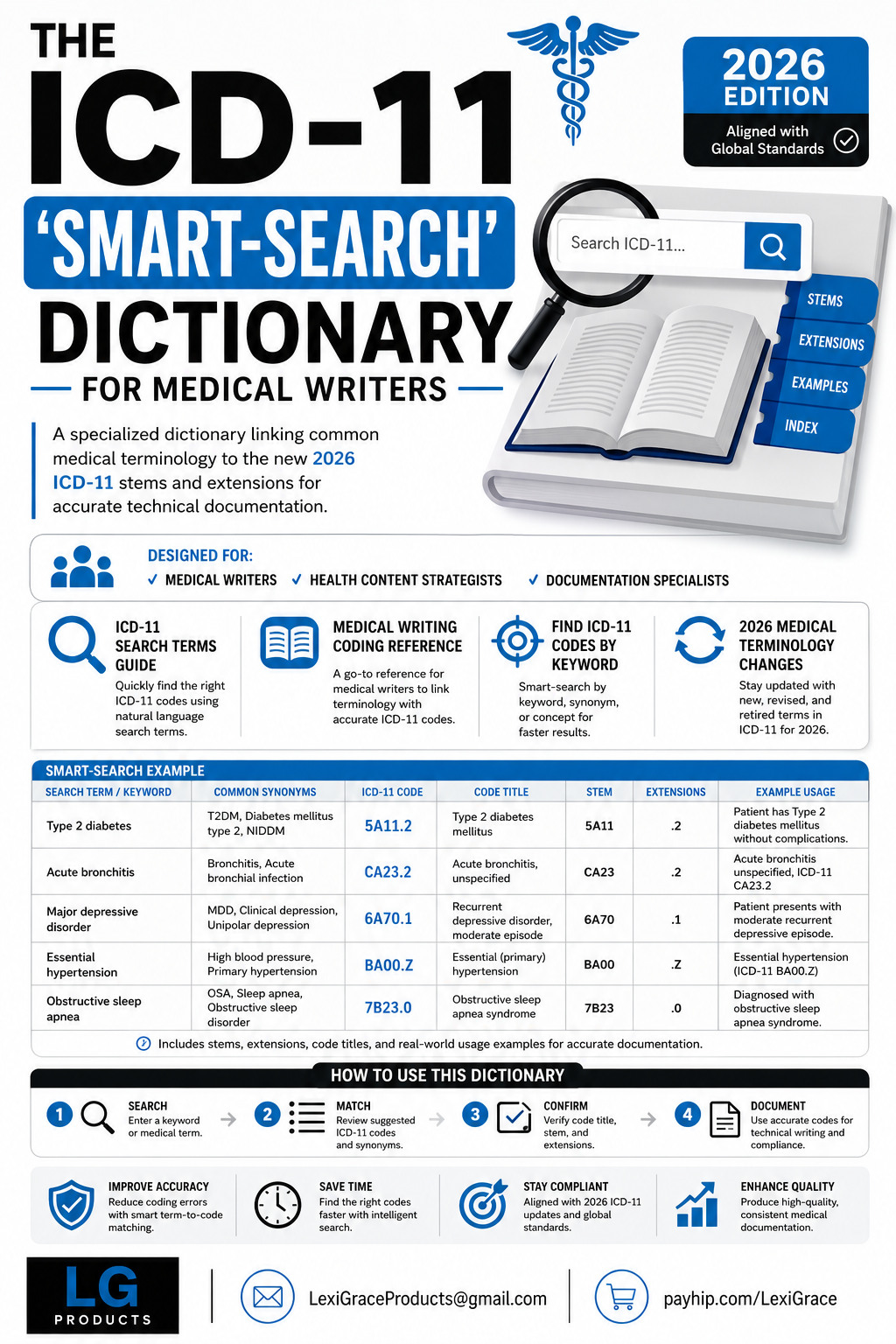
The ICD-11 'Smart-Search' Dictionary for Medical Writers — 2026 Edition
You know the medical term. But what is the ICD-11 code — and are you using the right one?
ICD-11 is now the global standard for disease classification. And for medical writers, health content strategists, and documentation specialists it introduces a completely new coding architecture — new stems, new extensions, new terminology, and hundreds of terminology changes from ICD-10 that affect the accuracy of every clinical document you write.
This dictionary bridges the gap between the way medical writers think about diseases and the way ICD-11 classifies them. Type in the term you know. Find the code you need. Write with confidence.
The ICD-11 'Smart-Search' Dictionary for Medical Writers — 2026 Edition is the specialized reference guide that links common medical terminology to the correct 2026 ICD-11 stems and extensions for accurate, compliant, and professionally written medical content.
Built specifically for medical writers, health content strategists, and documentation specialists — not clinical coders. Every entry is organized the way a writer searches: by common name, synonym, and keyword — not by code number.
What's Inside:
✅ Introduction — Why ICD-11 matters for medical writers, how the smart-search system works, and how to use this dictionary alongside the free WHO ICD-11 browser at icd.who.int/browse/2026
✅ Chapter 1 — ICD-11 search terms guide — a complete 4-step smart-search method for finding any ICD-11 code using natural language, plus 10 fully worked search examples covering diabetes, hypertension, heart attack, depression, COPD, stroke, asthma, kidney disease, anxiety, and more — each with synonyms, ICD-11 code, stem, extensions, and documentation example
✅ Chapter 2 — Medical writing coding reference — how to cite ICD-11 codes correctly in clinical trial protocols, regulatory submissions, patient education materials, clinical guidelines, drug labeling, health content articles, and package inserts — with a standard citation format table for every document type
✅ Chapter 3 — Find ICD-11 codes by keyword — the core A to Z smart-search directory with 50+ fully detailed entries covering the most commonly written-about conditions — each entry includes the search term, common synonyms, ICD-11 code, official code title, stem, available extensions, and a real-world documentation example
✅ Chapter 4 — Stems and extensions explained — the complete guide to ICD-11 postcoordination including what stem codes are, the 7 major extension categories (severity, laterality, temporality, morphology, causative agent, anatomy, and TNM staging), and 3 complete worked examples of building postcoordinated code expressions
✅ Chapter 5 — 2026 medical terminology changes — a comprehensive spelling reference table (ICD-11 uses WHO British English throughout), plus 10 high-impact terminology changes including the retirement of Asperger syndrome, mental retardation, manic-depressive illness, senile dementia, and CVA — with correct ICD-11 replacements for each
✅ Chapter 6 — ICD-11 by body system — quick reference tables for 8 body systems including cardiovascular, respiratory, endocrine and metabolic, nervous system, mental and behavioral health, musculoskeletal, genitourinary, and oncology — with the most commonly cited codes in medical writing for each system
✅ Chapter 7 — Documentation best practices — 10 evidence-based practices for writing accurate clinical content with ICD-11 including how to handle ICD-10 to ICD-11 crosswalks, postcoordinated code documentation, regulatory citation standards, SEO tagging for health content, and building a therapeutic area ICD-11 code library
✅ Bonus — Smart-Search Quick Reference Table — a print-ready 50-row reference table with all 7 columns matching the cover design: Search Term, Common Synonyms, ICD-11 Code, Code Title, Stem, Extensions, and Example Usage — formatted to print and laminate as your daily desk reference
This guide is perfect for:
- Medical writers working on clinical trial documents, regulatory submissions, and drug labeling
- Health content strategists creating SEO-optimized medical articles and patient education materials
- Documentation specialists transitioning from ICD-10 to ICD-11 terminology
- Clinical research associates and medical affairs professionals who write clinical documents
- Healthcare marketers and health journalists who need accurate disease coding in content
- Anyone who has struggled to find the right ICD-11 code quickly without searching through the full WHO tabular list
ICD-11 is not just a new code set. It is a new language for describing disease.
This dictionary teaches you that language — the vocabulary, the search strategy, the citation format, the terminology updates, and the documentation standards that separate accurate medical writing from outdated clinical content.
Search smart. Write accurately. Stay compliant.
Instant digital download. Start writing with ICD-11 confidence today.
Important Note: ICD-11 codes are maintained by the World Health Organization and updated annually. Always verify codes at icd.who.int/browse/2026. This dictionary is a reference supplement designed to help medical writers navigate ICD-11 — not a substitute for the official WHO ICD-11 browser.
© 2026 Lexi Grace Products | LexiGraceProducts@gmail.com | payhip.com/LexiGrace