
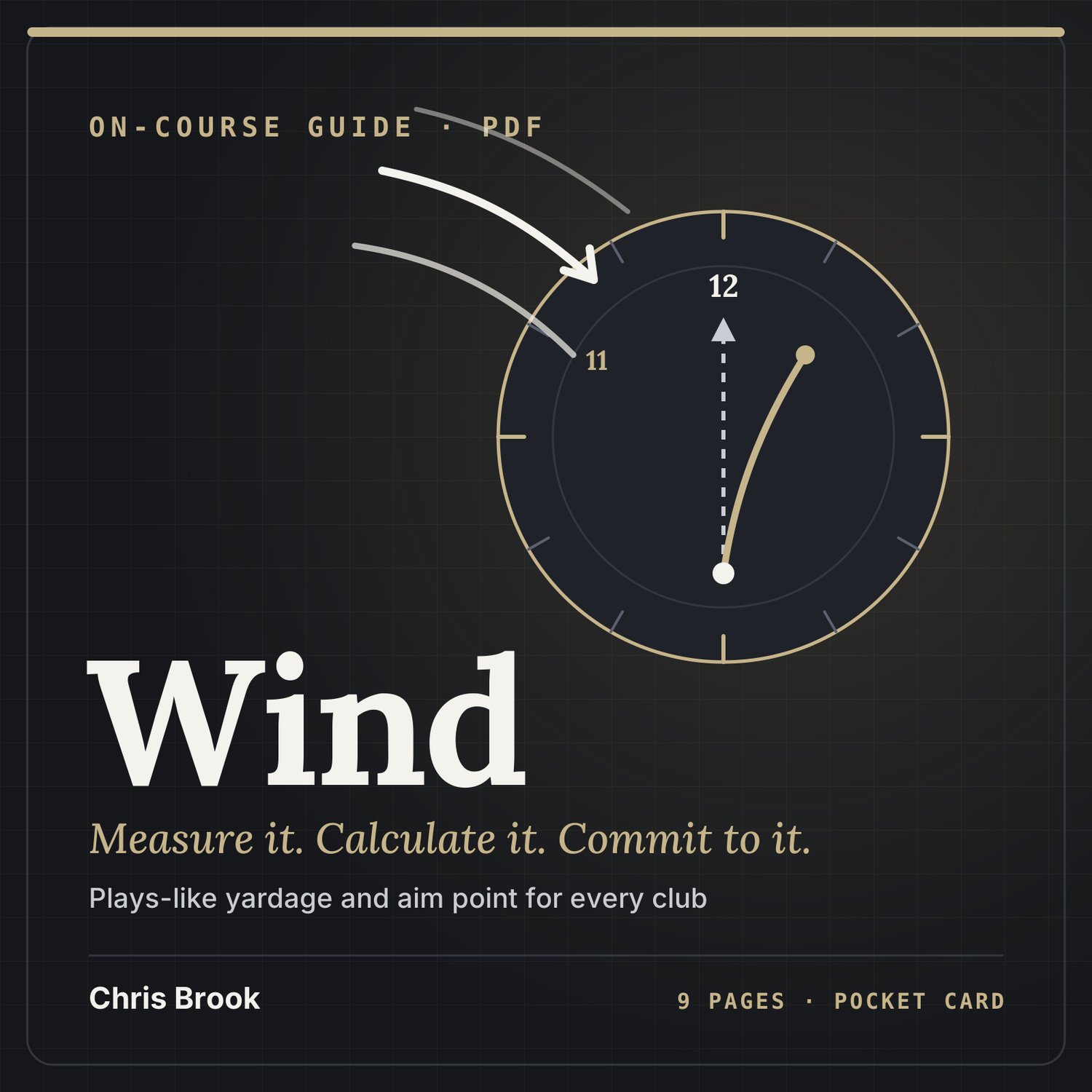
Wind: Measure It, Calculate It, Commit to It — On-Course Guide
Wind is the biggest number you're guessing.
Misread a 10 mph headwind by just 3 mph and a 7-iron finishes about 6 yards short or long and 5 yards offline. That's the difference between a putt and a chip.
Most golfers carry a vague rule like "one club per 10 mph" and then guess the wind. This guide fixes both ends: how to read the wind accurately, and exactly what that wind does to every club in your bag.
THE METHOD: FIVE STEPS, ONE NUMBER
1. Read – judge speed and direction from the flag, the trees and the sky
2. Lift – convert the wind you feel into the wind your ball actually flies through
3. Split – use the clock to separate head or tail from crosswind
4. Adjust – get your plays-like yardage for the club in your hand
5. Aim – allow for drift, then commit to one target
THE STEP MOST GOOD PLAYERS MISS
Your ball peaks 30–38 yards up, where the wind is 35–60% stronger than the wind on your face. A 10 mph reading in a tree-lined chute is a 16 mph wind for the ball. This is where yards go missing without you knowing why.
WHAT'S INSIDE (9 pages)
• A speed chart: what 4, 8, 13, 19 and 25 mph look and feel like on the course
• The ball-height wind factor for open links and sheltered parkland
• The wind clock: head, tail and crosswind split in seconds
• Plays-like percentages by club group, into and down the wind
• Club-by-club carry changes, driver to 56°, at 5 to 25 mph
• Crosswind drift and aim for every club, plus the quartering-wind correction
• Ride it or hold it: choosing your shape before your aim point
• Three worked examples, each checked against the full model to within 2 yards
• A one-page pocket card to print and keep in your bag
• A simple routine to calibrate your eye to within ±2 mph
Every figure comes from a calibrated ball-flight model, not a rule of thumb.
WHO IT'S FOR
Golfers whose strike and distance control are good enough that wind has become the biggest error left in the shot: competitive amateurs, club players who play links and exposed courses, and coaches who want a clear method to teach.
Instant PDF download. Yours to keep and print.
From Chris Brook — golf performance coach and author of Read It Before You Hit It and Quiet the Mind, Lower the Score.