

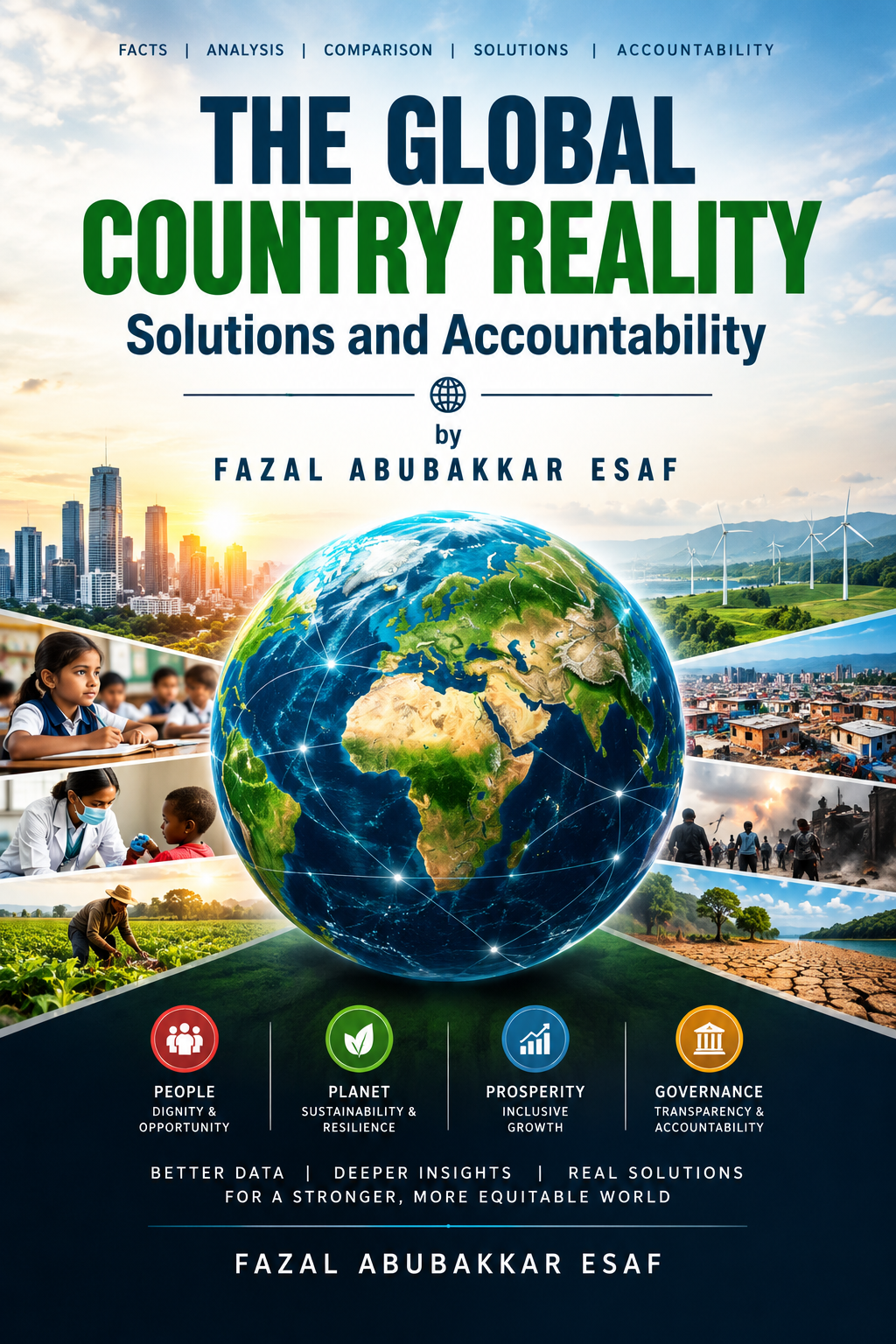
The Global Country Reality
Why This Book Exists
Every country has a story it tells the world, a story its institutions tell its citizens, and a story experienced by ordinary people.
These stories do not always agree.
A government may announce economic growth while households struggle with the cost of food. A country may build modern infrastructure while some communities lack safe drinking water. A nation may expand educational opportunities while students leave school without foundational skills. A city may appear prosperous while workers cannot afford adequate housing.
Elsewhere, a country facing severe difficulties may contain communities, institutions and local initiatives that have discovered practical ways to improve people's lives.
To understand a country honestly, we must examine all these realities together.
This book was conceived around one fundamental question:
How can we investigate the problems of 198 countries through one systematic framework without ignoring local differences, human suffering, institutional responsibility or practical solutions?
The answer cannot be a list of statistics alone. Nor can it be a collection of accusations, political speeches or attractive promises.
It requires a method.
We must identify what is happening, establish the evidence, understand the root causes, trace the distribution of costs and benefits, examine who holds the power to act, and determine which interventions have a realistic chance of succeeding.
We must ask uncomfortable questions. Why do public programs fail despite substantial expenditure? Why do preventable problems persist? Why are certain communities repeatedly excluded? Why do some reforms produce lasting improvements while others disappear after a change of government?
Equally important, we must investigate what works. Which communities have improved water access? Which countries have strengthened public health? Which policies have reduced poverty, improved learning or made infrastructure more resilient? What can other societies learn without copying policies blindly?
The thirty chapters of this book bring these questions into a single structure. They examine economic instability, employment, food, water, education, healthcare, inequality, justice, climate, infrastructure, corruption, governance, technology, conflict and national resilience. They then move beyond diagnosis to solutions, implementation budgets, measurable indicators, future scenarios and public accountability.
The intention is not to declare one country superior to another. National circumstances differ, and raw comparisons can mislead when they ignore population, income, geography, history, institutional capacity or data quality.
The intention is to make comparison more intelligent and public debate more useful.
A country should not be judged solely by its wealth, military strength, political reputation or headline growth rate. It should also be examined through the everyday conditions of its people: whether children learn, patients receive treatment, workers earn a living, families obtain safe water, public money delivers public benefits, and citizens can seek justice without unreasonable barriers.
This book is a framework, not a substitute for investigation. Its value will depend on the quality of the evidence gathered, the honesty of the analysis and the willingness to correct mistakes.
My hope is that researchers, students, journalists, policymakers, civil society organizations, educators and concerned citizens will use this framework to ask better questions and pursue practical answers.
The ultimate measure of progress is not how impressive a country looks on paper.
It is how meaningfully the lives of its people improve.