

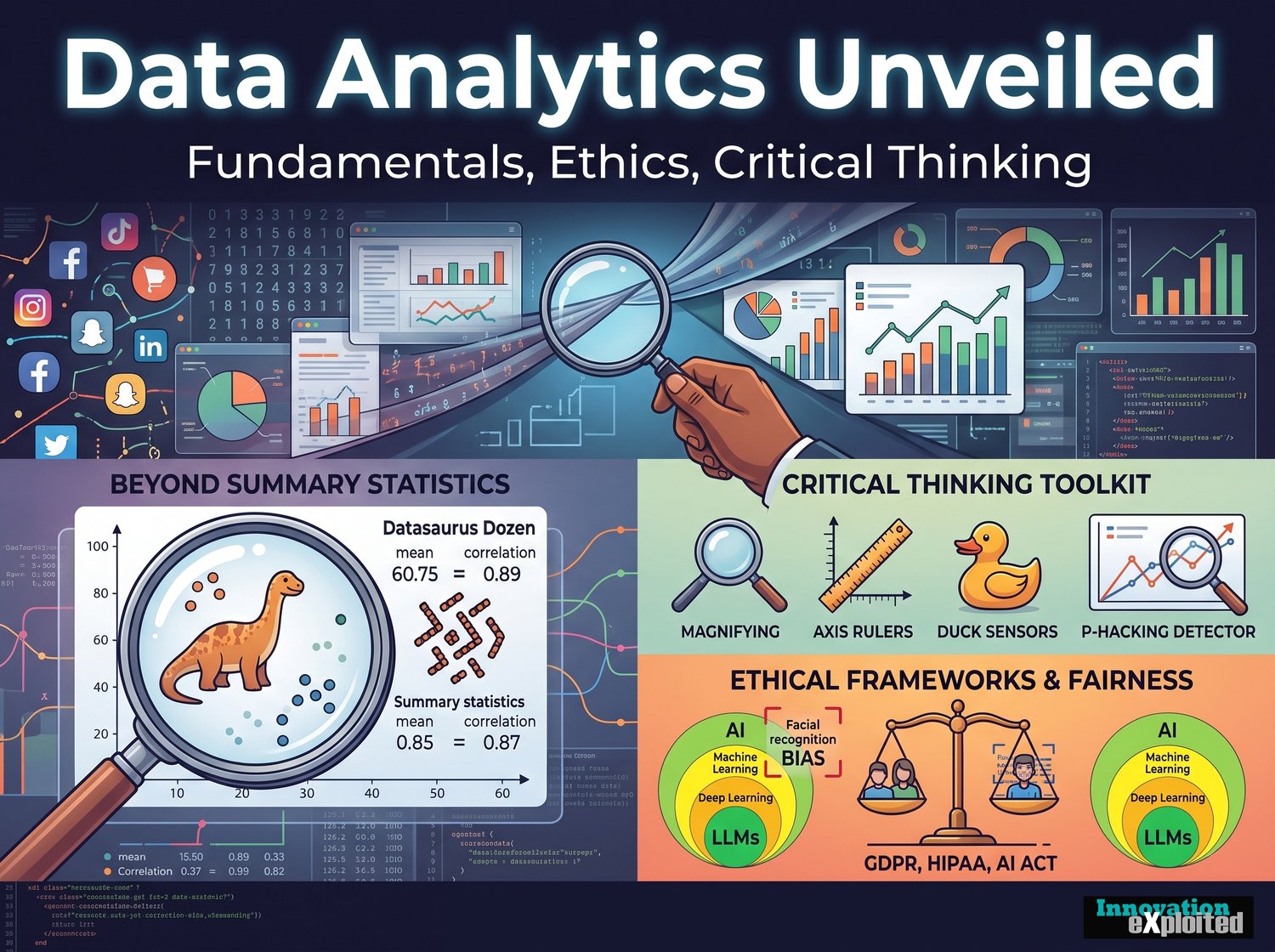
Data Analytics Unveiled
On Sale
€5.00
Pay what you want:
(minimum €5.00)
€
Data Analytics Unveiled [EARLY RELEASE]
Fundamentals, Ethics, Critical Thinking
Early Release Promotional Offer
Fix your price now for upcoming content updates!
(Final release expected shortly)
Contents Overview
In an increasingly data-driven world, quantitative figures and automated algorithms carry immense authority.
However, numbers do not speak for themselves: they can be miscalculated, cherry-picked, or deliberately manipulated.
These lecture notes provide readers with a dual foundation:
- practical data analytics skills (from acquisition and ETL pipelines to exploratory visualization)
- critical thinking skills required to evaluate claims, navigate ethical and regulatory standards, and dismantle statistical misinformation.
Data Analytics & Data Science Fundamentals
Focus: Understanding the data lifecycle, data pipeline engineering, and distribution analysis.
- The Analytics Lifecycle & Data Acquisition
- Analytics vs. Data Science: Distinguishing descriptive pattern detection (data analytics) from predictive modeling and forecasting (data science).
- Data Acquisition: Working with structured, unstructured, and synthetic datasets to protect privacy or augment small samples.
- ETL Pipelines: Designing Extract, Transform, and Load (ETL) workflows to harmonize disparate data sources, centralize storage, and eliminate data silos.
- Exploratory Data Analysis (EDA) & Visualizing Distributions
- EDA Principles: Uncovering hidden patterns, checking assumptions, and detecting correlations.
- Showing the Data: Why summary metrics (mean, standard deviation) mask critical structures, and why analysts must plot full distributions using dot plots, beeswarm plots, and histograms.
- The Datasaurus Dozen: Demonstrating how wildly different datasets can share identical summary statistics.
Refutation, Reproducibility, & Operational Safeguards
Focus: Conducting rigorous refutations, managing model decay, and implementing analytical guardrails.
- P-Hacking & The Crisis of Reproducibility Flaws of Null Hypothesis
- Significance Testing: How p-hacking, HARKing, multiple testing, and misuse of p-values create an epidemic of false positives in published research.
- Selection & Survival Bias: Recognizing how non-representative sampling and right-censored data produce misleading findings.
- Constructing Refutations & Model Maintenance
- Effective Refutations: Developing null models, synthetic benchmarks, and clear counter-visualizations to dismantle false claims.
- Telemetry & Data Drift: Monitoring deployed models in production to detect model decay and target drift.
- Methodological Guardrails: Enforcing pre-registered hypotheses, sample ratio mismatch (SRM) checks, and Twyman’s Law.
Critical Thinking & Debunking Data Misinformation
Focus: Unmasking sophisticated quantitative deception, visual tricks, and logical fallacies.
- Debunking “New-School” Misinformation & Black Boxes
- New-School Bullshit & “Mathiness”: How mathematical notation, statistics, and scientific jargon are weaponized to create a false impression of rigor.
- Auditing Black Boxes: Evaluating algorithmic inputs (training data bias) and outputs without needing to open complex model code (“Garbage In, Garbage Out”).
- Zombie Statistics: Spotting fabricated, outdated, or context-stripped figures that circulate across media.
- Graphical Misinformation & Statistical Fallacies
- Data Visualization Pathology: Identifying chart “ducks” (decorative clutter), “glass slippers” (forcing data into unfit visual metaphors), and violations of the principle of proportional ink.
- Axis & Bin Manipulation: Spotting truncated vertical axes, truncated time horizons, and altered bin widths used to exaggerate or hide trends.
- False Causality & Simpson’s Paradox: Distinguishing correlation from causation, recognizing spurious correlations, and understanding how aggregate trends reverse when segmented by confounders (e.g., the UC Berkeley admissions case).
Ethics, Privacy, Governance, and AI Security
Focus: Responsible data stewardship, regulatory compliance, algorithmic bias, and adversarial defense.
- Governance, Privacy Laws, and Human-in-the-Loop
- AI Privacy Regulations: Understanding legal frameworks including GDPR, CCPA, and HIPAA.
- Transparency & Documentation: Standardizing data provenance using Data Cards (Dataset Cards).
- Algorithmic Bias & Diversity: How machine learning models perpetuate societal biases in hiring, lending, and criminal justice, and how Human-in-the-Loop (HITL) oversight mitigates risk.
- AI Security Threats & Regulatory Frameworks
- Adversarial Attacks: Identifying training-phase data poisoning and output-phase model inversion attacks.
- Defense & Auditing: Applying data sanitization, anonymization, encryption, and red-team security testing.
- Global AI Regulation: Analyzing compliance guidelines under the EU AI Act and the US Executive Order on AI for high-risk automated systems.