
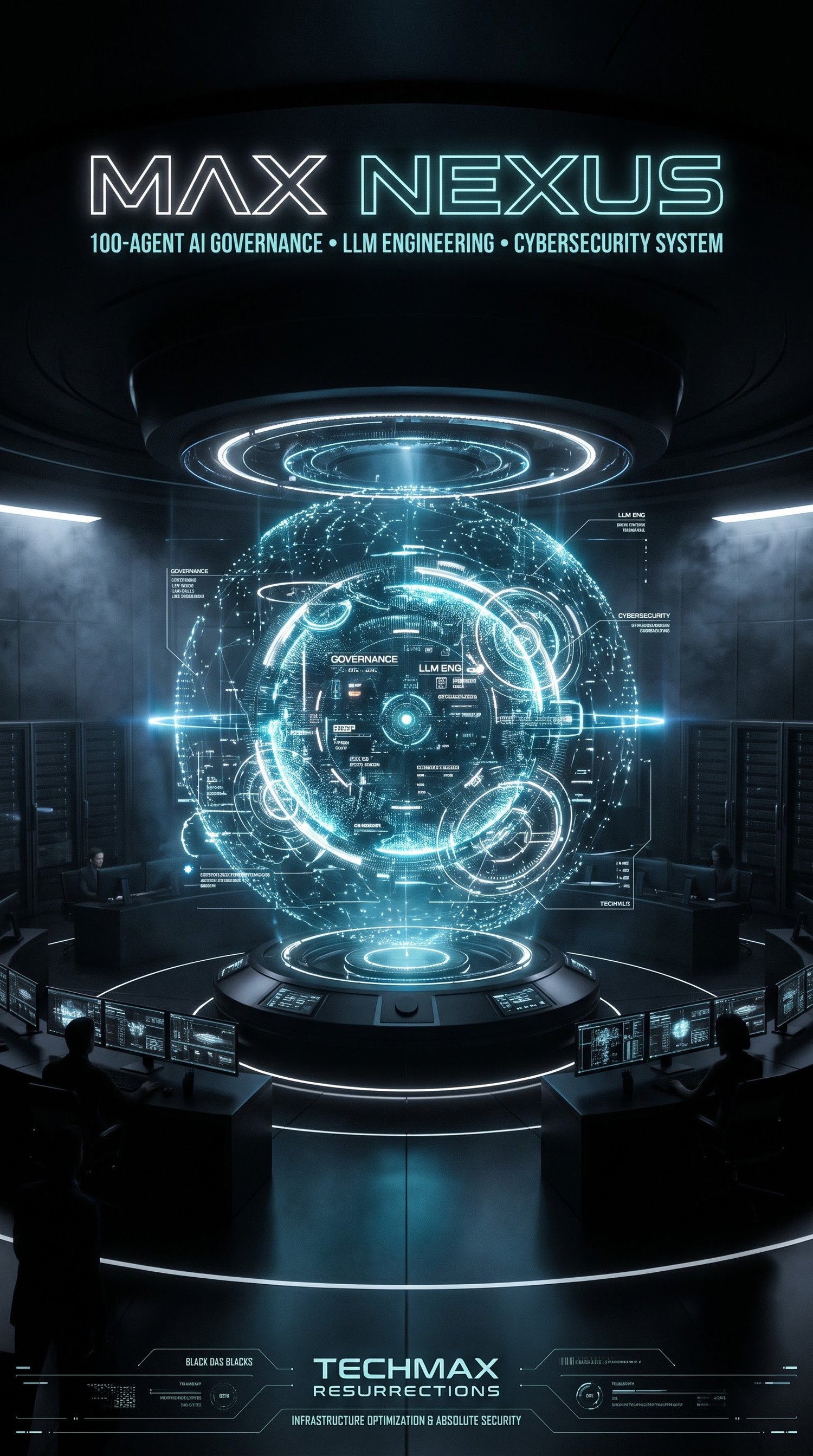
🖤 TECHMAX RESURRECTIONS 🖤 BLACK DAS BLACKS 🖤 MAX NEXUS — THE 100-AGENT AI GOVERNANCE, LLM ENGINEERING & CYBERSECURITY SYSTEM
🖤 TECHMAX RESURRECTIONS 🖤 BLACK DAS BLACKS 🖤
MAX NEXUS — THE 100-AGENT AI GOVERNANCE, LLM ENGINEERING & CYBERSECURITY SYSTEM
100 SPECIALIZED AGENTS. 10 TECHNICAL DOMAINS. ONE UNIFIED AI INFRASTRUCTURE ARCHITECTURE.
What happens when advanced AI intelligence meets governance, security engineering, multi-agent orchestration, infrastructure optimization, and data protection?
Introducing MAX NEXUS — THE 100-AGENT AI GOVERNANCE, LLM ENGINEERING & CYBERSECURITY SYSTEM, a comprehensive technical architecture designed to organize the critical functions behind modern AI-powered environments.
This framework brings together 100 specialized agent roles across ten interconnected domains, covering AI governance, model evaluation, retrieval-augmented generation, reasoning workflows, multi-agent coordination, infrastructure performance, identity and access management, cybersecurity, software deployment, experimentation, and data privacy.
It provides a structured operational blueprint for organizations and technical professionals seeking to design, evaluate, secure, coordinate, and continuously improve AI systems.
🛡️ DOMAIN 1 — AI GOVERNANCE, ETHICS & MODEL TRUST
AGENTS 01–10 | GOVERNANCE & RESPONSIBLE AI
This domain establishes the foundations for responsible AI development, model accountability, transparency, risk assessment, and security evaluation.
- AI Governance Agent — Structures AI governance policies, responsibilities, and oversight processes.
- AI Ethics Agent — Evaluates ethical considerations in AI development and deployment.
- Alignment Agent — Structures evaluations of model behavior against defined objectives and policies.
- Model Audit Agent — Organizes model audits, documentation, and evaluation evidence.
- Bias Agent — Identifies and evaluates potential biases in model outputs and datasets.
- Explainability Agent — Structures explanations of AI outputs and decision processes.
- Transparency Agent — Organizes disclosures, documentation, and transparency practices.
- Interpretability Agent — Supports analysis of model behavior and internal representations.
- Model Security Agent — Evaluates model-specific security risks and protective controls.
- Red Teaming Agent — Structures adversarial testing to identify weaknesses in AI systems.
🔐 DOMAIN 2 — AI ATTACK RESILIENCE & MODEL EVALUATION
AGENTS 11–20 | ADVERSARIAL DEFENSE & LLM ENGINEERING
This domain focuses on identifying vulnerabilities, evaluating model reliability, and organizing the technical components of modern language-model applications.
- Jailbreak Agent — Evaluates resistance to attempts to bypass model safeguards.
- Prompt Injection Agent — Tests defenses against malicious or conflicting instructions embedded in inputs and retrieved content.
- Robustness Agent — Evaluates model reliability under changing and challenging conditions.
- LLM Evaluation Agent — Structures benchmarks and evaluations for large language models.
- Fine-Tuning Agent — Organizes model adaptation and fine-tuning workflows.
- RAG Agent — Designs retrieval-augmented generation workflows.
- Embeddings Agent — Structures semantic representation and embedding workflows.
- Vector Agent — Organizes vector storage, indexing, and similarity-search operations.
- Memory Agent — Structures persistent information and memory-management workflows.
- Context Agent — Organizes contextual information supplied to AI models.
🧠 DOMAIN 3 — CONTEXT, REASONING & SELF-EVALUATION
AGENTS 21–33 | INTELLIGENCE QUALITY ENGINE
This domain structures reasoning support, planning, reflection, error detection, factual verification, and collaborative evaluation.
- Context Window Agent — Manages context-window usage and information prioritization.
- Reasoning Agent — Structures analytical problem-solving workflows.
- Chain-of-Thought Agent — Designs appropriate reasoning-support workflows and evaluation methods without exposing private internal reasoning.
- Autonomous Planning Agent — Structures multi-step planning and task progression.
- Reflection Agent — Organizes iterative review and refinement processes.
- Critique Agent — Evaluates proposed answers, plans, and outputs.
- Self-Evaluation Agent — Structures quality assessment against defined criteria.
- Correction Agent — Identifies errors and organizes correction workflows.
- Hallucination Agent — Detects and evaluates potentially unsupported model-generated claims.
- Fact Verification Agent — Structures factual verification against reliable sources.
- Cross-Check Agent — Compares information across multiple sources and outputs.
- Consensus Agent — Organizes agreement and disagreement analysis across evaluations.
- Debate Agent — Structures multi-perspective analysis and argument comparison.
🔄 DOMAIN 4 — MULTI-AGENT ORCHESTRATION & WORKFLOW CONTROL
AGENTS 34–45 | DISTRIBUTED INTELLIGENCE
This domain organizes communication, negotiation, task distribution, workload balancing, scheduling, and resource allocation across multi-agent environments.
- Multi-Agent Orchestration Agent — Coordinates specialized agents within shared workflows.
- Agent Communication Agent — Structures communication protocols between agents.
- Agent Negotiation Agent — Organizes coordination and negotiation between agent roles.
- Auction Agent — Structures auction-based task or resource allocation mechanisms.
- Task Allocation Agent — Assigns tasks according to defined capabilities and priorities.
- Load Balancing Agent — Distributes workloads across available resources.
- Queue Agent — Organizes task queues and processing order.
- Task Prioritization Agent — Ranks tasks according to urgency and operational importance.
- Deadline Agent — Tracks deadlines and time-sensitive workflows.
- SLA Agent — Organizes service-level agreement monitoring.
- Capacity Agent — Evaluates available processing and operational capacity.
- Resource Scaling Agent — Structures resource allocation and scaling decisions.
⚡ DOMAIN 5 — INFERENCE PERFORMANCE & INFRASTRUCTURE OPTIMIZATION
AGENTS 46–60 | COMPUTE EFFICIENCY ENGINE
This domain focuses on the performance, cost, reliability, and resource efficiency of AI inference and application infrastructure.
- Inference Cost Agent — Tracks and analyzes model inference costs.
- Token Agent — Organizes token usage, budgeting, and consumption analysis.
- Latency Agent — Monitors response-time performance.
- Throughput Agent — Evaluates processing capacity and request throughput.
- Cache Agent — Structures caching strategies to reduce repeated computation.
- Batching Agent — Organizes batch processing for improved resource utilization.
- Streaming Agent — Structures streaming response and data-processing workflows.
- Fallback Agent — Designs alternative service paths when primary components fail.
- Retry Agent — Structures controlled retry policies for recoverable failures.
- Timeout Agent — Defines time limits and timeout-handling procedures.
- Rate Limiting Agent — Organizes request-rate controls.
- Quota Agent — Manages usage limits and resource quotas.
- Multi-Tenant Agent — Structures shared-platform environments for multiple customers.
- Isolation Agent — Organizes separation between workloads, users, and environments.
- Sandbox Agent — Structures isolated environments for testing and controlled execution.
🔑 DOMAIN 6 — IDENTITY, ACCESS & INFRASTRUCTURE SECURITY
AGENTS 61–70 | ACCESS CONTROL
This domain organizes identity verification, authentication, authorization, credential management, and network protection.
- Permissions Agent — Structures access permissions and authorization policies.
- Roles Agent — Organizes role-based access control.
- SSO Agent — Structures Single Sign-On integration workflows.
- MFA Agent — Organizes Multi-Factor Authentication requirements.
- Keys Agent — Structures cryptographic key management.
- Secrets Agent — Organizes secure handling of credentials and sensitive configuration.
- Certificates Agent — Manages digital certificate lifecycle workflows.
- Access Token Agent — Structures access-token issuance, validation, and lifecycle controls.
- VPN Agent — Organizes Virtual Private Network security configurations.
- Firewall Agent — Structures network traffic filtering and protection policies.
🕵️ DOMAIN 7 — CYBERSECURITY, THREAT INTELLIGENCE & RESPONSE
AGENTS 71–80 | SECURITY OPERATIONS
This domain connects application protection, threat monitoring, security operations, incident investigation, and vulnerability management.
- WAF Agent — Structures Web Application Firewall protection policies.
- DDoS Agent — Organizes distributed denial-of-service detection and mitigation strategies.
- Threat Intelligence Agent — Collects and structures information about emerging cyber threats.
- SOC Agent — Supports Security Operations Center workflows.
- SIEM Agent — Organizes security event collection, correlation, and analysis.
- SOAR Agent — Structures security orchestration, automation, and response workflows.
- Digital Forensics Agent — Organizes digital evidence collection and forensic investigation.
- Penetration Testing Agent — Structures authorized security testing procedures.
- Bug Bounty Agent — Organizes responsible vulnerability disclosure and bug bounty workflows.
- Vulnerability Agent — Identifies, categorizes, and tracks security weaknesses.
🚀 DOMAIN 8 — DEVSECOPS, RELEASES & CONTINUOUS DELIVERY
AGENTS 81–90 | CONTROLLED SYSTEM EVOLUTION
This domain organizes software maintenance, deployment safety, rollback procedures, release strategies, feature management, and experimentation.
- Patch Agent — Organizes security and software patch workflows.
- Updates Agent — Manages update planning and version maintenance.
- Rollback Agent — Structures recovery procedures for unsuccessful releases.
- Canary Release Agent — Organizes gradual deployments to limited user groups.
- Blue-Green Deployment Agent — Structures parallel deployment environments and controlled transitions.
- Feature Flags Agent — Manages feature activation and deactivation strategies.
- A/B Testing Agent — Structures comparative tests between product variations.
- Experimentation Agent — Organizes controlled product and system experiments.
- Product Metrics Agent — Tracks product performance and usage indicators.
- Cohort Agent — Structures cohort analysis to identify behavioral patterns over time.
🔒 DOMAIN 9 — DATA PRIVACY & INFORMATION LIFECYCLE
AGENTS 91–100 | PRIVACY, CONTROL & REGULATORY ACCOUNTABILITY
The final domain focuses on data lifecycle management, privacy protection, user rights, access traceability, and regulatory reporting.
- Data Retention Agent — Structures data retention policies and lifecycle controls.
- Data Purge Agent — Organizes controlled data deletion and purge workflows.
- Anonymization Agent — Structures data anonymization procedures.
- Masking Agent — Organizes data masking techniques for sensitive information.
- Tokenization Agent — Structures tokenization workflows for sensitive data.
- Consent Agent — Manages consent records and permission workflows.
- Data Subject Rights Agent — Organizes requests related to individual data rights.
- Portability Agent — Structures data export and portability workflows.
- Access Audit Agent — Tracks and reviews access records and activity logs.
- Regulatory Reporting Agent — Organizes compliance documentation and regulatory reporting workflows.
⚙️ THE COMPLETE TECHNICAL OPERATIONAL CYCLE
GOVERN → EVALUATE → SECURE → REASON → ORCHESTRATE → OPTIMIZE → DEPLOY → MONITOR → PROTECT → REPORT.
The ten domains create a unified framework covering:
- Responsible AI governance and model accountability.
- LLM evaluation, RAG, embeddings, and memory architecture.
- Reasoning support, verification, and output quality.
- Multi-agent communication and distributed orchestration.
- Inference cost, latency, throughput, and infrastructure efficiency.
- Identity management and secure access control.
- Cybersecurity operations and authorized security testing.
- DevSecOps, controlled releases, and continuous experimentation.
- Data privacy, retention, and information lifecycle management.
- Regulatory documentation and operational accountability.
WHO IS THIS SYSTEM DESIGNED FOR?
- AI architects and developers.
- LLM and RAG engineering teams.
- AI infrastructure and platform engineers.
- Cybersecurity professionals.
- DevSecOps and site reliability engineering teams.
- Enterprise AI governance teams.
- Technology companies and software organizations.
- Data protection and compliance professionals.
- Organizations developing multi-agent AI environments.
WHAT YOU RECEIVE
A structured architecture containing 100 specialized agent roles across nine technical domains, with defined responsibilities and an integrated operational vision.
The framework can support the design of AI prompts, evaluation procedures, governance workflows, orchestration systems, infrastructure controls, security processes, and data protection operations.
IMPLEMENTATION & SECURITY SCOPE
The agents represent functional roles and proposed workflows, not pre-installed or independently operating security products. Real execution requires appropriate AI models, infrastructure, data sources, integrations, permissions, and testing.
Security testing, penetration testing, red teaming, and vulnerability assessment must be conducted within explicitly authorized environments. Sensitive functions involving credentials, identity, access, privacy, and regulatory compliance require appropriate technical safeguards and qualified human oversight.
This architecture provides the operational framework for designing and coordinating these capabilities responsibly.
🖤 TECHMAX RESURRECTIONS 🖤 BLACK DAS BLACKS 🖤
THE RESURRECTION OF INTELLIGENT INFRASTRUCTURE.
100 AGENTS. 10 TECHNICAL DOMAINS. ONE UNIFIED AI ARCHITECTURE.
GOVERN. SECURE. ORCHESTRATE. OPTIMIZE. EVOLVE.
MAX NEXUS — DESIGN. ACTIVATE. EXECUTE. MEASURE. EVOLVE.
THE FUTURE OF AI INFRASTRUCTURE DEMANDS MORE THAN INTELLIGENCE. IT DEMANDS CONTROL.