

Capricho Maracatu (solo violin)
Maracatu is a popular Brazilian manifestation that involves dance and music. Its origin dates back to colonial Brazil and consists of a mixture of African, Portuguese and indigenous cultures. Therefore, it is a genuinely Brazilian expression and it was created in the state of Pernambuco, present mainly in the cities of Olinda, Recife and Nazaré da Mata. There are two types, depending on the rhythm: Maracatu Nação (Baque Virado) and Maracatu Rural (Baque Solto). The first, quite common in the metropolitan region of Recife, is considered the oldest Afro-Brazilian rhythm; and the second is characteristic of the city of Nazaré da Mata (Zona da Mata Norte of Pernambuco). The oldest record of Maracatu Nação dates back to 1711, although its origin is uncertain. Maracatu Baque Virado is characterized by the predominant use of instruments of African origin. In percussion, the big drums stand out, called alfaias, which provide the rhythm – the baque of the music – and are accompanied by snares or taróis, ganzás, abês and a gonguê or agogô. The maracatu rhythm was used by composers such as Gilberto Gil and Caetano Veloso in their songs, and adapted in an innovative way by Egberto Gismonti.
.
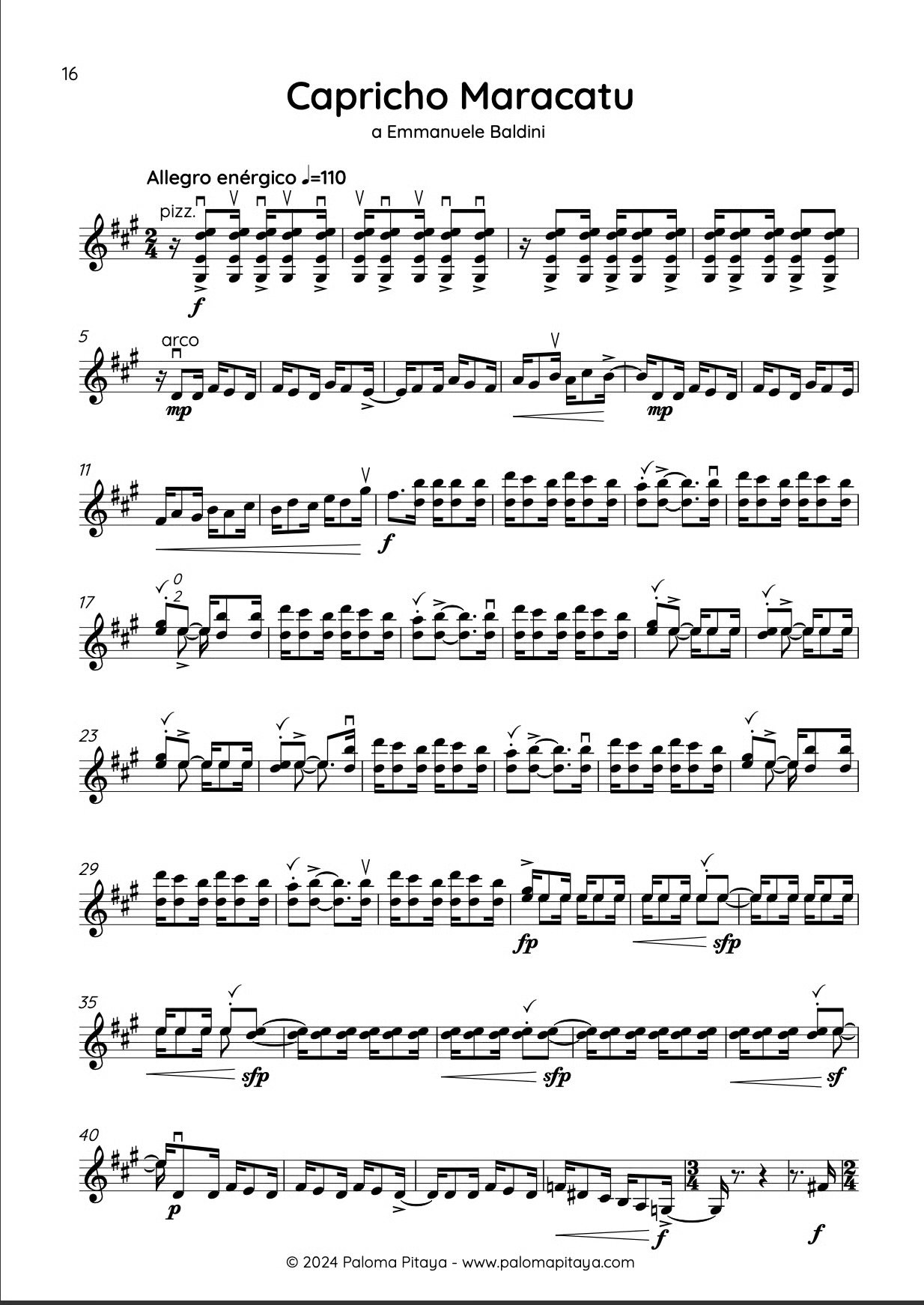
This piece is a part of 13 Caprichos Brasileiros para Violino, and proposes a fusion between traditional Brazilian music and the classical canon of works for solo violin. It can be played solo or accompanied, depending on the desire and creativity of each performer who wishes to play them.