
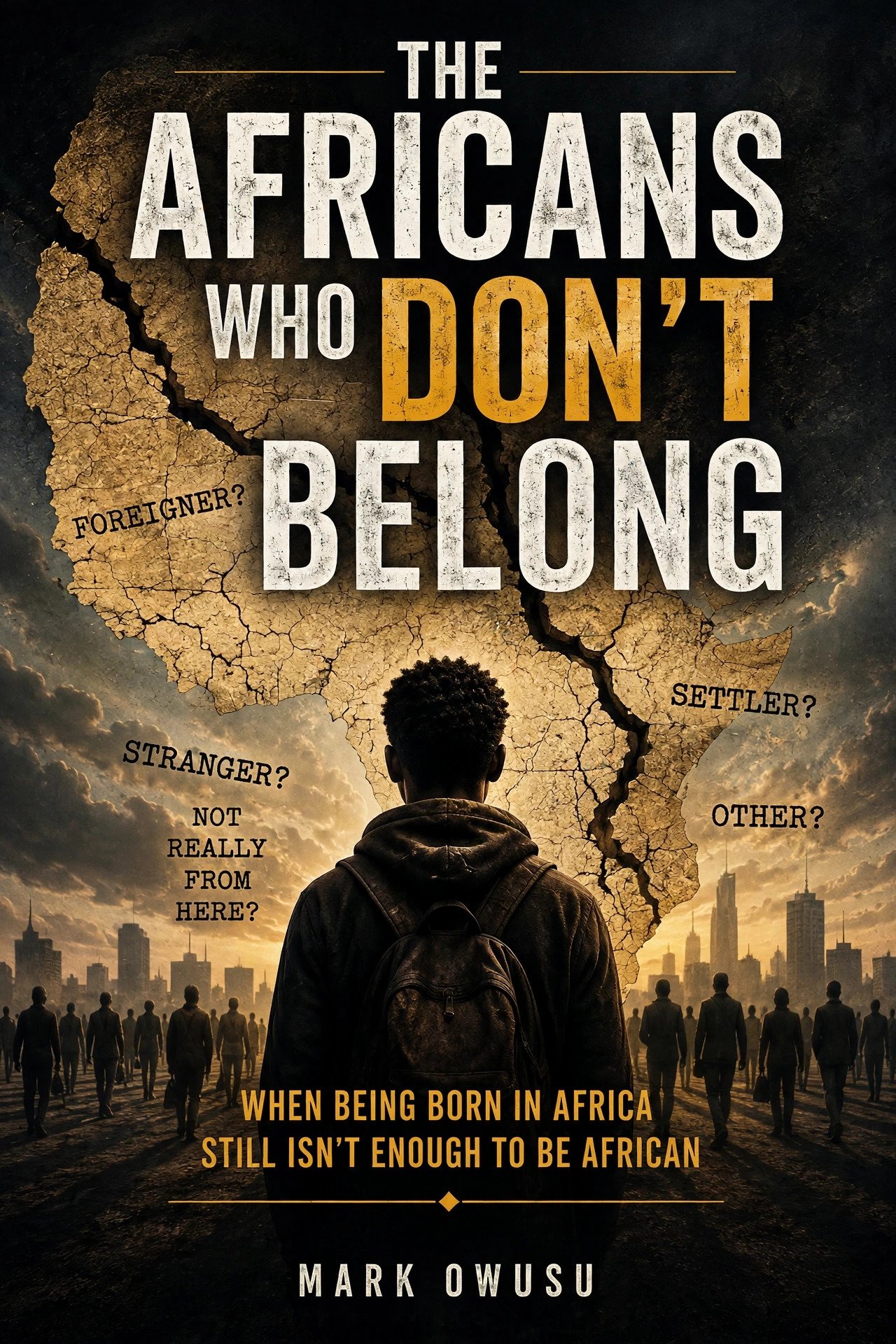
The Africans Who Don’t Belong : When Being Born in Africa Still Isn’t Enough to Be African
Ibrahim was born in Kumasi. He went to primary school in Kumasi. His accent, his friends, his favorite food — all Kumasi. But his father’s family name traces to northern Ghana, and that is enough for a landlord to refuse him a room in the only city he has ever called home.
His story is not unusual. Across the African continent, there are people who can say, without exaggeration, that they have lived their entire lives in one country and are still treated as foreigners in it. They are not refugees. They are not undocumented migrants. They are citizens on paper, outsiders in practice — and the line that excludes them is rarely written into any law.
The Africans Who Don’t Belong is a narrative-driven, intellectually rigorous exploration of that contradiction. Written by Mark Owusu and published under the Africa Unfiltered platform, the book moves in four parts:
Part I opens with the contradiction itself — the gap between legal citizenship and social belonging — and examines the stories, stereotypes, and unspoken rules that keep that gap in place.
Part II traces the gap to its roots: the colonial borders that split single ethnic groups across multiple countries, the “native/subject/stranger” categories the British, French, and Portuguese empires built into their administrations, and the modern crisis of statelessness that resulted.
Part III introduces the book’s central framework, the Identity Ledger — seven recurring “line items” (ethnicity, nation and citizenship, color and phenotype, class and education, language and accent, religion and moral belonging, and migration and arrival) that this book argues quietly determine how “African” a person is allowed to be, regardless of what their passport says.
Part IV turns from diagnosis to agency: how ordinary people reproduce these boundaries without meaning to, and how mixed marriages, cultural movements, institutional reform, and simple everyday choices can loosen them.
Along the way, the book reaches across the continent — from Côte d’Ivoire’s ivoirité crisis to Rwanda’s ethnic identity cards, from the Hausa and Yoruba peoples split by colonial borders to the accent premiums paid by returning diaspora professionals, from skin-tone bias in advertising to the citizenship gaps facing stateless communities in Kenya and the DRC.
This edition includes a glossary of key terms, a discussion guide for book clubs and classrooms, a quick-reference checklist of the Identity Ledger’s seven line items, and notes for readers who want to explore the source material further.
The Africans Who Don’t Belong does not offer a five-step plan to end exclusion — no honest book could. What it offers is a vocabulary: a way to name a pattern that millions of readers will recognize immediately, sometimes with discomfort, from their own lives. Naming is not the end of the work. But it is a necessary beginning.