
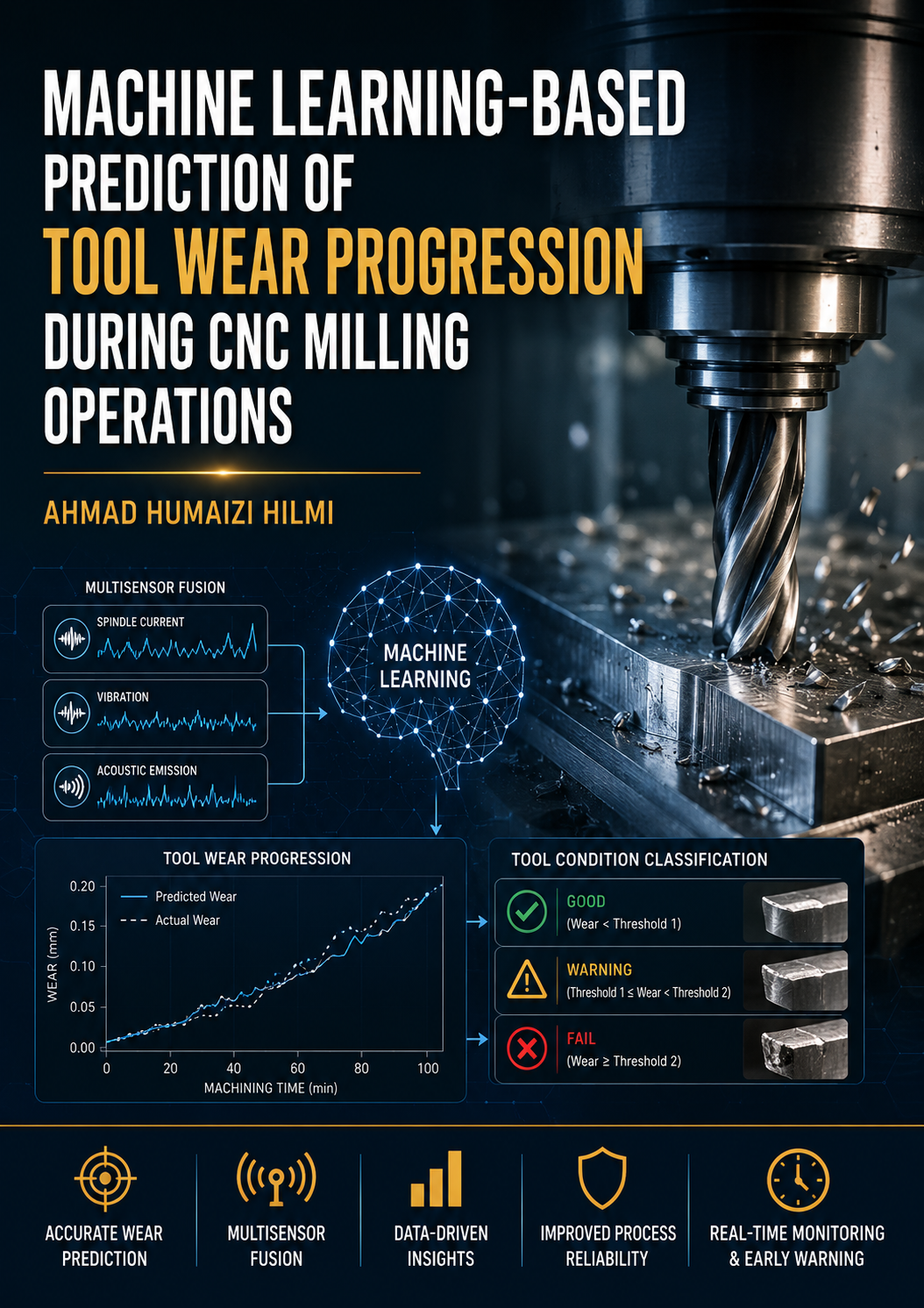
Machine Learning-Based Prediction of Tool Wear Progression During CNC Milling Operations
This review synthesises experimental and data-driven approaches for predicting tool wear in CNC milling, with the aim of identifying best practices for experimental design, dataset preparation, and machine-learning deployment. It surveys mechanistic wear modes across materials and scales, including abrasive and adhesive wear, edge rounding, and chip-crowding effects, and contrasts direct optical ground truth with continuous indirect sensors such as spindle current, vibration, and acoustic emission. The review evaluates feature engineering and representation choices, and compares model families: tree-ensemble and gradient-boosting methods provide robust baselines and interpretability, while convolutional and recurrent neural networks excel on spectrogram and sequential data when large annotated datasets are available. Cross-cutting recommendations emphasise multisensor fusion, inclusion of cutting-condition context, machining-case partitioning to avoid data leakage, and combined periodic on-machine geometric checks (for example laser tool setters) with continuous monitoring for label generation. Reported results show that contextualised multisensor models tend to improve classification and regression accuracy and that ensembles increase robustness to noise and drift. The review concludes with practical constraints for industrial adoption and research priorities to standardise datasets, report latency metrics, and validate lightweight on-machine inference.