
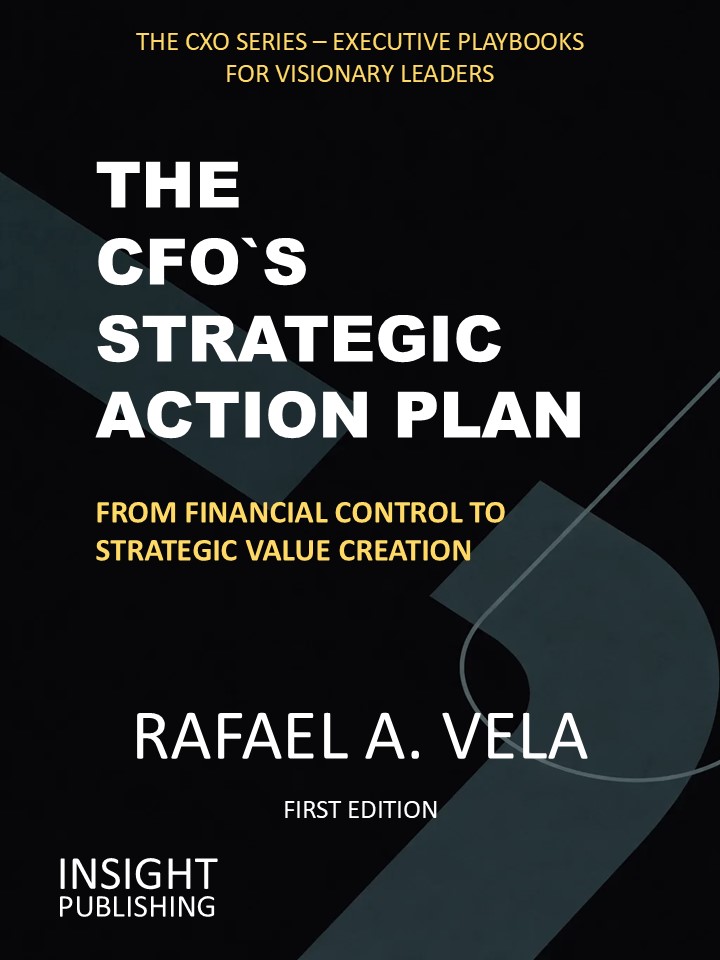
The CFO`s Strategic Action Plan - From Financial Control to Strategic Value Creation
The role of the CFO has outgrown financial control. Today’s CFO is no longer defined by reporting accuracy alone, but by the ability to shape strategy, allocate capital wisely, and influence enterprise-wide decisions.
This book addresses the shift from finance as a control function to finance as a source of strategic value. It explores how CFOs move beyond stewardship into active partnership with the executive team, balancing discipline with ambition, risk with opportunity, and precision with speed.
It examines the real tensions CFOs face: protecting the organization while enabling growth, enforcing governance without slowing execution, and translating financial insight into decisions that matter. The focus is not theory, but executive judgment applied under pressure.
Written for CFOs, CEOs, senior finance leaders, and board members, this book speaks to those operating where financial decisions shape strategic direction and long-term resilience.
There is no technical accounting instruction and no abstract finance models. Only clear executive logic, decision-oriented thinking, and a realistic view of how finance creates value at the top of the organization.
The CFO’s Strategic Action Plan is part of the CXO Series, a collection of executive literature focused on judgment, authority, risk, and decision architecture.
Strong CFOs do more than control numbers. They shape outcomes.
TABLE OF CONTENTS
Part I – The CFO as Architect and Guardian of Enterprise Value
Chapter 1 – Redefining the Role of the Modern CFO - 21
• From Financial Controller to Strategic Enterprise Leader - 21
• The CFO as Steward of Capital, Risk, and Credibility - 23
• Connecting Strategy, Financial Decisions, and Value Outcomes - 25
• Leading Finance Through Volatility, Complexity, and Scrutiny - 27
Chapter 2 – Crafting the Financial Vision and Strategic Narrative - 29
• Translating Corporate Strategy into Financial Priorities - 29
• Defining a Clear Value Narrative Beyond Earnings - 31
• Aligning Executives Around Financial Trade-Offs and Constraints - 32
• Using Financial Storytelling to Build Trust and Influence - 33
Chapter 3 – The Onboarding Blueprint: Seeing Before Acting - 37
• The CFO’s First Imperative: Understanding Performance, Risk, and Cash - 38
• Phase One – The First Month: Assess Financial Health and Governance - 42
• Phase Two – The First Three Months: Diagnose Cost, Capital, and Controls - 46
• Phase Three – The First Six Months: Clarify Priorities and Early Interventions - 51
• Phase Four – The First Year: Embed Discipline and Strategic Direction - 54
• Establishing Credibility with the Board, CEO, and Leadership Team - 58
Chapter 4 – Financial Risk, Resilience, and Scenario Intelligence - 63
• Identifying Financial, Operational, and Strategic Risk Exposure - 63
• Liquidity, Solvency, and Capital Structure Resilience - 65
• Scenario Planning, Stress Testing, and Uncertainty Management - 66
• Turning Risk Awareness into Strategic Optionality - 67
Chapter 5 – Designing the Finance Operating Model for Scale and Control - 71
• Linking Strategy, Structure, and Decision Authority - 72
• Centralized, Decentralized, and Hybrid Finance Models - 73
• Governance as an Enabler of Speed, Transparency, and Trust - 74
• Clarifying Accountability, Escalation, and Financial Ownership - 75
Part II – From Strategy to Structure
Chapter 6 – Aligning Financial Strategy, Structure, and Culture - 79
• The Strategic Alignment Triangle in Finance - 79
• Cascading Financial Priorities Across the Enterprise - 83
• Embedding Financial Discipline into Daily Decisions - 86
• Reinforcing Accountability Without Creating Bureaucracy - 90
Chapter 7 – Orchestrating the Executive and Functional Coalition - 95
• The CFO as Integrator Across the Enterprise - 95
• Partnering with the CEO, COO, CPO, CSCO, CHRO, and CIO - 100
• Aligning Finance with Operations, Supply Chain, and Commercial Strategy - 103
• Managing Trade-Offs Between Growth, Risk, and Return - 104
Chapter 8 – The CFO and the Board - 107
• Elevating Finance to Board-Level Strategic Dialogue - 107
• Communicating Performance, Risk, and Capital Allocation - 108
• Governance, Ethics, and Fiduciary Expectations - 112
• Long-Term Stewardship of Enterprise Value - 113
Part III – Execution and Value Creation
Chapter 9 – Turning Financial Strategy into Measurable Action - 117
• Translating Strategic Intent into Financial Roadmaps - 117
• Driving Execution Discipline Across Planning and Forecasting - 121
• Balancing Short-Term Performance with Long-Term Value - 124
• Decision Governance in High-Uncertainty Environments - 128
Chapter 10 – Digital Finance and Intelligent Decision-Making - 133
• Technology as a Force Multiplier for Financial Leadership - 133
• Data, Analytics, and Predictive Financial Insight - 137
• Automation, AI, and the Role of Human Judgment - 138
• Avoiding Complexity, Fragmentation, and Tool Fatigue - 139
Chapter 11 – Capital Stewardship and Enterprise Value Creation - 141
• Beyond Earnings: Cash Flow, Capital Efficiency, and Risk Protection - 141
• Capital Allocation, Investment Discipline, and Portfolio Thinking - 145
• Working Capital as a Strategic Lever - 148
• Creating Durable Value Through Financial Clarity152
Part IV – Leading People, Culture, and Ethics
Chapter 12 – Culture as the CFO’s Invisible Control System - 155
• Financial Culture as a Driver of Behavior and Outcomes - 155
• Embedding Integrity into Financial Decisions - 160
• Building Trust Across the Organization - 163
• Shaping Ethical Reflexes, Not Just Controls - 164
Chapter 13 – Finance Talent and Leadership Development - 167
• Redefining Finance Skills for a Strategic Future - 167
• Developing Analytical, Commercial, and Strategic Capability - 168
• Building Career Paths That Attract and Retain Talent - 169
• Creating a Legacy of Financial Leadership Excellence - 172
Chapter 14 – Ethics, Compliance, and Responsible Financial Leadership - 175
• Governance as a Strategic Responsibility - 175
• Transparency, Accountability, and Financial Integrity - 179
• Balancing Performance Pressure with Ethical Standards - 180
• Trust as a Source of Long-Term Advantage - 181
Part V – The CFO’s Dashboard
Chapter 15 – Measuring What Truly Matters in Finance - 183
• Designing the CFO’s Enterprise Value Scorecard - 183
• Leading and Lagging Indicators Beyond Financial Statements - 187
• Metrics for Risk, Resilience, Liquidity, and Value Creation - 191
• Using Metrics as a Leadership Tool, Not a Control Mechanism - 194
Chapter 16 – Sustaining Momentum and Institutionalizing Excellence - 199
• Embedding Continuous Improvement in Finance - 199
• Assessing Finance Maturity Over Time - 203
• Moving from Annual Cycles to Dynamic Financial Management - 207
• Reflecting on the Practice of Strategic Financial Leadership - 207
Conclusion – Financial Leadership as Enterprise Stewardship - 209
• Appendix A – CFO Onboarding and Enterprise Financial Assessment Framework - 213
• Appendix B – CFO Strategic Action Plan Template - 218
• Appendix C – Enterprise Financial Value and KPI Framework - 224
• Appendix D – Financial Risk and Scenario Assessment Toolkit - 230
• Appendix E – CFO Strategic Self-Assessment Framework - 237
• Appendix F – Glossary of Key Financial and Strategic Terms - 243
• Appendix G – Organizational Culture Risk Map - 250