
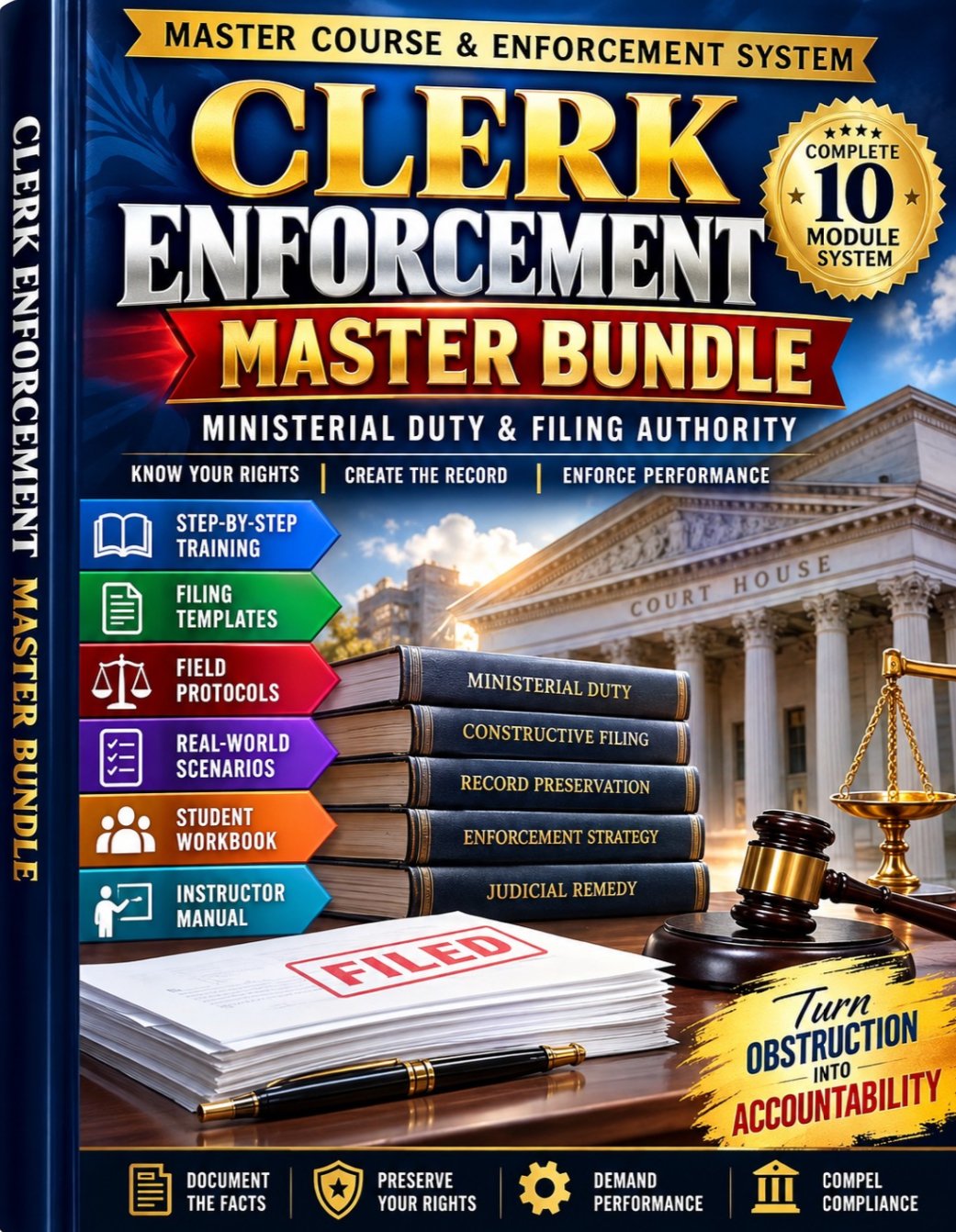
CLERK ENFORCEMENT MASTER MANUAL
🚨 WHEN A CLERK REFUSES YOUR FILING — DO YOU KNOW WHAT TO DO NEXT?
A filing problem can become a serious problem when deadlines, court records, evidence, or your ability to be heard are at stake.
The CLERK ENFORCEMENT MASTER MANUAL was created to help you understand the filing process, document problems correctly, identify the governing authority, and determine the proper next step when a filing is rejected, delayed, mishandled, or disputed.
📚 INSIDE THE MANUAL:
⚖️ Understand the clerk’s administrative and ministerial role
⚖️ Learn the difference between ministerial duties and discretionary or judicial decisions
⚖️ Understand what “filed” actually means — including presentation, receipt, acceptance, filing, and docketing
⚖️ Learn how to research the statute, court rule, local rule, standing order, or filing requirement that actually controls
⚖️ Know what to do during the FIRST 60 SECONDS of a filing refusal
⚖️ Learn how to preserve evidence of an attempted filing or rejection
⚖️ Build a clear chronology and supporting record
⚖️ Learn administrative cure and escalation procedures
⚖️ Understand filing-date and deadline issues
⚖️ Learn when a filing dispute may need to be placed before a judge
⚖️ Understand the basic framework surrounding mandamus and other judicial remedies
🆕 REMOTE ONLINE NOTARY REFUSALS
What happens when a document was legally notarized remotely or electronically — but the clerk says:
“We don’t accept online notarizations.”
The manual now includes a dedicated Remote Online Notarization (RON) section explaining how to:
🔹 Identify exactly WHY the document is being rejected
🔹 Research the applicable remote-notary law
🔹 Separate the validity of the notarization from separate filing or recording requirements
🔹 Ask the clerk for the specific authority supporting the refusal
🔹 Preserve the rejection and supporting evidence
🔹 Correct a legitimate technical defect
🔹 Determine the appropriate escalation or review process
It even includes language you can use at the counter to professionally request the authority behind a refusal.
📑 PLUS:
✔️ Filing Attempt Log
✔️ Authority Research Worksheet
✔️ Pre-Filing Checklist
✔️ Practical decision tree
✔️ Real-world filing scenarios
✔️ Evidence-preservation guidance
✔️ Adaptable declarations, notices and court forms
✔️ Quick-reference material
✔️ Module mastery checks
The purpose isn’t to argue with a clerk.
The purpose is to know the difference between a legitimate filing requirement and a disputed refusal — and to CREATE THE RECORD when something goes wrong.
The method throughout the manual is simple:
🔥 FACTS FIRST.
🔥 AUTHORITY SECOND.
🔥 REMEDY THIRD.
Stop relying on assumptions.
Know what happened.
Find the authority.
Preserve the evidence.
Then determine the proper remedy.
📕 CLERK ENFORCEMENT MASTER MANUAL
By Michele DeVito
Educational and self-study resource. Filing requirements, procedures and remedies vary by jurisdiction and must be verified against current governing authority.
#ClerkEnforcement #CourtFilings #KnowYourRights #LegalEducation #WeRThePeople