
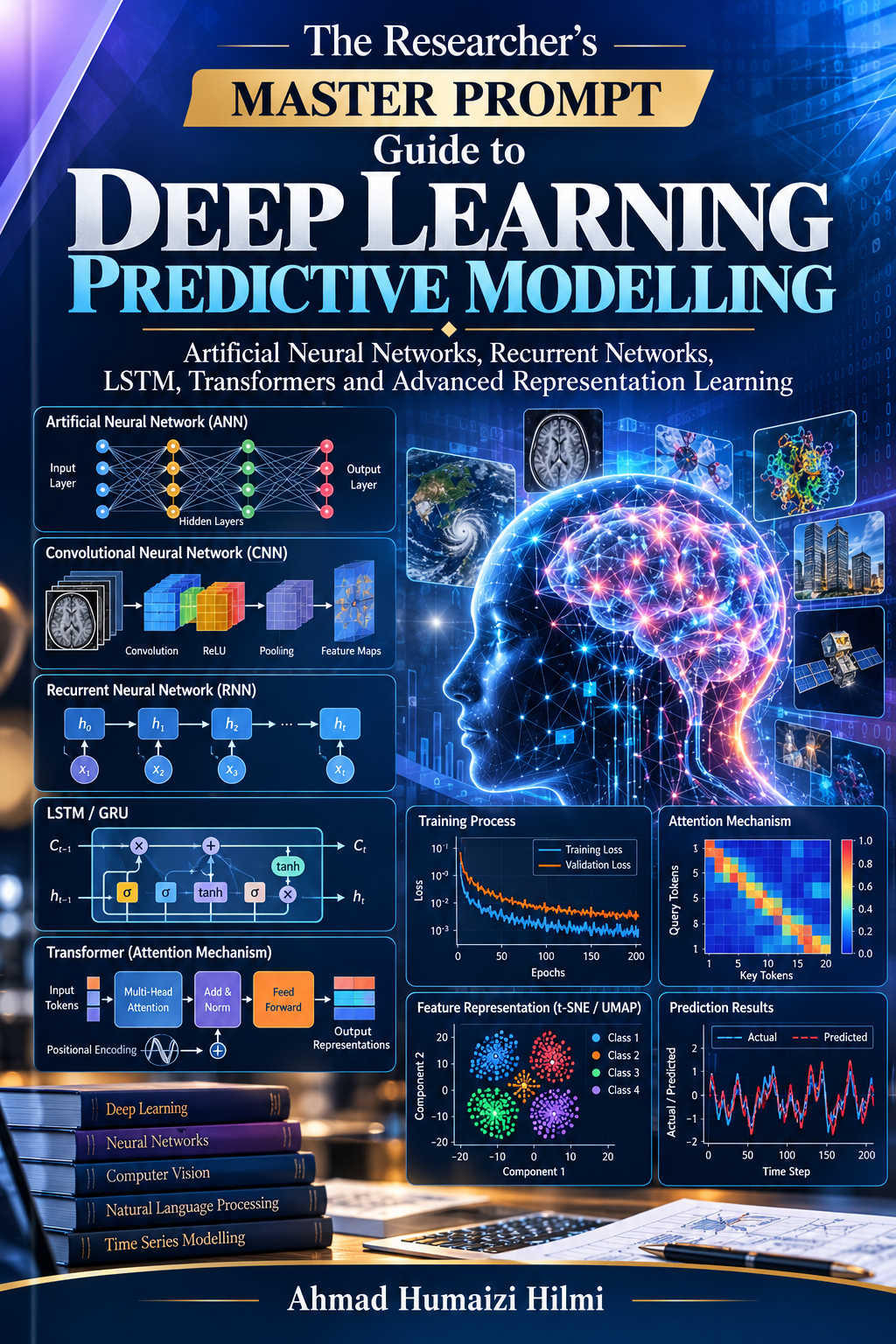
4. PM-DL-004 — Deep Learning Predictive Modelling, Artificial Neural Networks, Recurrent Networks, LSTM, Transformers and Advanced Representation Learning
Description
This Master Prompt addresses advanced predictive modelling using deep learning architectures capable of learning complex nonlinear relationships, hierarchical representations, temporal dependencies, spatial patterns and high-dimensional interactions from structured and unstructured datasets. It guides researchers through artificial neural networks, multilayer perceptrons, convolutional neural networks, recurrent neural networks, long short-term memory networks, gated recurrent units, attention mechanisms, transformer architectures, neural processes, pretrained models and foundation-model-based predictive approaches. The theme examines network architecture selection, activation functions, loss functions, optimization algorithms, learning-rate scheduling, regularization, dropout, batch normalization, early stopping, transfer learning and computational resource requirements. Researchers are guided in modelling complex dynamic systems, oscillatory responses, thermal decomposition, biomedical images, molecular and protein information, clinical outcomes and engineering performance. Particular emphasis is placed on the use of LSTM and attention-based architectures for sequential prediction, transformer regression for complex material behaviour, pretrained representations for biological prediction and multimodal neural architectures for integrated datasets. The theme also addresses architecture benchmarking, ablation studies, training stability, generalization, data sufficiency, explainability, uncertainty, reproducibility and deployment considerations. It provides a structured foundation for developing, comparing and validating deep learning predictive models while ensuring that architectural complexity is justified by the research problem and available evidence.