
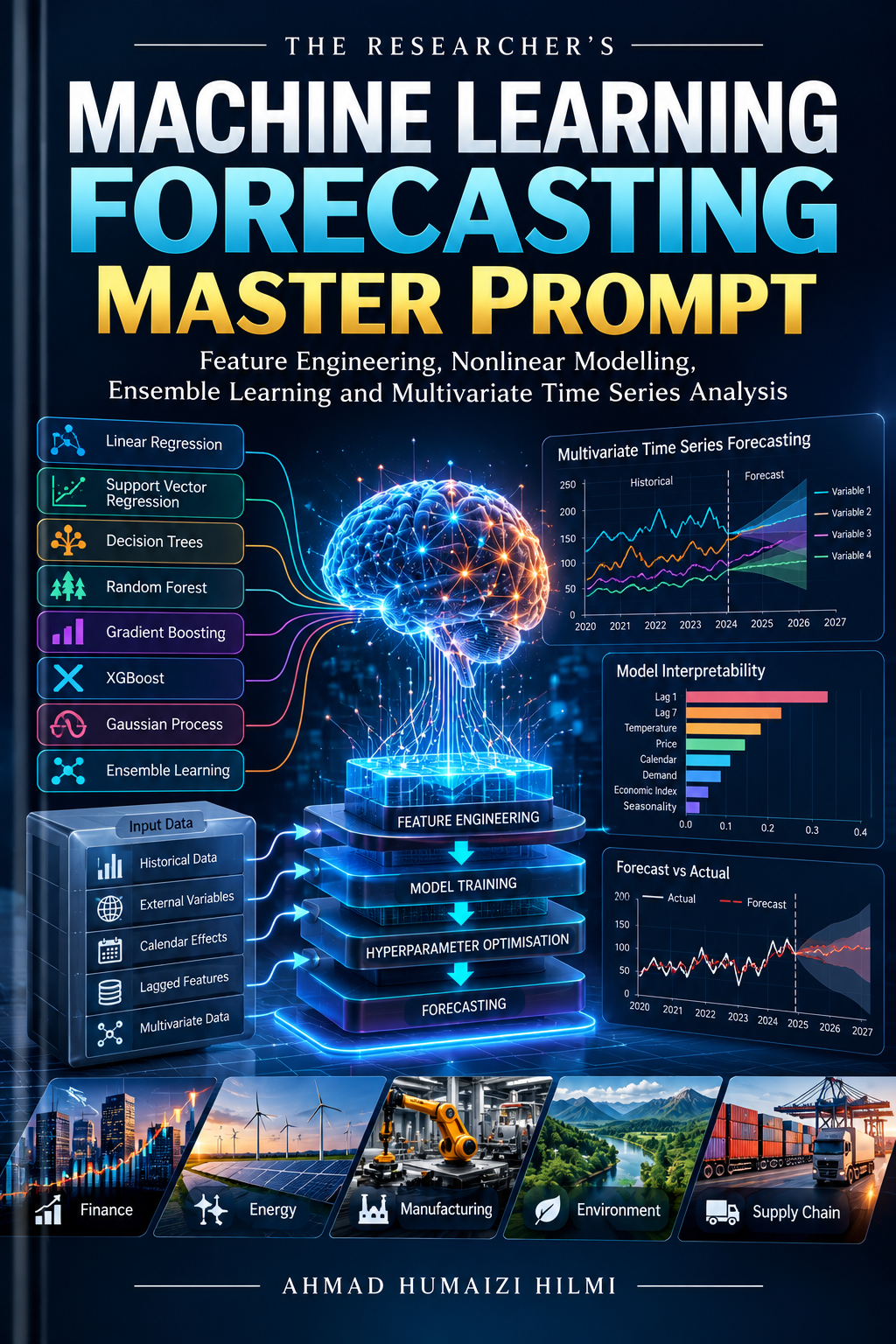
3. FOR-MLR-003 — Machine Learning Forecasting, Feature Engineering, Nonlinear Modelling, Ensemble Learning and Multivariate Time Series Analysis
Description
This Master Prompt explores the development and application of machine learning methodologies for forecasting complex, nonlinear, high-dimensional, and multivariate time-dependent systems. It encompasses linear and regularised regression, support vector regression, decision trees, random forests, gradient boosting, extreme gradient boosting, kernel-based learning, Gaussian processes, and other supervised learning techniques adapted to temporal forecasting. The theme investigates lagged-variable construction, rolling-window features, calendar effects, external explanatory variables, leading indicators, feature selection, dimensionality reduction, hyperparameter optimisation, and nonlinear interaction modelling. It further addresses direct, recursive, multi-output, and hybrid multi-step forecasting strategies; ensemble construction; forecast combination; model interpretability; leakage prevention; temporal cross-validation; and robustness under changing data distributions. Applications include financial markets, commodity prices, electricity demand, industrial production, inventory requirements, environmental indicators, and other forecasting problems where nonlinear dependencies and heterogeneous information sources influence future outcomes