






Literature Review Synthesis & Research Gap Toolkit
Literature Review Synthesis & Research Gap Toolkit
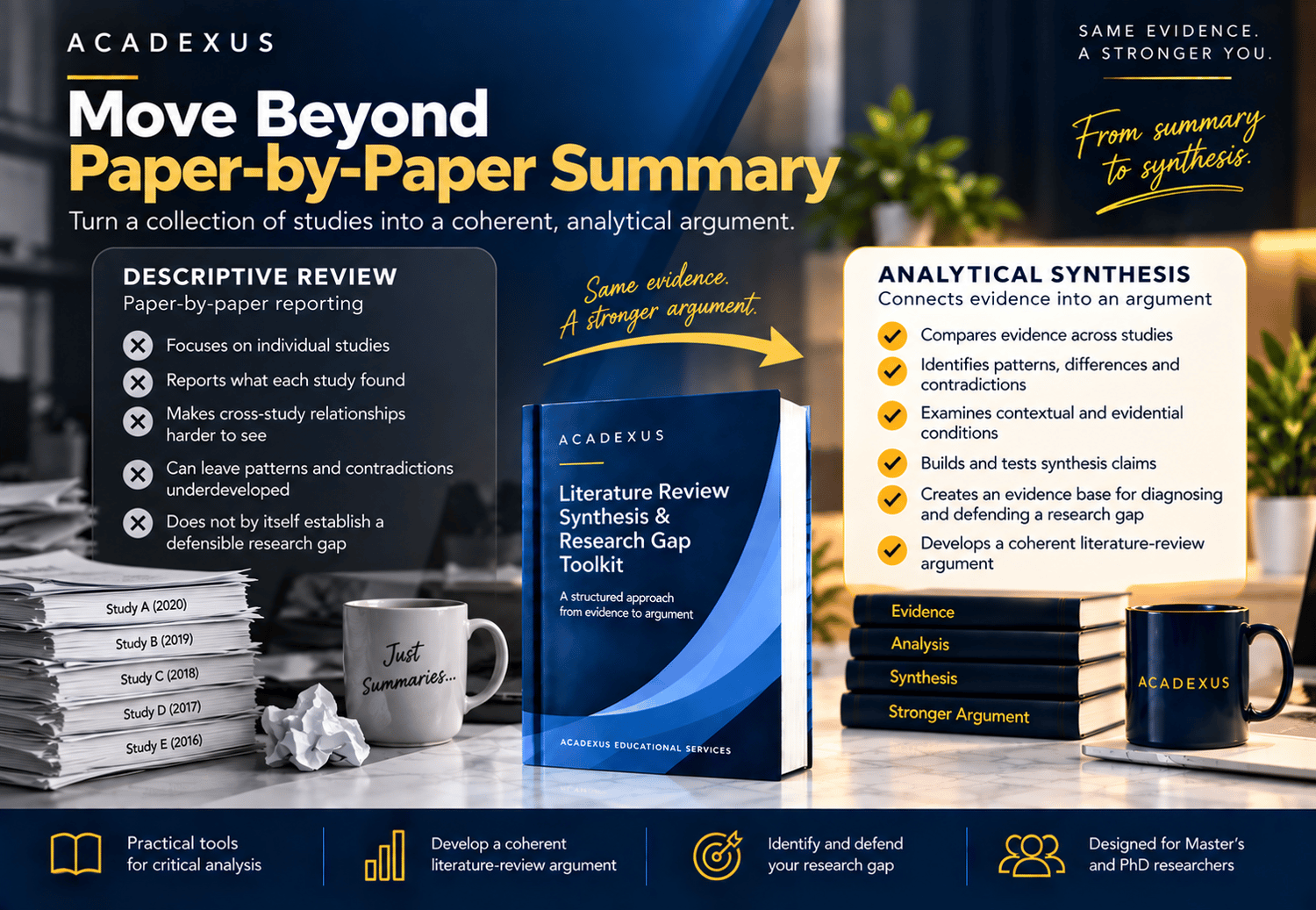
Designed for Master’s and PhD researchers, this toolkit helps you move beyond paper-by-paper summary towards the analytical reasoning expected in a strong literature review.
Rather than giving you another literature matrix or reading tracker, it provides a structured reasoning system for moving from individual studies to critical evaluation, synthesis, research-gap development and literature-review argument construction.
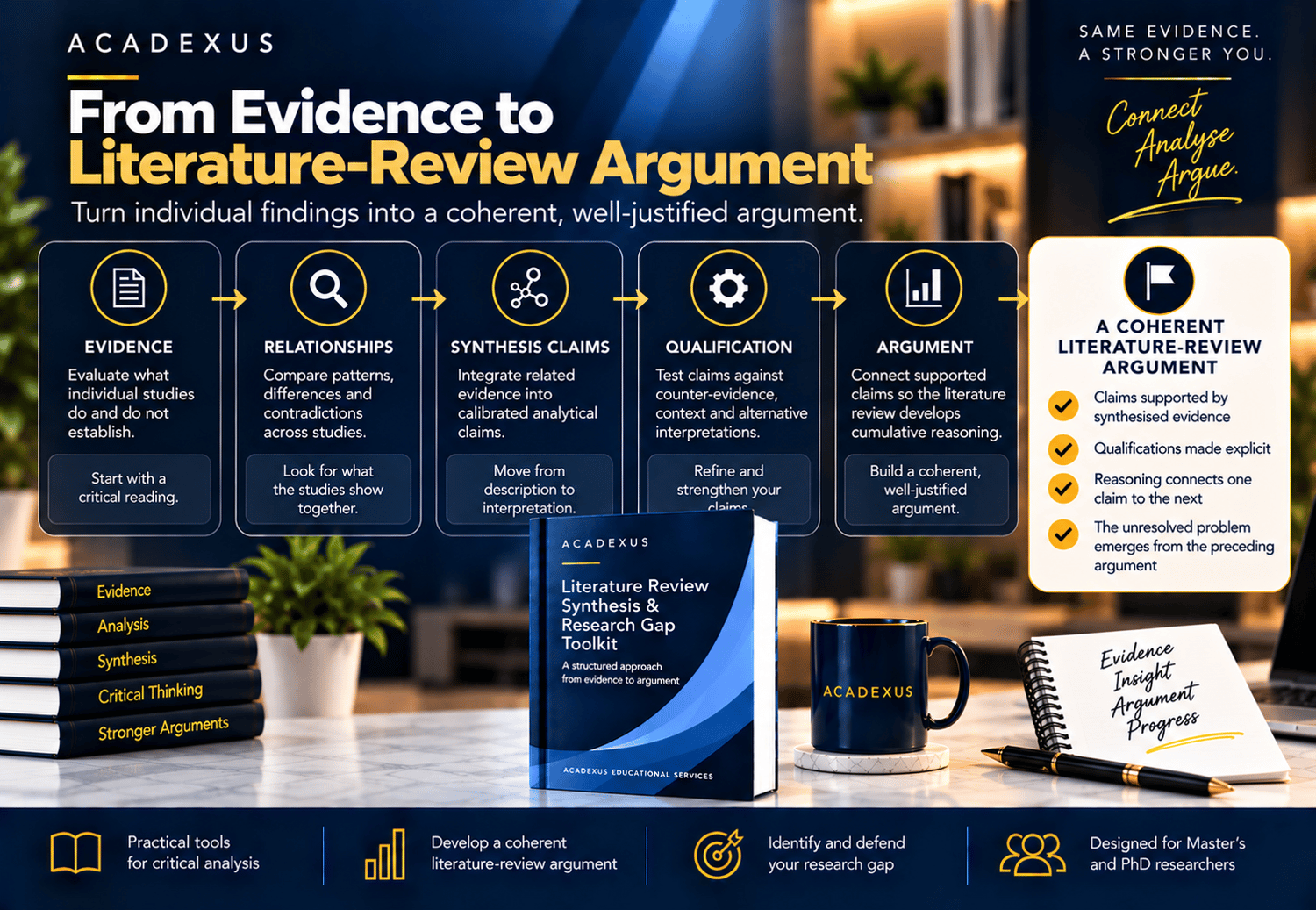
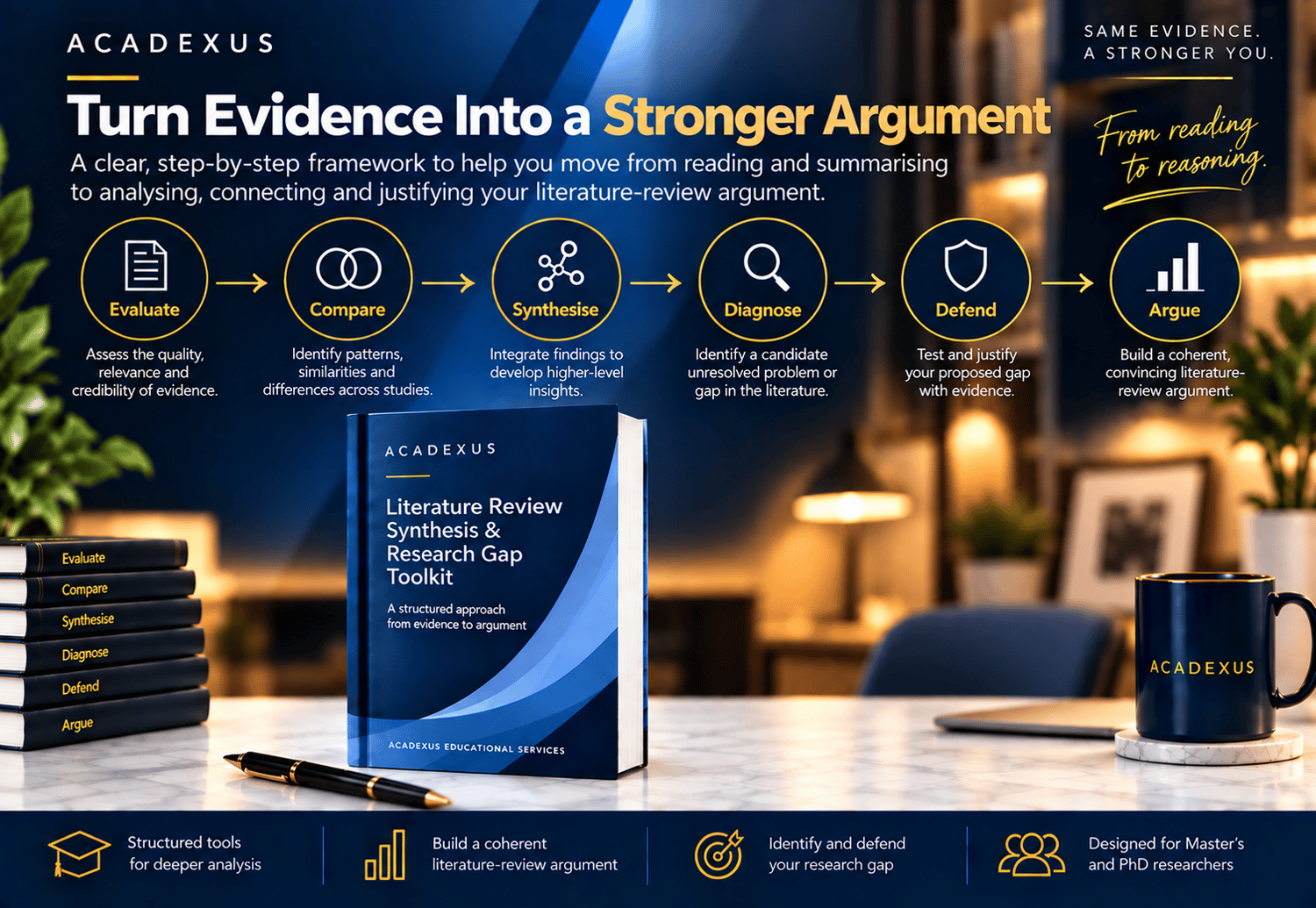
The toolkit takes you through six connected stages:
EVALUATE → COMPARE → SYNTHESISE → DIAGNOSE → DEFEND → ARGUE
You’ll learn how to critically evaluate what individual studies do—and do not—establish; compare evidence around meaningful analytical questions; and identify patterns, contradictions and relevant conditions.
You’ll then use that evidence to construct and stress-test synthesis claims, diagnose possible research gaps, build an evidence trail for a candidate gap, test whether that gap survives scrutiny, and connect your synthesis and gap into a coherent literature-review argument.
A continuous illustrative evidence base shows the reasoning in action—including what happens when a claim is too strong or a proposed research gap cannot yet be defended.
The aim is not to give you a ready-made gap or write your literature review for you. It is to give you a repeatable reasoning system for making stronger analytical decisions from the literature you have examined.
What’s Included
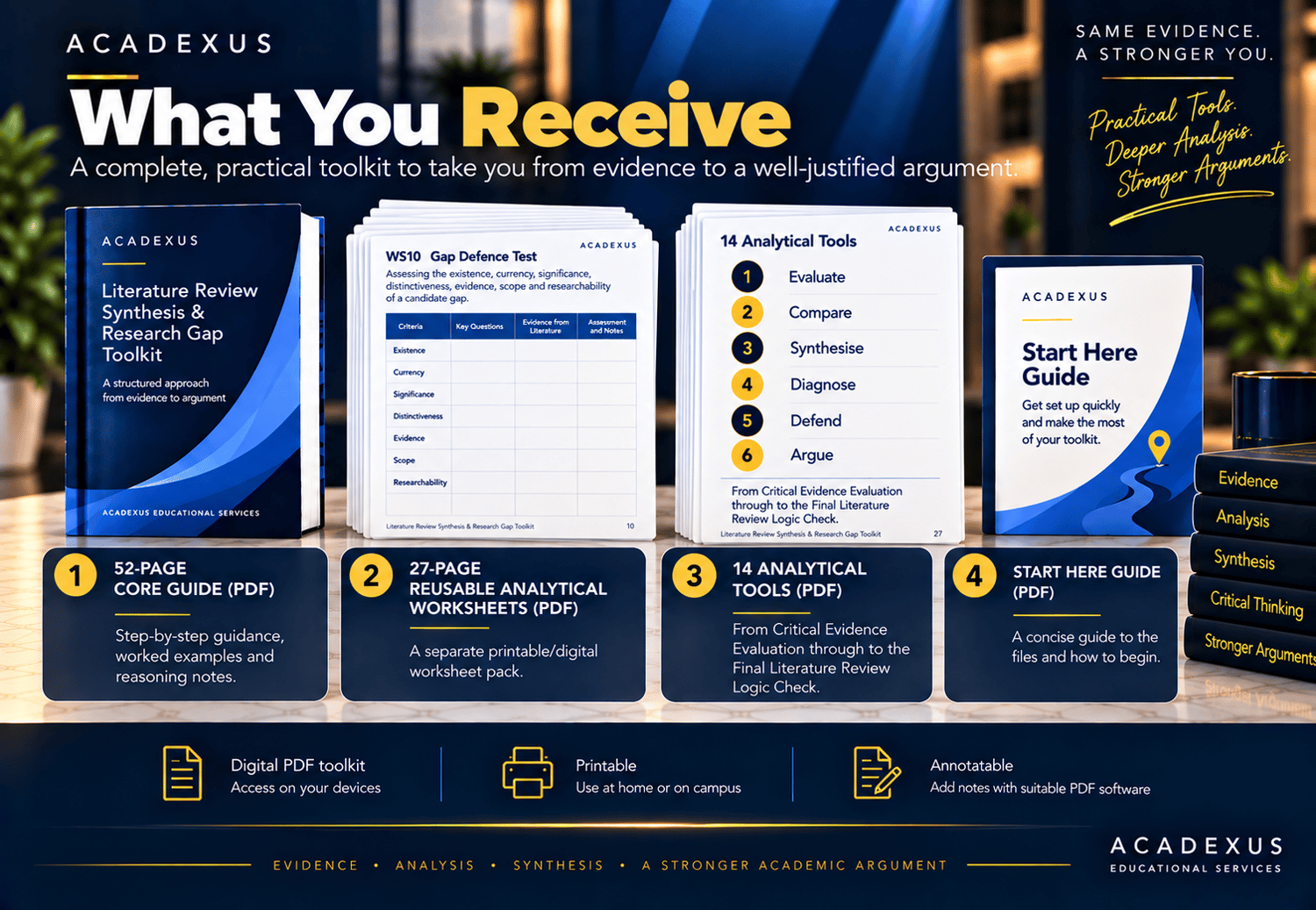
Your download contains:
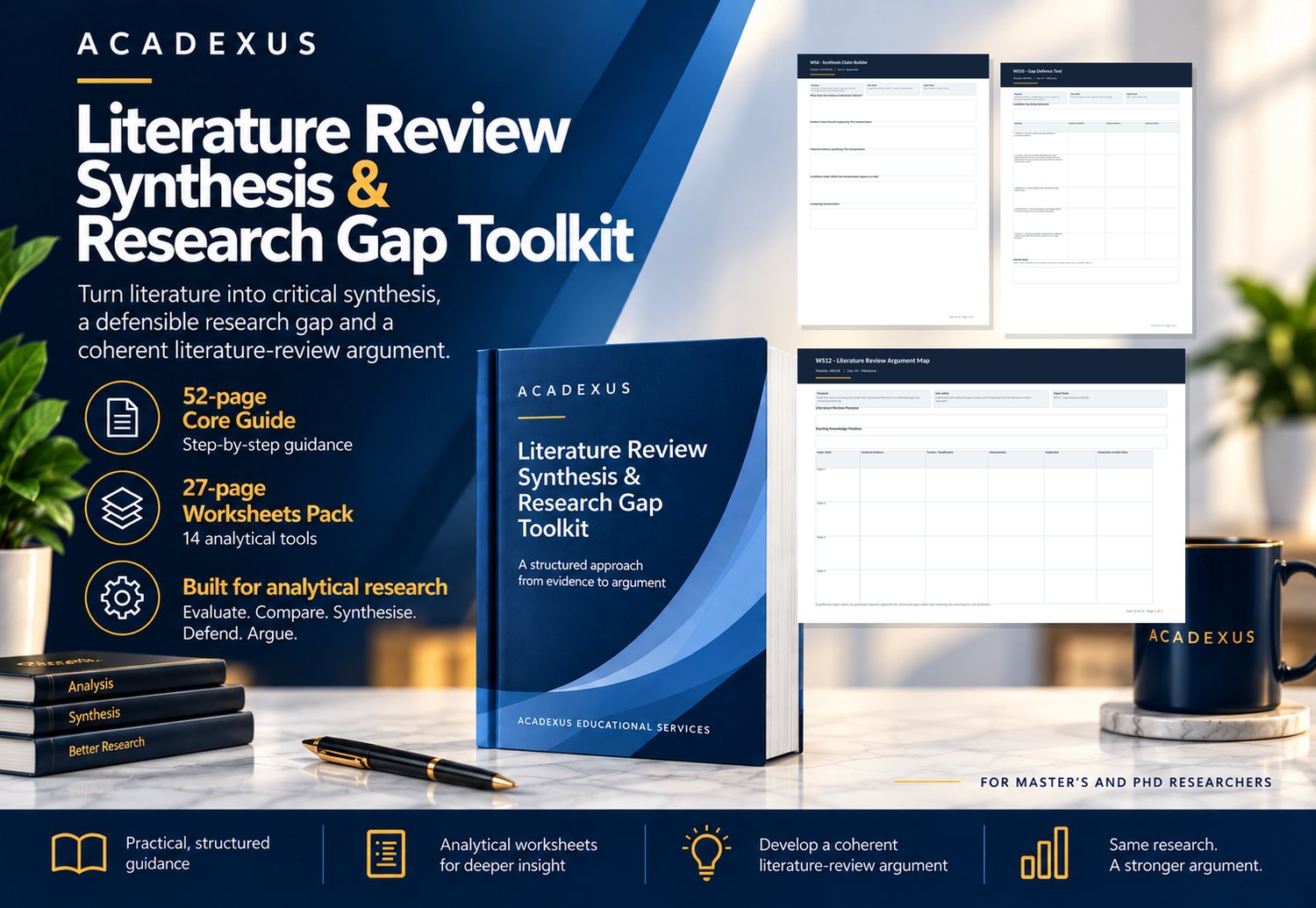
52-Page Core Guide
A guided explanation of the complete six-stage analytical process, with worked reasoning, diagnostic checks and a continuous illustrative example.
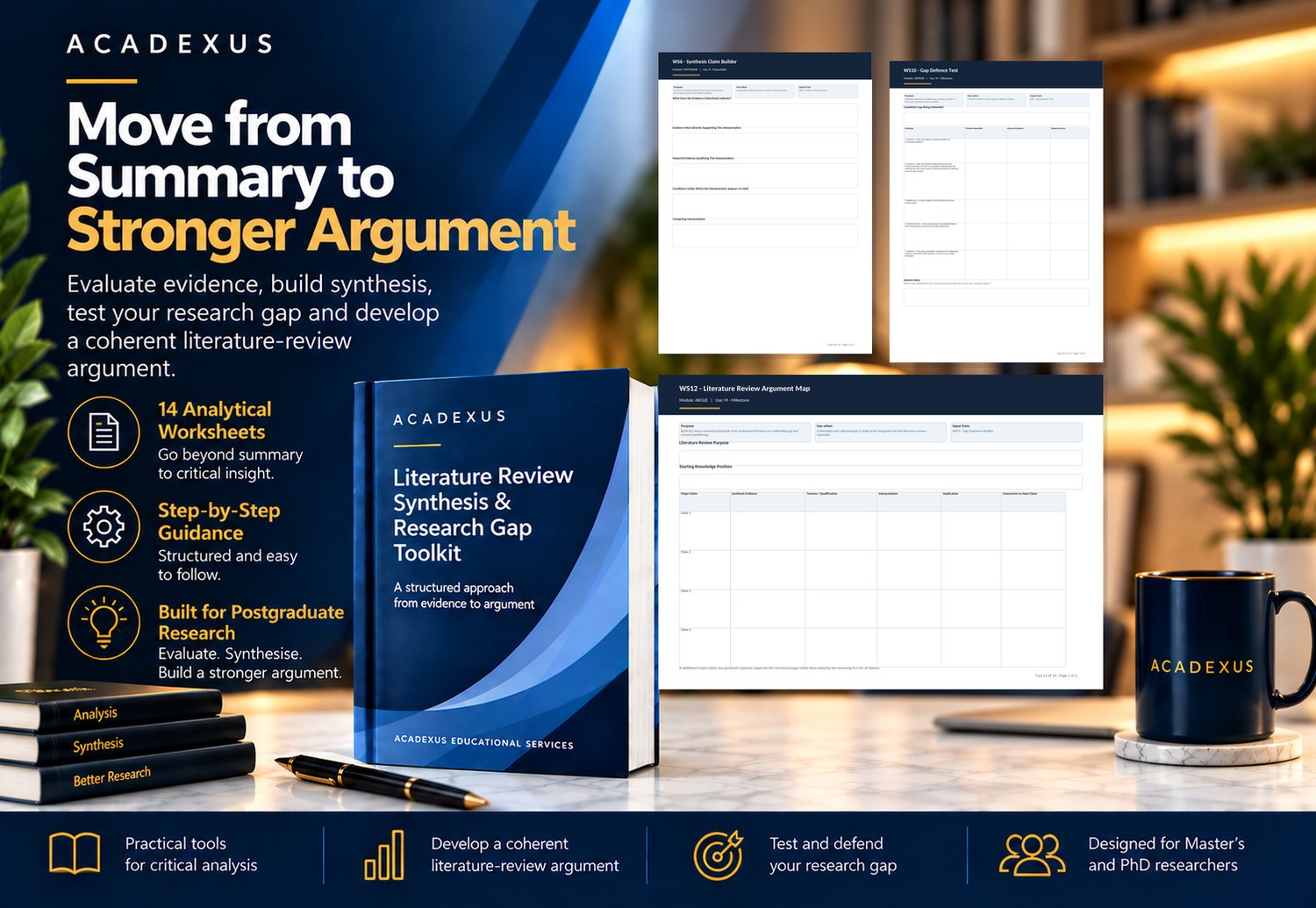
27-Page Reusable Analytical Worksheets Pack
A structured set of reusable worksheets for applying the process to your own research.
The pack contains 14 analytical tools across the six stages:
EVALUATE
- WS1 — Critical Evidence Evaluation
- WS2 — Evidence Boundary Check
COMPARE
- WS3 — Cross-Study Comparison Map
- WS4 — Pattern & Contradiction Map
SYNTHESISE
- WS5 — Evidence Cluster Canvas
- WS6 — Synthesis Claim Builder
- WS7 — Synthesis Stress Test
DIAGNOSE
- WS8 — Candidate Gap Diagnostic
- WS9 — Gap Evidence Trail
DEFEND
- WS10 — Gap Defence Test
- WS11 — Gap Statement Builder
ARGUE
- WS12 — Literature Review Argument Map
- WS13 — Paragraph Reasoning Builder
- WS14 — Final Literature Review Logic Check
You’ll also receive a concise Start Here Guide explaining how the resources work together.
Who It’s For
This toolkit is designed for Master’s and PhD researchers who already have relevant literature but are finding it difficult to move from reading and summarising individual papers to synthesis, gap development and argument construction.
It will be particularly useful if you find yourself asking:
- How do I stop describing studies one by one?
- How do I know which studies can legitimately be synthesised?
- Are these studies actually contradictory—or simply different?
- Is this really a research gap, or just a limitation in one study?
- What evidence do I need before I can defend my gap?
- How do I make the literature review lead logically towards my research?
It is intended for researchers who want analytical structure, rather than another system for simply storing or tracking papers.
How It Works
You can follow the toolkit’s Core Analytical Route:
WS1 → WS3 → WS5 → WS6 → WS8 → WS9 → WS10 → WS11 → WS12 → WS14 Architecture Check → Draft → WS14 Draft Logic Re-check
Additional diagnostic tools—WS2, WS4, WS7 and WS13—can be used when your reasoning needs further testing.
You therefore do not have to complete all 14 worksheets for every piece of literature. You use the tools according to the analytical problem you need to solve.
The worksheets are reusable, allowing you to apply the process repeatedly as your evidence base and literature-review argument develops.
What Makes This Different?
This is not another literature tracker.
Its focus is the intellectual work between reading research and constructing an argument.
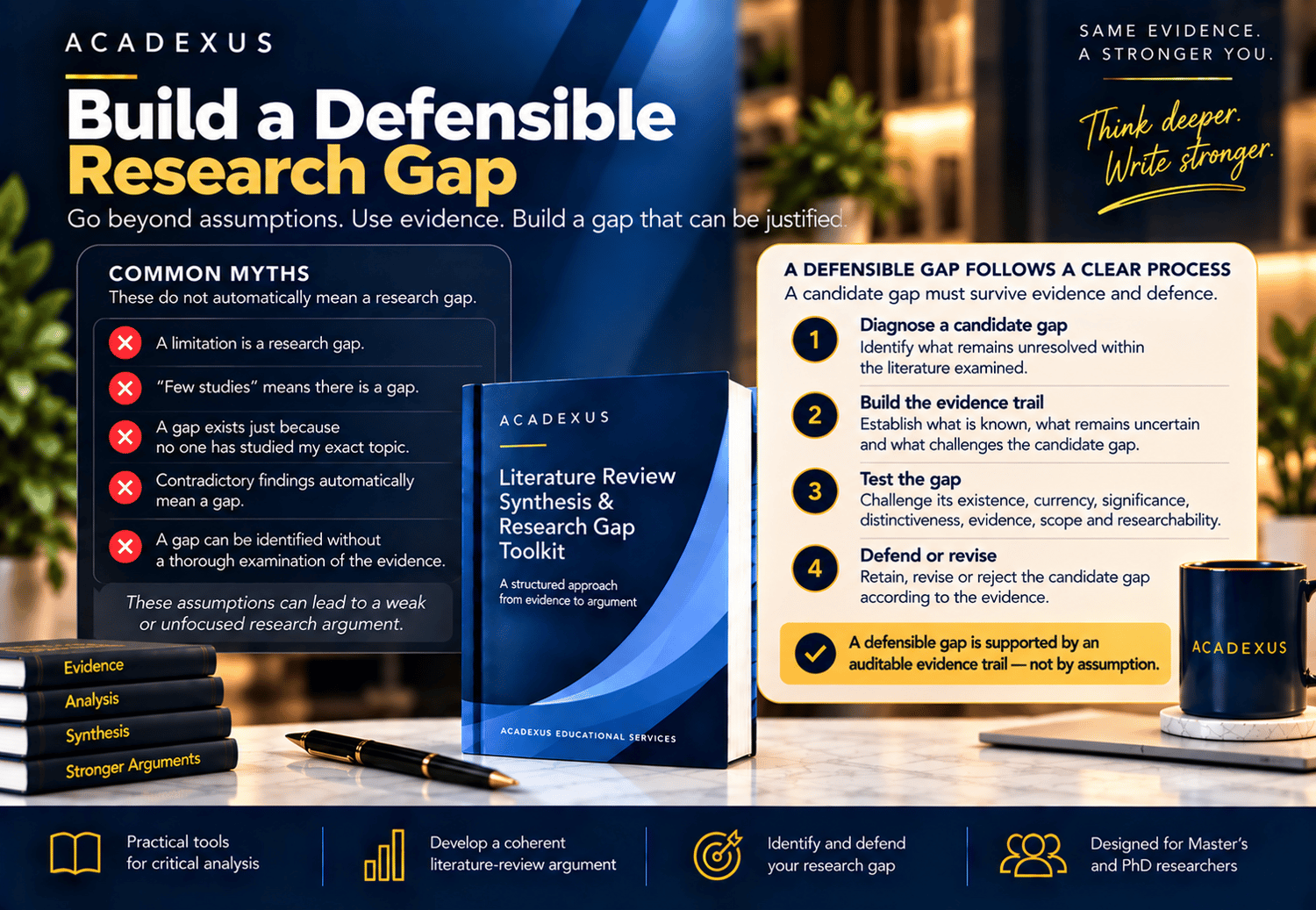
The toolkit deliberately challenges weak reasoning. A synthesis claim can be revised or withdrawn. A candidate gap can require further evidence—or be rejected.
That matters because:
A limitation is not automatically a research gap.
A small number of studies does not automatically establish a meaningful gap.
Finding a diagnostic category does not prove that a gap exists.
Cautious wording cannot compensate for insufficient evidence.
The objective is not simply to produce a research-gap sentence. It is to help you develop a gap and literature-review argument that are better supported by the evidence you have examined.
Important Information
This toolkit supports analysis of the literature you have examined. It cannot guarantee global novelty, establish that no relevant literature has been overlooked, or certify that a proposed research gap is original.
The illustrative studies used in the Core Guide are fictional pedagogical studies created specifically to demonstrate analytical reasoning. They are not published research and should not be cited as scholarly evidence.
This is not a systematic-review or PRISMA toolkit, bibliography or citation manager, database-search guide, automatic research-gap finder, or literature-review writing service.
The worksheets are supplied as digital and printable PDFs. They do not contain interactive PDF form fields. You can annotate them using suitable PDF software, print and complete them by hand, or reproduce the relevant fields in your own research notes.
Move Beyond Summarising Papers
Build a clearer path from evidence to synthesis, from synthesis to a defensible research gap, and from that gap to a coherent literature-review argument.
Get the Acadexus Literature Review Synthesis & Research Gap Toolkit for £19.99.