

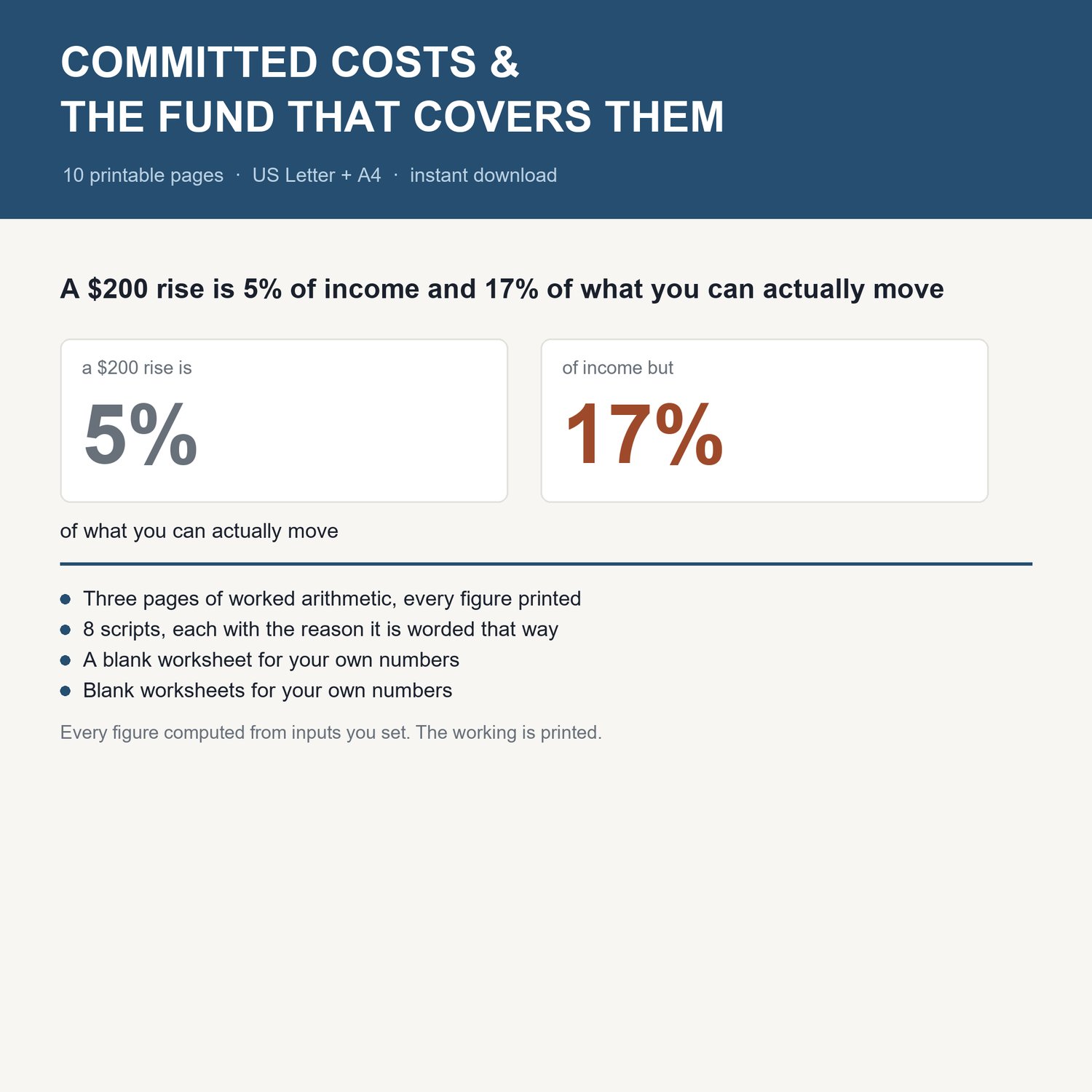

Committed Costs & The Fund That Covers Them — A $200 rise is 5% of income and 17% of what you can actually move
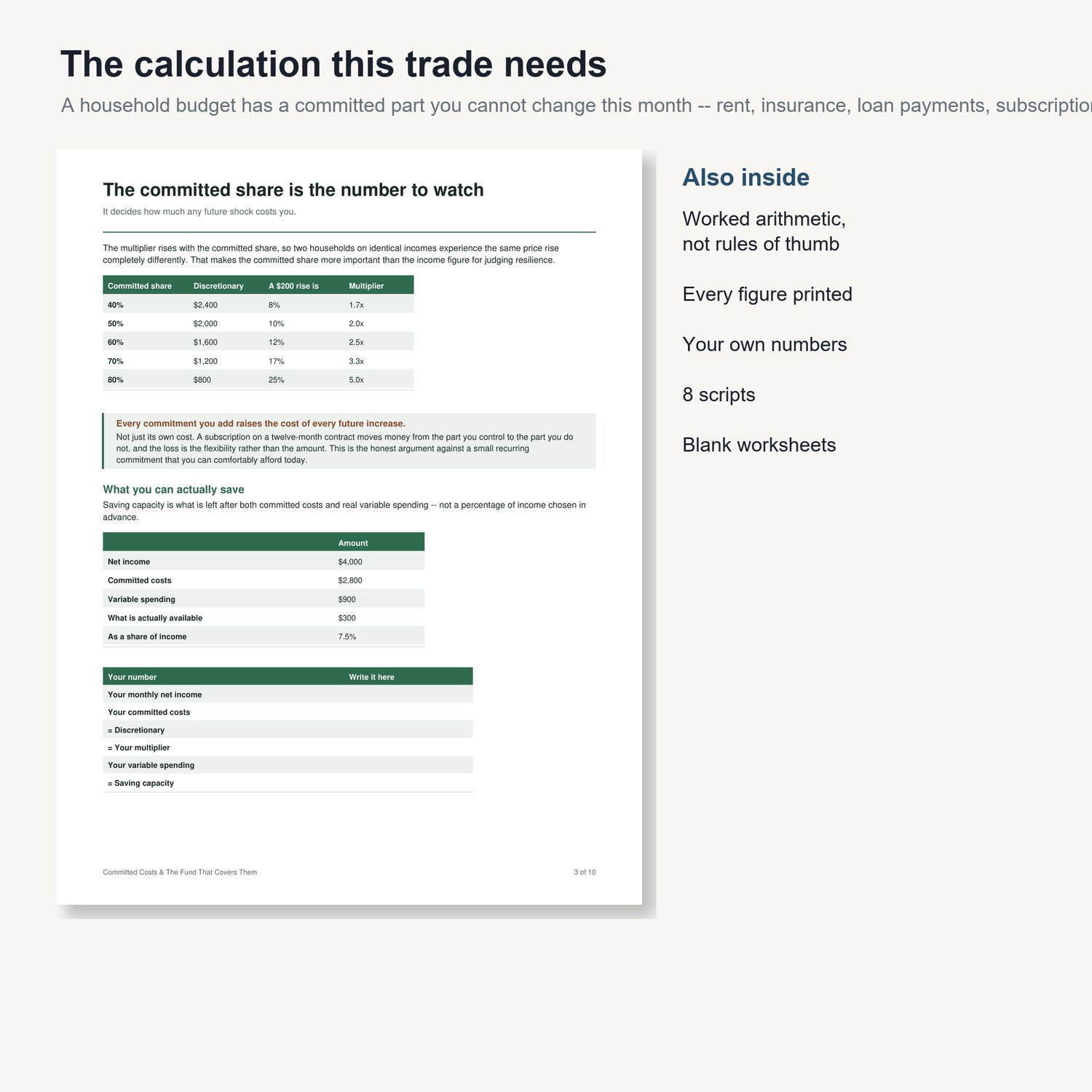
A household budget has a committed part you cannot change this month -- rent, insurance, loan payments, subscriptions on contract -- and a discretionary part you can. Measured against income, a cost increase sounds small, but it lands entirely on the discretionary part. On $4,000 of net income with 70% committed, a $200 rise is 5% of income and 17% of the $1,200 you actually control: a 3.3x multiplier that explains why a modest rise feels like a crisis.
A $200 rise is 5% of your income and 17% of what you control
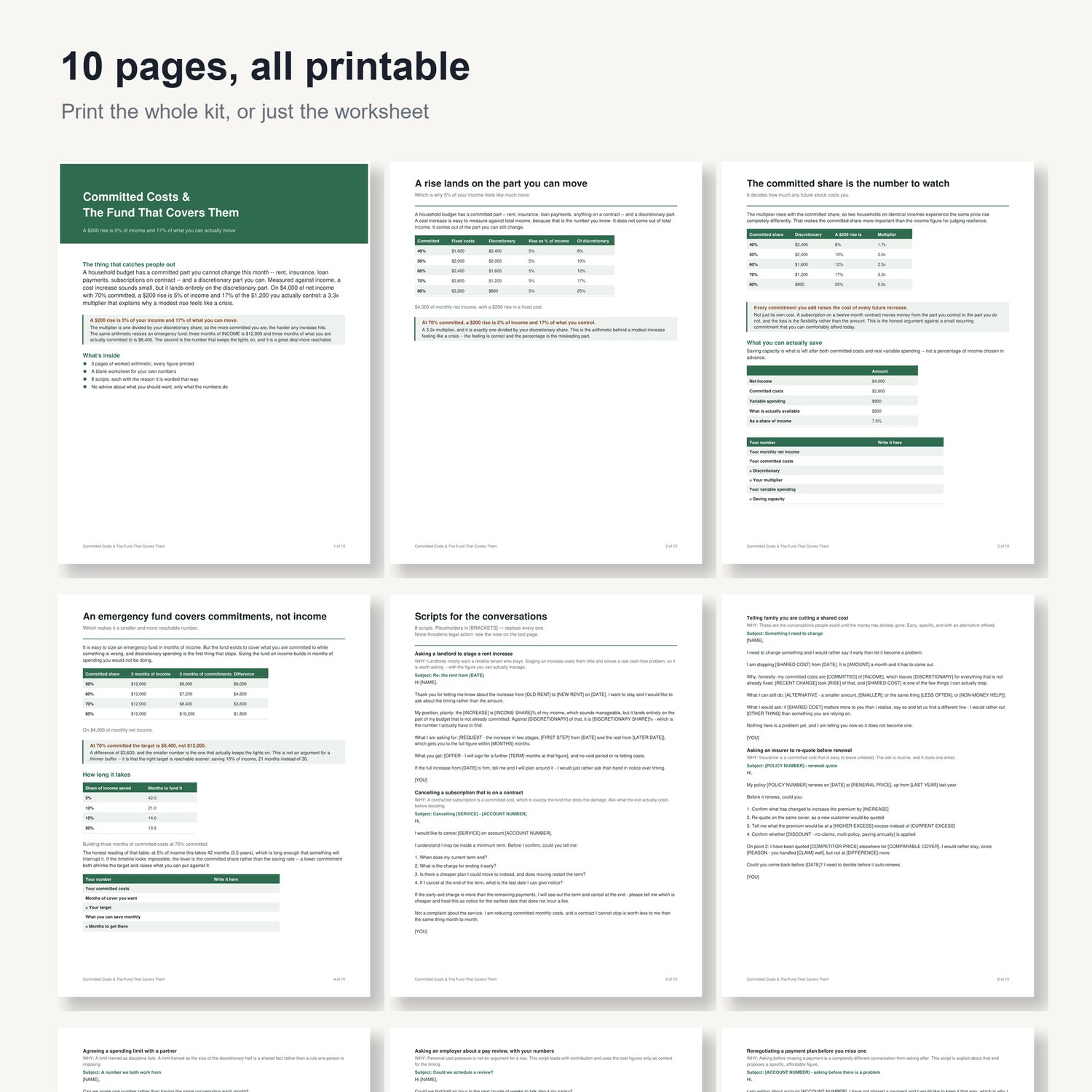
A household budget has a committed part you cannot change this month (rent, insurance, loan payments, anything on contract) and a discretionary part you can. Measured against income, a cost increase sounds small. It does not come out of income. It comes out of the part you can still move.
On $4,000 of net income with 70% committed, a $200 rise is 5% of income and 17% of the $1,200 you actually control: a 3.3x multiplier, which is exactly one divided by your discretionary share. That is why a modest increase feels like a crisis: the feeling is right and the percentage is the misleading part.
The same arithmetic resizes an emergency fund. Three months of INCOME is $12,000. Three months of what you are actually committed to is $8,400, $3,600 less, and the smaller figure is the one that keeps the lights on, because discretionary spending is the first thing that stops. At 10% of income saved that takes 21 months; at 20% it takes 10.5.
Three pages of worked arithmetic, worksheets for your own numbers, and eight scripts: asking a landlord to stage an increase, cancelling a subscription inside its term, agreeing a spending limit with a partner, and renegotiating a payment plan before you miss one rather than after.
Includes a live Excel workbook. Put in your income, commitments and a rise, and it returns your multiplier, your saving capacity and both emergency-fund figures. Every formula verified by recalculation.
8 scripts for the conversations this involves
Each one carries a line explaining why it is worded that way, because a script you do not understand is one you will not send. Placeholders are in [BRACKETS] so nothing goes out in someone else's words.
- Asking a landlord to stage a rent increase
- Cancelling a subscription that is on a contract
- Telling family you are cutting a shared cost
- Asking an insurer to re-quote before renewal
- Agreeing a spending limit with a partner
- Asking an employer about a pay review, with your numbers
- Declining a recurring commitment you cannot carry
- Renegotiating a payment plan before you miss one
What this is not
This is arithmetic, not advice. Every figure is computed from the inputs stated on the page, and the working is printed so you can substitute your own. What it cannot tell you is what you should want — it shows what a choice costs, not which choice is right for your household.
Nothing here is financial, tax or legal advice, and it is not a recommendation to buy, sell, borrow or sign anything. The scripts are wording for a conversation, not legal instruments, and none of them threatens anything.
Where the kit uses a published rate or threshold, it is the one current when the kit was built. Those change; the arithmetic does not.
Honest about the format
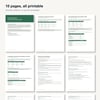
Printable PDFs plus an editable Excel workbook, not a physical product. One US Letter PDF (10 pages) and one A4 PDF (10 pages), and one .xlsx that opens in Excel, Numbers, LibreOffice and Google Sheets. Files are available immediately after purchase; nothing ships.
Refunds
If this isn't what you expected, email me within 30 days and I'll refund you in full — no need to explain. Because it's an instant download I can't take the files back, so I'd rather you just had your money back.