
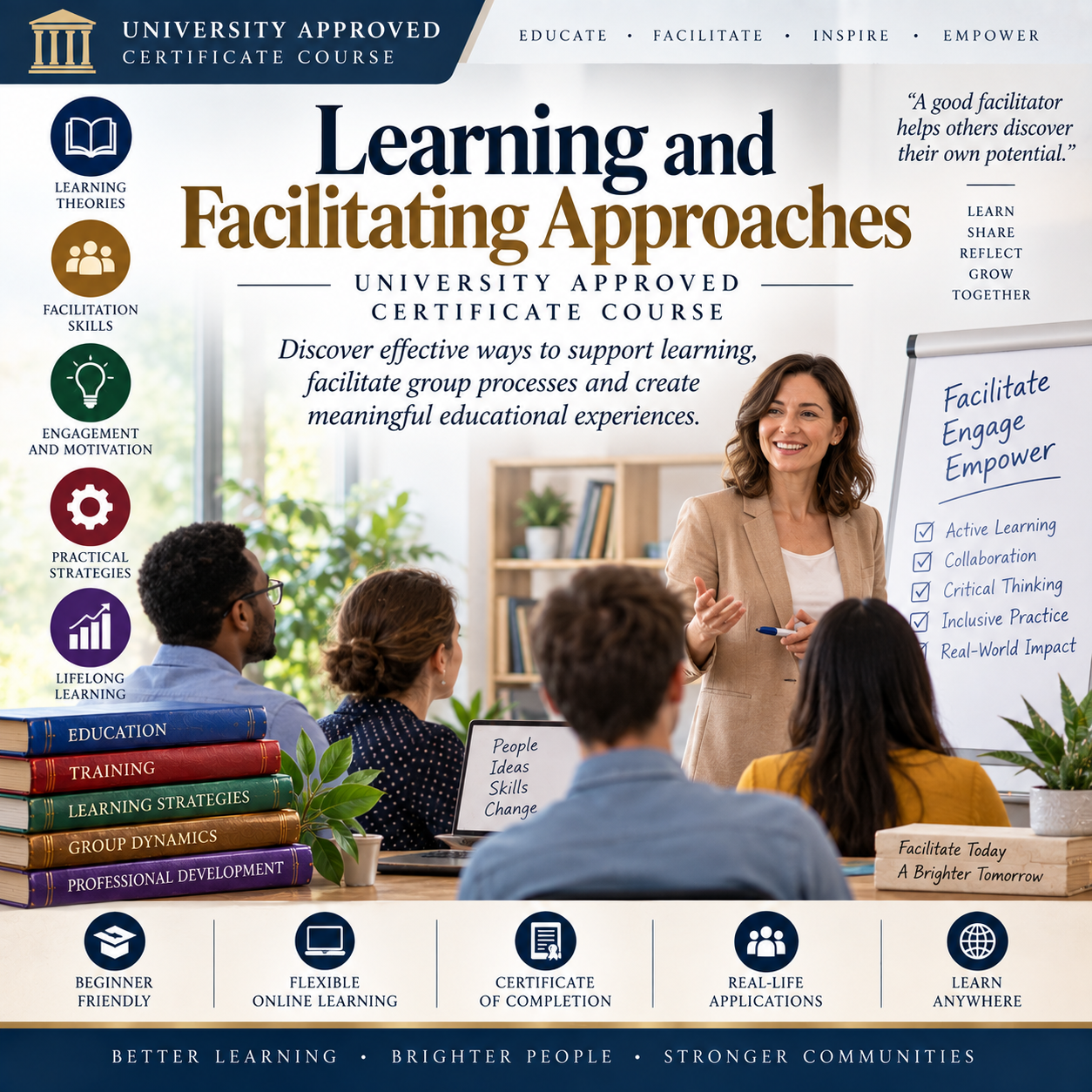
Learning and Facilitating Approaches University Approved Ce
Learning and Facilitating Approaches – University Approved Certificate Course
Learn How to Support Learning, Facilitate Groups, Engage Participants, and Create Meaningful Educational Experiences
Effective learning does not happen simply because information is presented.
Good learning environments are created through thoughtful planning, active participation, clear communication, appropriate facilitation, learner engagement, feedback, reflection, and practical application.
The Learning and Facilitating Approaches – University Approved Certificate Course provides a structured introduction to the principles, theories, strategies, and practical techniques used to support learning and facilitate individuals and groups.
This course is suitable for teachers, trainers, facilitators, coaches, managers, team leaders, education students, human resources professionals, workshop leaders, community educators, and anyone who wants to improve the way they support learning and development.
No previous specialist qualification is required to begin.
Whether you are new to facilitation or already work in an educational or professional environment, this course can help you develop a broader understanding of how people learn and how effective facilitators can create more engaging, inclusive, and productive learning experiences.
What Is Facilitation?
Facilitation is the process of helping individuals or groups learn, communicate, participate, solve problems, develop ideas, and achieve shared objectives.
A facilitator is not simply a person who gives information.
Effective facilitation involves creating conditions in which learners can:
- Participate actively
- Ask questions
- Share ideas
- Reflect
- Collaborate
- Solve problems
- Practise skills
- Develop confidence
- Learn from experience
- Learn from one another
The facilitator helps guide the process while encouraging learners to take an active role in their own development.
What You Will Learn
Throughout this course, you will explore topics such as:
- Principles of learning
- Major learning theories
- Adult learning
- Facilitation skills
- Learner engagement
- Motivation
- Active learning
- Group dynamics
- Communication
- Questioning techniques
- Feedback
- Reflective learning
- Collaborative learning
- Inclusive learning
- Experiential learning
- Problem-based learning
- Planning learning activities
- Managing group participation
- Supporting different learners
- Evaluating learning
- Lifelong learning
- Professional development
The course combines theoretical understanding with practical approaches that can be applied in educational, workplace, training, and community environments.
Understanding How People Learn
People do not all learn in exactly the same way.
Learning can be influenced by:
- Previous experience
- Motivation
- Confidence
- Environment
- Attention
- Expectations
- Culture
- Communication
- Feedback
- Relevance
- Practice
- Participation
Effective facilitators understand that learning is a process rather than a single event.
The course introduces learners to important principles that can help make learning more meaningful and engaging.
Major Learning Theories
Learning theories provide different explanations for how people acquire knowledge, skills, behaviours, and attitudes.
The course introduces major approaches such as:
- Behaviourist approaches
- Cognitive approaches
- Constructivist approaches
- Social learning
- Experiential learning
- Humanistic approaches
- Collaborative learning
Understanding these theories can help facilitators make more informed decisions about how to structure learning activities.
Behaviourist Approaches
Behavioural learning theories focus on observable behaviour and the influence of environmental consequences.
Learners may explore concepts such as:
- Reinforcement
- Feedback
- Practice
- Repetition
- Behavioural responses
- Learning through consequences
These ideas have influenced education, workplace training, coaching, and skills development.
Cognitive Approaches to Learning
Cognitive learning theories focus on how people:
- Think
- Remember
- Understand
- Process information
- Solve problems
- Make decisions
The course explores how factors such as attention, memory, prior knowledge, and mental organisation can influence learning.
Understanding cognitive processes can help facilitators present information more clearly and structure learning more effectively.
Constructivist Learning
Constructivist approaches suggest that learners actively build understanding by connecting new information with previous knowledge and experience.
This perspective encourages:
- Active participation
- Discussion
- Exploration
- Problem-solving
- Reflection
- Practical application
The facilitator becomes a guide who helps learners develop their own understanding rather than simply transmitting information.
Social Learning
People often learn by observing others.
Social learning can occur through:
- Demonstration
- Modelling
- Peer interaction
- Group discussion
- Mentoring
- Collaboration
A well-designed learning environment can allow participants to benefit from the experiences and perspectives of others.
Experiential Learning
Experience can be one of the most powerful forms of learning.
Experiential learning often involves:
- Doing or experiencing something
- Reflecting on the experience
- Identifying lessons
- Applying the learning to future situations
This approach is particularly useful in workshops, training programs, professional education, coaching, and practical skills development.
Adult Learning
Adults often bring significant life and work experience into the learning environment.
Effective adult learning may be strengthened when:
- The purpose is clear
- Learning is relevant
- Experience is recognised
- Participation is encouraged
- Practical application is available
- Learners have some autonomy
The course explores principles that can help facilitators work effectively with adult learners.
The Role of the Facilitator
An effective facilitator may act as:
- Guide
- Organiser
- Communicator
- Listener
- Questioner
- Motivator
- Observer
- Supporter
- Coordinator
The facilitator does not need to dominate every discussion.
Instead, successful facilitation often involves helping others participate, contribute, reflect, and learn.
Core Facilitation Skills
The course introduces important facilitation skills such as:
- Clear communication
- Active listening
- Questioning
- Summarising
- Observing group dynamics
- Encouraging participation
- Managing time
- Giving instructions
- Providing feedback
- Handling different viewpoints
- Supporting reflection
- Managing activities
These skills can be useful in classrooms, workshops, meetings, training sessions, coaching environments, and group discussions.
Communication Skills
Communication is central to effective facilitation.
Learners will explore principles such as:
- Clear language
- Tone
- Body language
- Listening
- Clarification
- Summarising
- Respectful communication
- Appropriate questioning
Good communication helps learners understand expectations and feel more confident about participating.
Active Listening
Active listening is more than simply hearing another person.
It involves:
- Paying attention
- Avoiding unnecessary interruption
- Asking clarifying questions
- Reflecting key points
- Demonstrating understanding
- Responding appropriately
Facilitators who listen effectively can often identify learner needs more accurately.
Questioning Techniques
Questions can be powerful learning tools.
The course explores how facilitators can use different types of questions to:
- Check understanding
- Encourage reflection
- Explore ideas
- Promote critical thinking
- Encourage participation
- Solve problems
Open questions can be particularly useful for generating discussion and encouraging learners to explain their thinking.
Active Learning
Active learning encourages participants to engage directly with the learning process.
Activities may include:
- Discussions
- Case studies
- Problem-solving
- Role plays
- Demonstrations
- Practical exercises
- Simulations
- Group tasks
- Reflection
- Presentations
Active participation can help learners connect theory with practice.
Collaborative Learning
Collaborative learning allows participants to work together.
Group learning can help develop:
- Communication
- Teamwork
- Problem-solving
- Listening
- Cooperation
- Leadership
- Respect for different perspectives
Facilitators can help create structures that allow group work to remain productive and inclusive.
Group Dynamics
Every group develops its own patterns of communication, participation, influence, and behaviour.
The course introduces learners to aspects of group dynamics such as:
- Group roles
- Participation
- Leadership
- Cooperation
- Conflict
- Decision-making
- Group norms
- Communication patterns
Understanding group dynamics can help facilitators respond more effectively to different situations.
Managing Participation
Some learners participate easily, while others may be quieter or less confident.
Facilitators can encourage balanced participation by:
- Creating a respectful environment
- Inviting different perspectives
- Using small-group activities
- Providing thinking time
- Avoiding unnecessary pressure
- Managing dominant participants
- Valuing different contributions
The goal is not to force participation but to create opportunities for meaningful involvement.
Learner Engagement
Engagement increases when learners understand why the material matters.
The course explores ways to improve engagement through:
- Relevant examples
- Practical activities
- Clear objectives
- Interaction
- Discussion
- Feedback
- Variety
- Real-life application
Engagement is often strengthened when learners feel that their experiences and ideas are respected.
Motivation
Motivation can strongly affect learning.
Factors influencing motivation may include:
- Personal goals
- Confidence
- Interest
- Relevance
- Rewards
- Feedback
- Expectations
- Progress
- Learning environment
Facilitators cannot completely control motivation, but they can create conditions that make participation more meaningful.
Inclusive Facilitation
Good facilitation recognises that learners are different.
Differences may involve:
- Experience
- Culture
- Language
- Confidence
- Education
- Age
- Ability
- Communication preferences
- Learning needs
Inclusive facilitation aims to provide fair opportunities for participation while respecting diversity.
Creating a Positive Learning Environment
Learners are often more willing to participate when they feel respected and psychologically safe.
A positive learning environment can include:
- Clear expectations
- Mutual respect
- Appropriate boundaries
- Encouragement
- Constructive feedback
- Opportunities to participate
- Respect for different viewpoints
Facilitators play an important role in establishing these conditions.
Planning Learning Sessions
Good facilitation usually begins with planning.
Learners will explore how to consider:
- Learning objectives
- Participant needs
- Content
- Time
- Activities
- Resources
- Assessment
- Feedback
- Evaluation
A clear plan can help facilitators remain focused while still allowing flexibility when needed.
Setting Learning Objectives
Learning objectives explain what learners are expected to know, understand, or be able to do.
Clear objectives can help:
- Guide session planning
- Select appropriate activities
- Communicate expectations
- Evaluate learning
- Maintain focus
The course introduces learners to the importance of creating realistic and meaningful learning objectives.
Choosing Learning Activities
Different learning objectives may require different activities.
For example:
- Discussion can help explore opinions
- Demonstration can support skills learning
- Case studies can develop problem-solving
- Role play can develop communication
- Reflection can support deeper understanding
- Group work can develop collaboration
Effective facilitators match activities to the purpose of the session.
Giving Instructions
Clear instructions can significantly improve the success of learning activities.
Facilitators should consider:
- What participants need to do
- How much time is available
- What outcome is expected
- What resources are required
- How groups should work
Checking understanding before an activity begins can prevent confusion.
Feedback
Feedback is an important part of learning.
Effective feedback is generally:
- Clear
- Specific
- Relevant
- Constructive
- Respectful
- Timely
The course explores how feedback can help learners recognise strengths and identify opportunities for improvement.
Reflective Learning
Reflection encourages learners to think about what they have experienced.
Useful reflective questions might include:
- What happened?
- What did I learn?
- What worked well?
- What was difficult?
- What would I do differently?
- How can I apply this learning?
Reflection can help transform experience into deeper learning.
Critical Thinking
Facilitators can encourage learners to move beyond memorisation.
Critical thinking may involve:
- Analysing information
- Comparing viewpoints
- Questioning assumptions
- Evaluating evidence
- Identifying problems
- Developing arguments
- Drawing conclusions
Good facilitation creates opportunities for learners to think independently.
Problem-Based Learning
Problem-based learning uses realistic challenges as a starting point.
Participants may work individually or in groups to:
- Identify the problem
- Explore possible causes
- Gather information
- Develop solutions
- Evaluate options
- Present recommendations
This approach can be particularly valuable in professional education and workplace training.
Real-Life Applications
Learning becomes more meaningful when learners can connect it to real situations.
Facilitators can use:
- Workplace examples
- Case studies
- Simulations
- Personal experiences
- Practical exercises
- Realistic scenarios
This can help participants understand how knowledge applies outside the learning environment.
Managing Challenging Situations
Facilitators may sometimes encounter:
- Low participation
- Disagreement
- Dominant participants
- Confusion
- Distraction
- Resistance
- Time pressure
The course introduces practical principles for responding calmly and professionally while maintaining a productive learning environment.
Conflict and Disagreement
Disagreement does not always need to be negative.
Different viewpoints can create valuable learning opportunities when discussion remains respectful.
Facilitators can help by:
- Clarifying viewpoints
- Encouraging respectful communication
- Focusing on issues rather than personalities
- Summarising areas of agreement
- Helping participants explore differences constructively
Evaluating Learning
Facilitators need ways to understand whether learning has taken place.
Evaluation may include:
- Questions
- Discussions
- Practical tasks
- Reflection
- Quizzes
- Demonstrations
- Feedback forms
- Self-assessment
Evaluation can help both learners and facilitators identify progress.
Evaluating Your Own Facilitation
Facilitators also need to reflect on their own performance.
Useful questions include:
- Were the objectives achieved?
- Were learners engaged?
- Were instructions clear?
- Did activities work?
- Was timing appropriate?
- What could be improved?
Continuous reflection supports professional development.
Online Facilitation
Learning increasingly takes place online.
The course also introduces general considerations for digital facilitation, including:
- Clear instructions
- Online engagement
- Discussion management
- Virtual participation
- Communication
- Feedback
- Digital learning activities
Effective online facilitation requires many of the same core skills as face-to-face learning, adapted for a different environment.
Facilitation in the Workplace
Facilitation skills can be highly valuable in professional environments.
They may be used for:
- Staff training
- Meetings
- Workshops
- Team development
- Induction
- Professional development
- Brainstorming
- Problem-solving
- Change management
People who can guide productive learning and discussion can contribute significantly to organisational development.
Lifelong Learning
Learning continues throughout life.
Facilitators can play an important role in helping people:
- Develop new skills
- Adapt to change
- Build confidence
- Explore new ideas
- Improve professional performance
- Continue personal development
Lifelong learning is increasingly important in rapidly changing social and professional environments.
Who Is This Course For?
This course may be suitable for:
- Teachers
- Trainers
- Facilitators
- Education students
- Teaching assistants
- Coaches
- Mentors
- Human resources professionals
- Managers
- Team leaders
- Workshop leaders
- Community educators
- Social care professionals
- Learning and development professionals
- Volunteers
- People involved in professional training
- Anyone interested in helping others learn
No previous facilitation qualification is required.
Beginner Friendly
The course is designed to be accessible to learners with different levels of experience.
Important concepts are introduced clearly and progressively.
You can begin even if you have never formally studied education, training, or facilitation.
Flexible Online Learning
Study according to your own schedule.
The online format makes the course suitable for learners balancing education with:
- Employment
- Family
- Professional responsibilities
- University study
- Other courses
You can revisit the learning materials and progress at a pace that works for you.
What You Can Gain From This Course
By completing this course, you can develop a broader understanding of:
- How people learn
- Learning theories
- Facilitation techniques
- Group dynamics
- Learner engagement
- Motivation
- Communication
- Active learning
- Collaborative learning
- Inclusive practice
- Reflective learning
- Feedback
- Session planning
- Evaluation
- Professional development
You can also build greater confidence in supporting learning within different environments.
A Foundation for Further Study
This course may provide useful preparation for further learning in areas such as:
- Education
- Teaching
- Training and development
- Adult education
- Educational psychology
- Coaching
- Human resources
- Organisational development
- Learning and development
- Instructional design
- Leadership
- Professional development
Professional Applications
Facilitation knowledge can be useful across many professional environments.
These may include:
- Schools
- Colleges
- Universities
- Training centres
- Businesses
- Community organisations
- Non-profit organisations
- Healthcare education
- Human resources departments
- Corporate training
- Coaching
- Professional workshops
The skills are transferable because effective learning and communication are needed in many different professions.
Certificate of Completion
Learners who successfully complete the applicable course requirements may receive a Certificate of Completion for:
Learning and Facilitating Approaches – University Approved Certificate Course
The certificate may be useful for:
- CVs and résumés
- LinkedIn profiles
- Continuing professional development records
- Personal learning portfolios
- Professional development documentation
- Academic portfolios
- Demonstrating additional learning
Course Format: Online
Level: Beginner / Introductory
Study Method: Self-Paced
Subject: Learning and Facilitation
Certificate: Available upon successful completion of applicable course requirements
Why Choose This Course?
Understand Learning
Develop a stronger foundation in how people acquire knowledge and skills.
Develop Facilitation Skills
Explore practical approaches for guiding individuals and groups.
Improve Learner Engagement
Learn ways to encourage participation, motivation, and active learning.
Real-Life Applications
Connect learning theory with practical educational and professional situations.
Beginner Friendly
No previous formal facilitation qualification is required.
Flexible Online Study
Learn according to your own schedule.
Professional Development
Develop transferable skills useful in education, management, training, coaching, and leadership.
Certificate of Completion
Document your learning after successfully completing the applicable course requirements.
Educate. Facilitate. Inspire. Empower.
A good learning experience can do more than provide information.
It can help people develop confidence.
It can encourage curiosity.
It can build practical skills.
It can bring people together.
It can create opportunities.
And it can encourage lifelong growth.
The Learning and Facilitating Approaches – University Approved Certificate Course gives you an accessible introduction to the skills and principles needed to support these outcomes.
Learn how people learn.
Facilitate meaningful participation.
Encourage reflection and critical thinking.
Create more engaging learning environments.
Help people recognise their own potential.
Better Learning. Brighter People. Stronger Communities.
Start your learning journey today.
Important Professional Notice
This course is intended for educational and personal/professional development purposes.
Completion of the course does not automatically confer a regulated teaching licence, professional trainer licence, academic degree, or other occupational qualification where additional national or local requirements apply.
Learners intending to work in regulated education, teaching, counselling, healthcare, or other professional environments should confirm the relevant qualification and licensing requirements applicable in their jurisdiction.