
John Deere CT322 CT332 Compact Track Loader Operator's Manual omt215996 PDF - MJODOMT215996.zip
The full Operator's Manual covering the John Deere CT322 and CT332 Compact Track Loaders, containing every shop detail you need to run and service your machine.
OMT215996 - CT322 and CT332 Compact Track Loader Operator's Manual.PDF
OMT215996 - CT322 and CT332 Compact Track Loader Operator's Manual.epub
PRODUCT DETAILS:
Total Pages: 324 pages
File Format: PDF/EPUB/MOBI/AZW (PC/Mac/Android/Kindle/iPhone/iPad; bookmarked, ToC, Searchable, Printable)
Language: English
MAIN SECTIONS
1-2 - Safety - General Precautions
1-3 - Safety - Operating Precautions
1-4 - Safety - Maintenance Precautions
1-5 - Safety - Safety Signs
2-1 - Operation - Operator's Station
2-2 - Operation - Operating the Machine
2-3 - Operation - Track Information
3-1 - Maintenance - Machine
3-2 - Maintenance - Periodic Maintenance
3-3 - Maintenance - As Required
3-4 - Maintenance - Every 10 hours or Daily
3-5 - Maintenance - The First 20 hours
3-6 - Maintenance - Every 50 Hours
3-7 - Maintenance - Every 250 Hours
3-8 - Maintenance - Every 500 Hours
3-9 - Maintenance - Every 1000 Hours
3-10 - Maintenance - Every 6000 Hours
4-1 - Miscellaneous - Machine
4-2 - Miscellaneous - Operational Checkout
4-3 - Miscellaneous - Troubleshooting
4-4 - Miscellaneous - Storage
4-5 - Miscellaneous - Machine Numbers
4-6 - Miscellaneous - Specifications
Total Pages: 360 pages
File Format: PDF (bookmarked, ToC, Searchable, Printable, high quality)
Language: English
omt215996 - CT322 and CT332 Compact Track Loader
Table of Contents
Foreword
Technical Information Feedback Form
Section 1-1: Safety—Safety and Operator Conveniences
Safety and Operator Convenience Features
Section 1-2: Safety—General Precautions
Recognize Safety Information
Follow Safety Instructions
Operate Only If Qualified
Wear Protective Equipment
Avoid Unauthorized Machine Modifications
Inspect Machine
Stay Clear of Moving Parts
Avoid High-Pressure Fluids
Avoid High-Pressure Oils
Work In Ventilated Area
Prevent Fires
Prevent Battery Explosions
Handle Chemical Products Safely
Dispose of Waste Properly
Prepare for Emergencies
Clean Debris from Machine
Section 1-3: Safety—Operating Precautions
Use Steps and Handholds Correctly
Start Only From Operator's Seat
Use and Maintain Seat Belt
Prevent Unintended Machine Movement
Avoid Work Site Hazards
Keep Riders Off Machine
Avoid Backover Accidents
Avoid Machine Tip Over
Operating or Traveling On Public Roads
Inspect and Maintain ROPS
Add and Operate Attachments Safely
Section 1-4: Safety—Maintenance Precautions
Park and Prepare for Service Safely
Service Cooling System Safely
Remove Paint Before Welding or Heating
Make Welding Repairs Safely
Service Tires Safely
Drive Metal Pins Safely
Section 1-5: Safety—Safety Signs
Replace Safety Signs
Safety Signs
Section 2-1: Operation—Operator’s Station
Pedals and Levers - Standard Controls
Pedal and Levers - EH Controls
Instrument Panel
Instrument Panel Functions
Engagement and Monitor Unit Operation — Standard Controls
Anti-Theft Security System Operation — Standard Controls
Engagement and Monitor Unit Data Items — Standard Controls
Engagement and Monitor Unit Operation — EH Controls
Anti-Theft Security System Operation—EH Controls
Engagement and Monitor Unit Data Items—EH Controls
Engagement and Monitor Unit Display Messages—EH Controls
Reading Diagnostic Trouble Codes
Gauges and Indicator Lights
Gauge and Indicator Light Functions
Auto Shutdown With Alarm
Horn Button—If Equipped
12-Volt Power Outlet
Dome Light
Heating/Defrosting Controls—If Equipped
Air Conditioning Controls—If Equipped
Rear Window (Secondary Exit)
Seat Adjustment
Adjusting Suspension Seat
Armrest Adjustment
Section 2-2: Operation—Operating the Machine
Before Starting Work
Operator's Daily Machine Check Before Starting
Entering Skid Steer
Engine Break-In Period
Starting the Engine
Engine Speed Control Devices
Cold Weather Starting
Using Engine Block Heater—If Equipped
Self-Leveling—If Equipped
Using Attachment Mounting System—Quik-Tatch™
Boom Lock
Boom Release—Standard Controls
Steering Levers—Standard Controls
Operating Auxiliary Hydraulics—Standard Controls (Hand-Foot Machines)
Operating Boom—Standard Controls (Hand-Foot Machines)
Operating Bucket—Standard Controls (Hand-Foot Machines)
Operating Auxiliary Hydraulics—Standard Controls (Hands-Only Machines)
Operating Boom and Bucket—Standard Controls (Hands-Only Machines)
Boom Release—EH Controls
Steering Controls—EH Controls
Operating Auxiliary Hydraulics—EH Controls
Operating Boom—EH Controls
Operating Bucket—EH Controls
Using Attachment Mounting System—Hydraulic Quik-Tatch™ (S.N. — 131876)
Using Attachment Mounting System—Electric Quik-Tatch™ (S.N. 131877 — )
Stopping the Engine—Standard Controls
Stopping the Engine—EH Controls
Loading Machine On a Trailer
Section 2-3: Operation—Track Information
Rubber Track Usage
Track Frame Assembly Models
John Deere Rubber Track Structure
Track Sag Adjustment
Sprocket Teeth Wear
Normal Break-In
Rubber Track-Types of Damages
Cut on Lug Side Rubber
Crack on Lug Side Rubber—Fatigue
Cuts on the Edges of the Track Roller Side Rubber
Lug Abrasion
Deterioration of the Track Roller Side Rubber Surface
Separation of Metal Inserts—External Forces and Corrosion
Cut Steel Cord
Soft Ground Operation
Normal Track Wear in Dirt Conditions
Section 3-1: Maintenance—Machine
Diesel Fuel
Lubricity of Diesel Fuel
Handling and Storing Diesel Fuel
Biodiesel Fuel
Testing Diesel Fuel
Minimizing the Effect of Cold Weather on Diesel Engines
Alternative and Synthetic Lubricants
Diesel Engine Oil
Diesel Engine Oil and Filter Service Intervals
Hydraulic and Hydrostatic Oil
Gear Oil
Grease
Light Duty Diesel Engine Coolant (for diesel engines without wet sleeve cylinder liners)
Drain Intervals for Diesel Engine Coolant
John Deere COOL-GARD™ II COOLANT EXTENDER
Supplemental Coolant Additives
Operating in Warm Temperature Climates
Additional Information About Diesel Engine Coolants and John Deere COOL-GARD™ II COOLANT EXTENDER
Testing Diesel Engine Coolant
Section 3-2: Maintenance—Periodic Maintenance
Service Machine at Specified Intervals
Fuel Tank
Raising and Blocking Machine
Opening and Closing Rear Service Door
Opening and Closing Engine Cover
Removing Side Panels
Raising Operator's Station
Removing Cover Plates
Fluid Analysis Program Test Kits and 3-Way Coolant Test Kit
Service Intervals
Required Parts
Section 3-3: Maintenance—As Required
Check Coolant
Section 3-4: Maintenance—Every 10 Hours or Daily
Check Engine Oil Level
Check Hydraulic Tank Oil Level
Clean Radiator and Oil Cooler
Check Radiator Coolant Level
Drain Fuel Water Separator Filter
Section 3-5: Maintenance—The First 20 Hours
Track Sag Break-In
Section 3-6: Maintenance—Every 50 Hours
Lubricate Boom Linkage, Cylinder Pivots, and Quik-Tatch
Adjust Track Sag
Section 3-7: Maintenance—Every 250 Hours
Take Engine Oil Sample
Change Engine Oil and Replace Filter
Section 3-8: Maintenance—Every 500 Hours
Replace Fuel Filter and Water Separator
Replace In-Line Fuel Filter
Replace Primary Air Cleaner Element
Replace Hydraulic Oil Tank Breather Element
Replace Hydraulic Oil Filter—CT322
Replace Hydraulic Oil Filter—CT332
Change Hydrostatic Planetary Oil
Change Engine Oil and Replace Filter
Lubricate Steering Linkage
Lubricate Foot Pedal
Take Fluid Samples
Section 3-9: Maintenance—Every 1000 Hours
Replace Secondary Air Cleaner Element
Change Hydraulic Tank Oil
Change Hydrostatic Planetary Oil
Check Coolant
Section 3-10: Maintenance—Every 6000 Hours
Drain Cooling System
Flush Cooling System
Fill Cooling System
Section 4-1: Miscellaneous—Machine
Fuel Starvation
Bleed Fuel System
Checking Radiator, Air Conditioning Condenser
Replacing Fan and Alternator Belt
Adjusting Auxiliary Hydraulic Linkage—Standard Controls (Hand-Foot Machines)
Adjusting Boom and Bucket Linkage—Standard Controls (Hands-Only Machines)
Adjusting Pedal Angle
Cleaning and Replacing Air Conditioner and Heater/Defroster Air Filters (If Equipped)
Using Booster Batteries—12-Volt System
Checking Battery Electrolyte Level (Maintenance Type Batteries Only)
Using Battery Charger
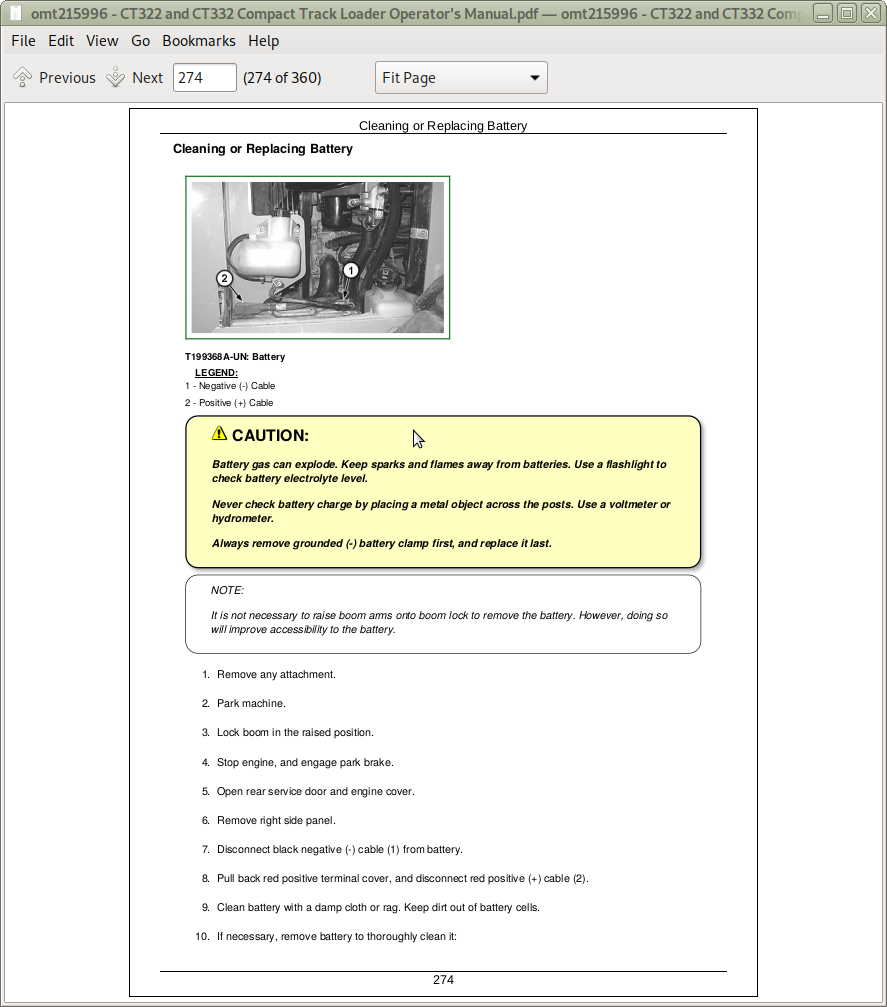
Cleaning or Replacing Battery
Replacing Fuses—Standard Controls
Replacing Fuses—EH Controls
Replacing Blower Motor Fuse
Replacing Glow Plug Fuse
Unified Inch Bolt and Cap Screw Torque Values
Metric Bolt and Cap Screw Torque Values
Section 4-2: Miscellaneous—Operational Checkout
Operational Checkout
Section 4-3: Miscellaneous—Troubleshooting
Troubleshooting Procedure
Engine
Electrical System
Hydraulic System
Section 4-4: Miscellaneous—Storage
Prepare Machine for Storage
Monthly Storage Procedure
Section 4-5: Miscellaneous—Machine Numbers
Record Product Identification Number (PIN)
Record Engine Serial Number
Keep Proof of Ownership
Keep Machines Secure
Section 4-6: Miscellaneous—Specifications
CT322 Engine Specifications
CT332 Engine Specifications
CT322 Drain and Refill Capacities
CT332 Drain and Refill Capacities
CT322 Machine Dimensions
CT332 Machine Dimensions
Pallet Fork Lift Chart
John Deere CT322 and CT332 Compact Track Loader Operator's Manual (OMT215996)