
John Deere 4044M 4044R 4052M 4052R 4066M 4066R Tractor Operator's Manual (OMLVU29832) PDF - MJODOMLVU29832.zip
John Deere 4044M, 4044R, 4052M, 4052R, 4066M, and 4066R Tractors Operator's Manual (OMLVU29832)
This full operator's manual covers the John Deere 4044M, 4044R, 4052M, 4052R, 4066M, and 4066R Tractors, providing every technical detail you need to run and care for your JD equipment.
omlvu29832 - John Deere 4044M, 4044R, 4052M, 4052R, 4066M, and 4066R Tractors Operator's Manual (North America, September 2015) - (North American Edition) Operator's Manual.pdf
PRODUCT DETAILS:
Total Pages: 557 pages
File Format: PDF (Internal Links, Bookmarked, Table of Contents, Searchable, Printable, high quality)
Language: English
omlvu29832 - 4044M, 4044R, 4052M, 4052R, 4066M, and 4066R Tractors Operator's Manual (North America, September 2015) -: (North American Edition)
Table of Contents
Foreword
Section 01: Introduction
Thank You for Purchasing a John Deere Product
Using Your Operator’s Manual
Special Messages
Attachments for Your Machine
Glossary of Terms
Section 02: Product Identification
Product Identification Information
Record Identification Numbers
Section 03: Safety Labels
Replace Safety Signs
Safety Signs—All
Safety Signs—OOS
Safety Signs—Cab
Section 04: Safety
Recognize Safety Information
Understand Signal Words
Follow Safety Instructions
Prepare for Emergencies
Wear Protective Clothing
Protect Against Noise
Handle Fuel Safely—Avoid Fires
Handle Starting Fluid Safely
Fire Prevention
In Case of Fire
Avoid Static Electricity Risk When Refueling
Keep ROPS Installed Properly
Use Foldable ROPS and Seat Belt Properly
Stay Clear of Rotating Drivelines
Use Steps and Handholds Correctly
Read Operator’s Manuals for ISOBUS Controllers
Use Seat Belt Properly
Operating the Tractor Safely
Avoid Backover Accidents
Limited Use in Forestry Operation
Operating the Loader Tractor Safely
Keep Riders Off Machine
Instructional Seat
Use Safety Lights and Devices
Use a Safety Chain
Transport Towed Equipment at Safe Speeds
Use Caution On Slopes and Uneven Terrain
Freeing a Mired Machine
Avoid Contact with Agricultural Chemicals
Handle Agricultural Chemicals Safely
Handling Batteries Safely
Avoid Heating Near Pressurized Fluid Lines
Remove Paint Before Welding or Heating
Handle Electronic Components and Brackets Safely
Practice Safe Maintenance
Avoid Hot Exhaust
Clean Exhaust Filter Safely
Work In Ventilated Area
Support Machine Properly
Prevent Machine Runaway
Park Machine Safely
Transport Tractor Safely
Service Cooling System Safely
Service Accumulator Systems Safely
Service Tires Safely
Service Front-Wheel Drive Tractor Safely
Tightening Wheel Retaining Bolts/Nuts
Avoid High-Pressure Fluids
Do Not Open High-Pressure Fuel System
Store Attachments Safely
Decommissioning: Proper Recycling and Disposal of Fluids and Components
Section 05: Operating Controls
Open Operator Station Controls—Hydrostatic Transmission
Open Operator Station Controls—PowrReverser Transmission
Cab—Operator Station Controls
Floor Panel Operation
Fender Controls—If Equipped
HVAC Controls
Section 06: Operating
Daily Operating Checklist
Avoid Damage to Plastic and Painted Surfaces
Entering and Exiting Machine
Adjusting Seat
Using Seat Belt
Adjusting Tilt Steering Wheel—If Equipped
Using Toolbox—If Equipped
Using Key Switch
Using Instrument Panel
Using Lights and Turn Signals
Using Display Mode Switch
Using Cruise Control—If Equipped
Using eThrottle—If Equipped
Using LoadMatch—If Equipped
Using SpeedMatch—If Equipped
Using MotionMatch—If Equipped
Using Dome Light—Cab
HVAC Temperature Control—Cab
Using Windshield Wiper and Washer—Cab
Defrost Windshield and Side Glass—Cab
Using Radio—Cab
Using Rear Window—Cab
Using Power Port Outlet
Exterior Cable Access—Cab
Testing Safety Systems
Testing Rear PTO Switch
Testing the Seat Switch
Using Brake Pedals
Using Park Brake
Using Throttle
Using Fuel Shutoff Valve
Filling Fuel Tank
Starting the Engine—Hydrostatic Transmission
Starting the Engine—PowrReverser Transmission
Stopping Machine
Operating Hydrostatic Transmission
Operating PowrReverser Transmission
Driving Machine—Hydrostatic Transmission
Driving Machine—PowrReverser Transmission
Come Home Mode
Using PowrReverser Shuttle Control—If Equipped
Using Differential Lock (Traction Assist)
Using Mechanical Front Wheel Drive (MFWD)
Using the Power Take-Off (PTO) Safely
Using Rear PTO Switch
Using the Two Speed Rear PTO—If Equipped
Using Hitch Assist—If Equipped
Using Drawbar Hitch—If Equipped
Using 3-Point Hitch
Using Optional iMatch Quick-Attach Hitch System
Using Attachments
Connecting Implement Hydraulic Hoses
Using Dual Selective Control Valve Lever—If Equipped
Using 3rd Selective Control Valve (SCV) Outlet—If Equipped
Using Power Beyond Outlet—If Equipped
Using IV and V Rear Outlet Selective Control Valve (SCV)—If Equipped
Using Diverter I, II, and III Rear Outlets—If Equipped
Raising and Lowering Roll-Over Protective Structure (ROPS)
Ballasting Machine
Transporting Machine on Trailer
Transporting Machine
Pushing or Towing Machine
Cleaning Hood Vents
Exhaust Filter System Overview
Automatic (AUTO) Exhaust Filter Cleaning
Disabled Exhaust Filter Cleaning
Parked Exhaust Filter Cleaning
Service Exhaust Filter Cleaning
Using Front 3-Point Hitch—If Equipped
Using Front Hitch Lift Arms—Category 1—If Equipped
Using Loader with Front Hitch—If Equipped
Placing Front Hitch Lift Arms in Storage Position—Category 1—If Equipped
Using Torsion Tube—Category 1—If Equipped
Using Heavy Duty Push Bar—Category 1—If Equipped
Section 07: Replacement Parts
Service Literature
Parts
Section 08: Fuel, Lubricants, and Coolant
Diesel Fuel
Handling and Storing Diesel Fuel
Testing Diesel Fuel
Minimizing the Effect of Cold Weather on Diesel Engines
Alternative and Synthetic Lubricants
Engine Oil
Diesel Engine Coolant
Operating in Warm Temperature Climates
Testing Coolant Freeze Point
Section 09: Service Intervals
Servicing Your Machine
As Needed
After First 10 Hours
Every 10 Hours or Daily
Every 50 Hours
Every 100 Hours
Every 200 Hours or Annually
Every 400 Hours
Every 400 Hours or Annually
Every 600 Hours
Yearly
Every 1000 Hours
Every Two Years or 2000 Hours
Every 6 Years or 6000 Hours
Section 10: Service Lubrication
Grease
Lubricating 3-Point Hitch
Lubricating Axle Trunnion
Section 11: Service Engine
Required Emission-Related Information
Avoid Fumes
Checking Engine Oil Level
Changing Engine Oil and Filter
Cleaning Dust Unloading Valve
Servicing Air Filter Elements
Checking Air Filter Intake Hose
Service Cooling System Safely
Servicing Cooling System
Checking Radiator Hoses and Clamps
Cleaning Cooling Fins
Servicing the Alternator Belt
Servicing the Air Conditioner Belt—Cab
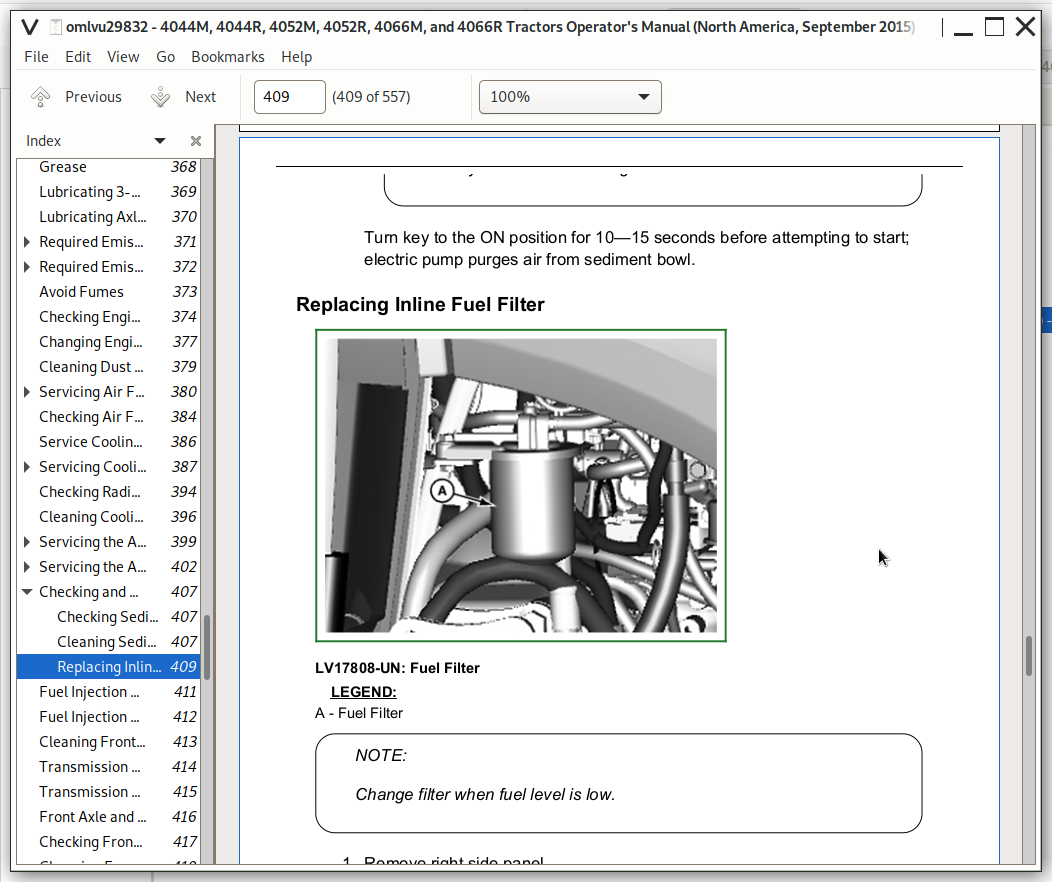
Checking and Cleaning Fuel Filter Sediment Bowl and Replacing Filter
Fuel Injection Pump
Fuel Injection Nozzles
Cleaning Front Grille Screens
Section 12: Service Transmission
Transmission and Hydraulic Oil
Front Axle and MFWD Oil
Checking Front Axle Oil Level
Changing Front Axle Oil
Adjusting Front Axle Thrust Bolt Torque
Checking Transmission Oil Level
Changing Transmission Oil and Hydraulic Suction Oil Filter
Section 13: Service Electrical
Service Electrical
Service the Battery Safely
Checking Battery Electrolyte Level
Battery Removal and Installation
Cleaning Battery and Terminals
Using Booster Battery
Replacing Headlight Bulb
Replacing Light Bulbs—Open Station
Replacing Light Bulbs—Cab
Replacing Relays and Fuses
Section 14: Service Miscellaneous
Using Proper Fuel (Diesel)
Raising and Lowering Hood
Side Panel Removal and Installation
Hood Cowl Removal and Installation
Checking Wheel Bolts and Hardware
Removing and Installing Wheels
Checking Tire Pressure
Selecting Front Tire Rolling Direction
Changing Wheel Spacing and Tread Width
Checking and Adjusting Toe-In
Cleaning Plastic Surfaces
Cleaning and Repairing Metal Surfaces
Cleaning Hood Vents
Servicing Air Conditioner
Cleaning Cab Air Filter
Checking Cab Roll-Over Protection System Installation
Section 15: Troubleshooting
Using Troubleshooting Chart
Engine
Electrical System
Heater and Air Conditioning System
Machine
Brakes
Steering
Section 16: Storage
Storing Safety
Preparing Machine for Storage
Preparing Fuel and Engine For Storage
Removing Machine From Storage
Section 17: Specifications
Engine
Drivetrain
Hydraulic System
Electrical System
Front Wheels and Tires Maximum Pressure
Rear Wheels and Tires Maximum Pressure
Fluid Capacities
Ground Speeds
Dimensions
Tread Width
Height from Ground
Ground Clearance
Turning Circle
Weight
3-Point Hitch
Unified Inch Bolt and Screw Torque Values
Metric Bolt and Screw Torque Values
Section 18: Warranty
Product Warranty
John Deere, California and U.S. EPA Emission Control System Warranty (Non-Road Diesel)
Tire Warranty
Limited Battery Warranty
Section 19: John Deere Quality Statement
John Deere Quality
Section 20: Service Record
Record Service Dates