






Internal vs External Explained — Which level (PDF Guide)
You were told to target external liquidity and ignore internal, and then given no way to tell them apart on a live chart. So you guessed, and every level you skipped looked exactly like every level you took.
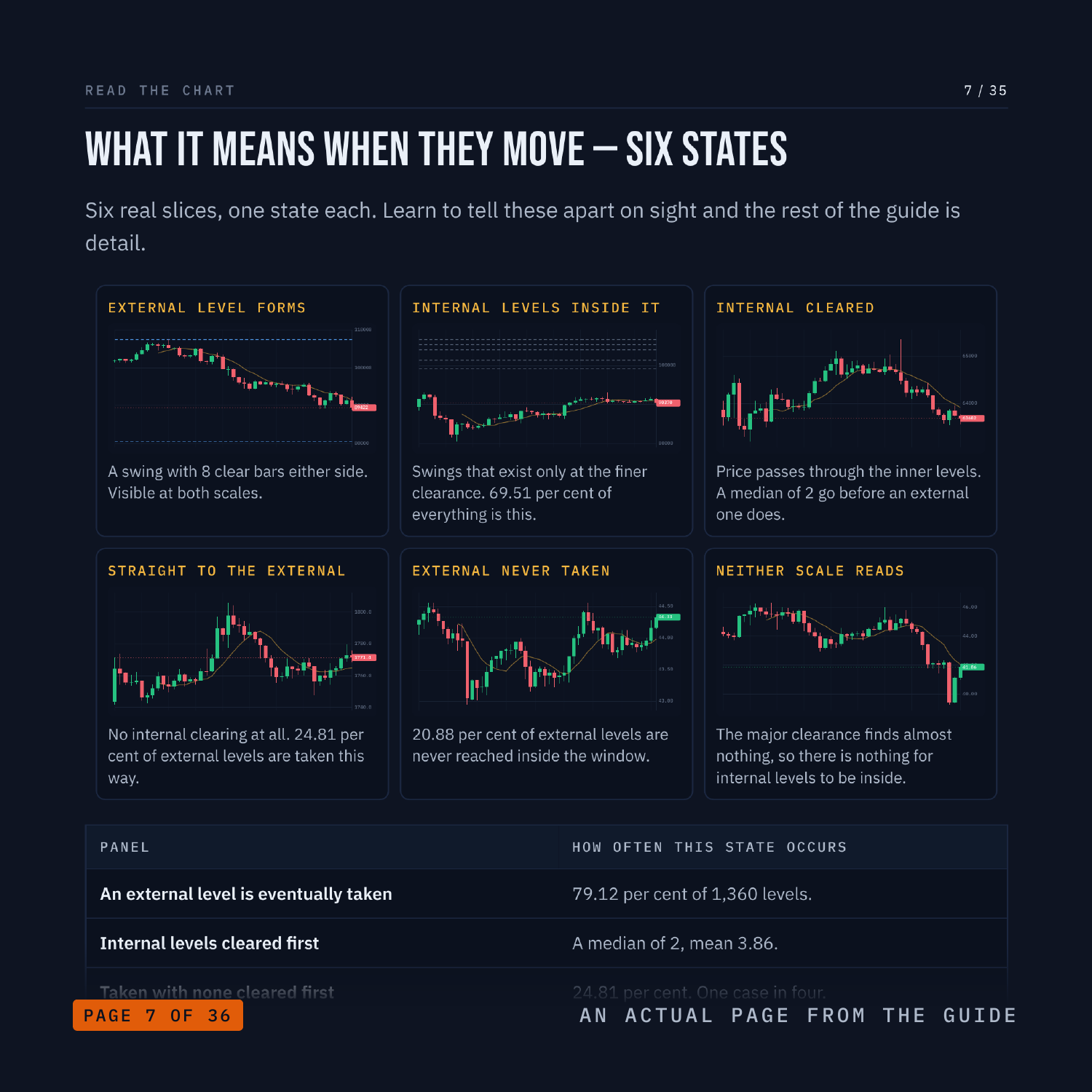
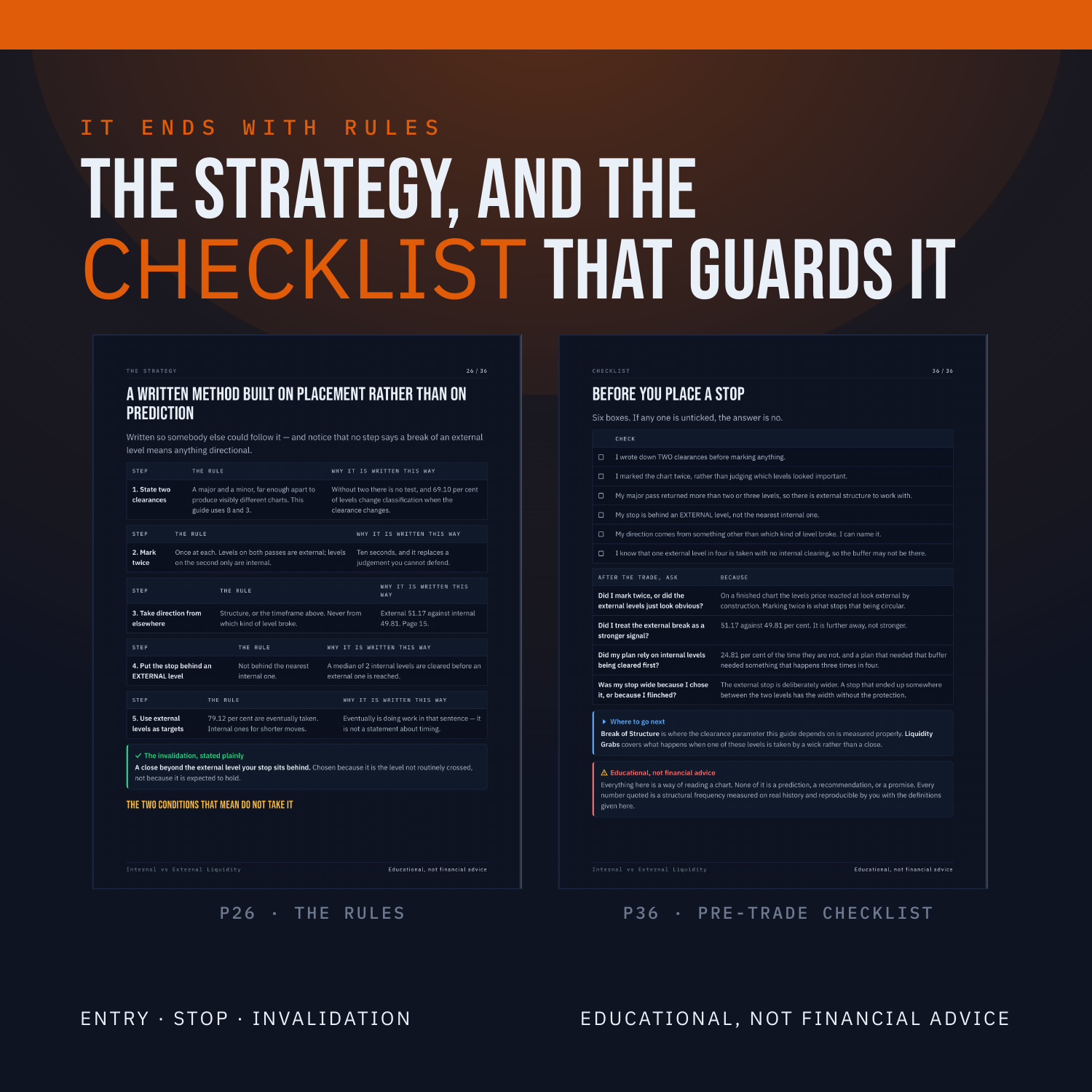
Which is which is a two-clearance test: a level that registers at your major clearance is external, one that only exists at the minor clearance is internal. Measured across 35,944 bars, 69.51% of breaks are internal. And this guide measures the question nobody attaches a number to - across 1,360 external levels, 79.12% were eventually taken, with a median of 2 internal levels cleared first, and 24.81% taken with no internal clearing at all. This is a 36-page PDF that teaches Internal vs External from the first thing you see on the screen through to a written strategy with an entry, a stop and an explicit rule for when the trade is wrong.
Nothing is taught underneath a chart. Every label sits on the candle, the line or the level it is describing, on real market data. There are three quizzes on real charts, each followed by the same chart re-shown annotated with the reasoning, plus faded practice pages where the first steps are filled in and you finish the rest.
WHAT'S INSIDE
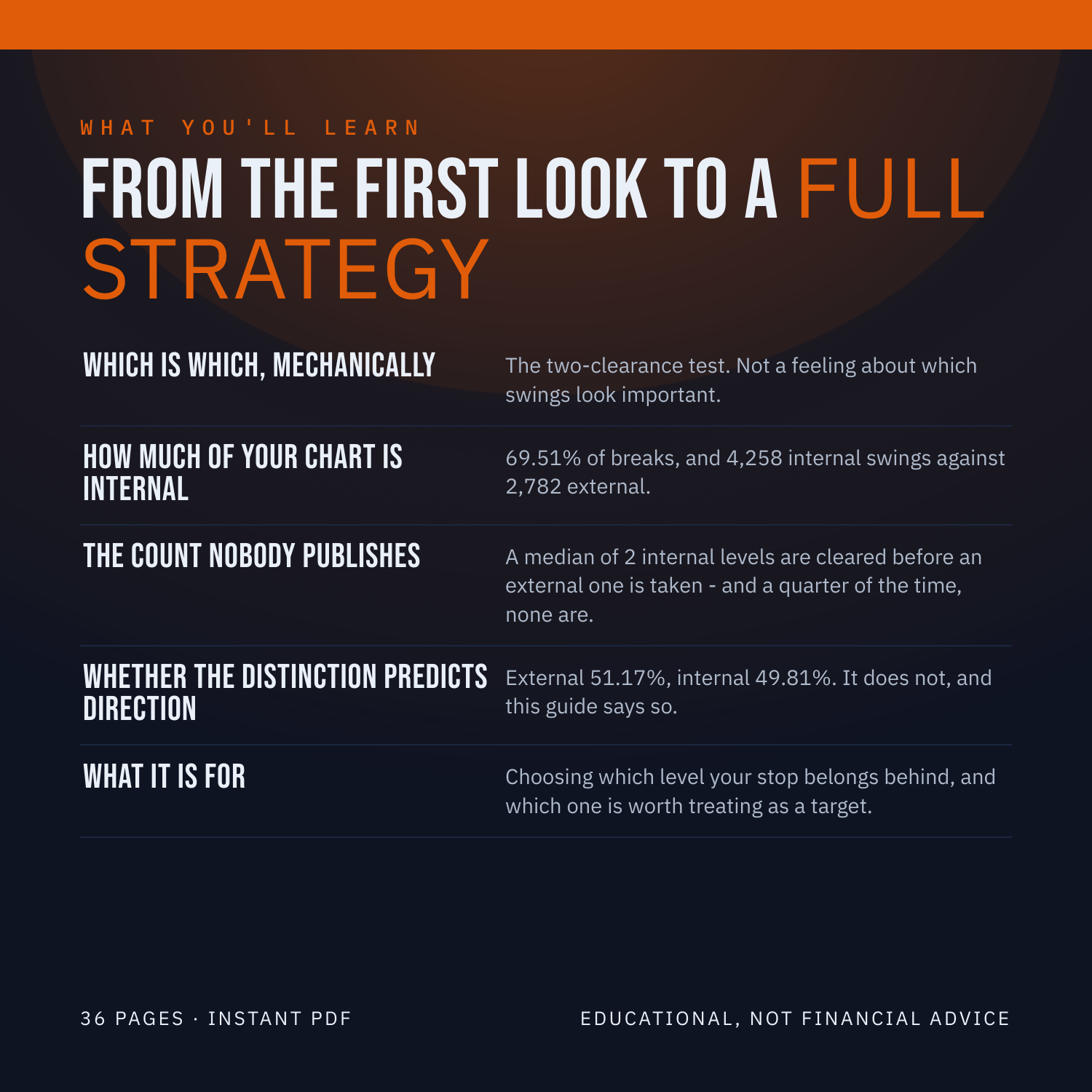
• Which is which, mechanically — The two-clearance test. Not a feeling about which swings look important.
• How much of your chart is internal — 69.51% of breaks, and 4,258 internal swings against 2,782 external.
• The count nobody publishes — A median of 2 internal levels are cleared before an external one is taken - and a quarter of the time, none are.
• Whether the distinction predicts direction — External 51.17%, internal 49.81%. It does not, and this guide says so.
• What it IS for — Choosing which level your stop belongs behind, and which one is worth treating as a target.
WHAT YOU'LL BE ABLE TO DO
• Sort any level into internal or external with a stated test.
• Say how much of what you are looking at is internal.
• Give a number for how many internal levels get cleared first.
• Stop treating the distinction as a directional filter.
• Put your stop behind the level that is not routinely cleared.
AN HONEST NOTE
Internal vs External is a clue, not a crystal ball. It describes what price has already done. This guide contains no win-rates, no backtest results and no promises about what you will make, because nobody can verify those and you should not trust anyone who prints them. What it hands you instead is a set of rules you can test yourself on TradingView in an afternoon. Educational, not financial advice.
Instant download. 36 pages, PDF.