
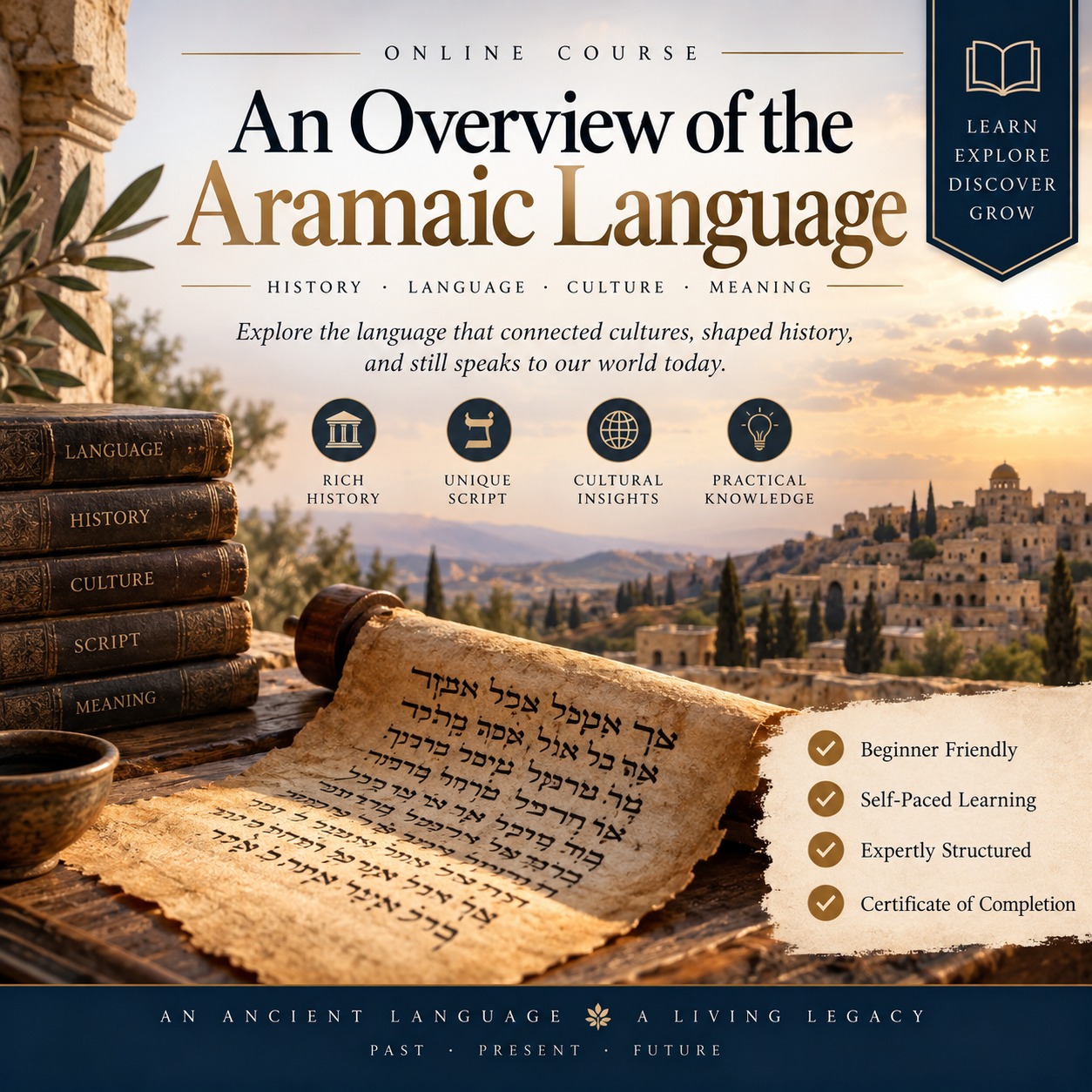
An Overview of the Aramaic Language
An Overview of the Aramaic Language
Discover One of the World’s Most Historically Important Languages
Step into the fascinating world of Aramaic, one of the most influential languages of the ancient Near East and a language with a remarkable history extending across thousands of years.
An Overview of the Aramaic Language is an accessible online course designed to introduce learners to the history, development, cultural significance, writing traditions, and linguistic characteristics of Aramaic.
Whether you are interested in ancient languages, history, religion, archaeology, linguistics, manuscripts, Middle Eastern cultures, or simply enjoy discovering how languages shape civilizations, this course offers an engaging starting point.
You do not need any previous knowledge of Aramaic.
The course has been structured so that beginners can gradually build an understanding of the language while also discovering the extraordinary historical environment in which Aramaic developed.
Why Study Aramaic?
Few languages have played such a broad historical role across different civilizations, regions, communities, and centuries.
Aramaic emerged in the ancient Near East and eventually became widely used across large parts of the region. Over time, it developed into numerous dialects and literary traditions and became an important language of administration, trade, scholarship, religion, and everyday communication.
Its historical importance extends across many areas, including:
- Ancient Near Eastern history
- Mesopotamian civilizations
- The Persian Empire
- Biblical studies
- Early Judaism
- Early Christianity
- Syriac Christianity
- Ancient manuscripts
- Semitic linguistics
- Archaeology
- Religious history
- Cultural history of the Middle East
Studying Aramaic therefore means studying much more than vocabulary or grammar.
It provides a window into the intellectual, cultural, religious, and political worlds of ancient societies.
What Is Aramaic?
Aramaic belongs to the Semitic family of languages, alongside languages such as Hebrew, Arabic, Akkadian, and several other ancient and modern languages.
The earliest evidence of Aramaic dates back thousands of years.
From its early regional origins, the language spread widely and became an important means of communication across the Near East.
Throughout its long history, Aramaic developed into numerous varieties.
Rather than thinking of Aramaic as a single unchanging language, it is more accurate to understand it as a large historical linguistic tradition containing different periods, dialects, scripts, and literary cultures.
This course helps learners understand that development in a clear and approachable way.
What You Will Explore
Throughout the course, you will be introduced to key topics relating to Aramaic language and culture.
The Origins of Aramaic
Explore where Aramaic came from and learn about the communities associated with its earliest development.
Understand the historical setting of the ancient Near East and how different peoples and languages interacted.
The Historical Development of Aramaic
Discover how Aramaic expanded from a regional language into one of the most significant languages of the ancient world.
You will explore the major historical periods in the development of Aramaic and see how political change, migration, commerce, and empire contributed to its spread.
Imperial Aramaic
One of the most important periods in Aramaic history came when varieties of the language were widely used for administration across large territories.
Learners will examine the role of Aramaic as a language of communication and administration and consider why it became so practical in multicultural environments.
Aramaic and the Ancient Near East
The course places Aramaic within the broader historical environment of civilizations including:
- Mesopotamia
- Assyria
- Babylonia
- Persia
- The Levant
- Syria
- Palestine
- Anatolia
Understanding this historical context makes the language much easier to appreciate.
The Aramaic Writing Tradition
A major part of the course introduces learners to the development of Aramaic writing.
You will explore:
- Aramaic alphabets
- Historical scripts
- Letter forms
- Writing direction
- Manuscript traditions
- The relationship between language and script
- Changes in writing systems over time
You will also begin to understand how Aramaic writing influenced or interacted with other writing traditions.
The objective is not simply to memorize letters, but to understand how written Aramaic developed historically.
Aramaic and Other Semitic Languages
Aramaic belongs to a wider linguistic family.
Throughout the course, learners will gain awareness of similarities and differences between Aramaic and related Semitic languages.
Topics may include comparisons involving:
- Hebrew
- Arabic
- Akkadian
- Phoenician
- Syriac
These comparisons can help students understand how Semitic languages are historically related and how vocabulary, sounds, grammatical structures, and writing traditions evolved.
Introduction to Aramaic Vocabulary
Learners will encounter selected Aramaic words and expressions while gaining an understanding of how the language is structured.
Rather than overwhelming beginners with extensive memorization, the course introduces vocabulary in context.
Students can begin developing familiarity with:
- Common words
- Basic expressions
- Roots
- Word formation
- Historical terminology
- Selected textual examples
This approach allows learners to gradually become comfortable with the appearance and structure of the language.
Introduction to Aramaic Grammar
The course also provides an overview of important grammatical concepts.
Depending on the section studied, learners may encounter introductory explanations concerning:
- Nouns
- Pronouns
- Verbs
- Roots
- Gender
- Number
- Word formation
- Sentence structure
- Basic grammatical patterns
The aim is not to turn beginners immediately into advanced Aramaic readers.
Instead, the course provides a foundation from which further study becomes easier.
Aramaic and Religious History
Aramaic occupies an important place in the study of several religious traditions.
Historical forms of Aramaic appear in religious literature and communities associated with Judaism and Christianity.
The language is particularly important for understanding the linguistic environment of the ancient Near East during important periods of religious development.
Students interested in religious history will therefore find Aramaic especially valuable.
Biblical Aramaic
Parts of the Hebrew Bible contain passages written in Aramaic.
The course introduces learners to the significance of Biblical Aramaic and explains why scholars distinguish it from other historical varieties of the language.
Students interested in biblical history, theology, religious studies, or ancient texts can use this overview as a foundation for more specialized study later.
Aramaic in the Time of Jesus
Aramaic is frequently discussed in connection with the linguistic environment of Jesus and the communities of the eastern Mediterranean during the first century.
This course examines the historical context carefully and helps learners understand the role that Aramaic played alongside other languages used in the region.
Rather than relying on popular myths or oversimplifications, learners are encouraged to approach the subject historically and linguistically.
Syriac and the Aramaic Tradition
One of the most important literary traditions associated with Aramaic is Syriac.
Syriac became a major language of Christian scholarship, literature, theology, translation, philosophy, and intellectual exchange.
Learners will be introduced to the importance of Syriac and its relationship to the broader Aramaic linguistic tradition.
This provides an excellent starting point for anyone who may later wish to study Syriac manuscripts or literature in greater depth.
Ancient Manuscripts and Inscriptions
Aramaic has been preserved through many forms of historical evidence.
These include:
- Inscriptions
- Administrative documents
- Religious texts
- Letters
- Manuscripts
- Legal documents
- Stone inscriptions
- Papyri
- Historical records
Studying these materials allows researchers to reconstruct aspects of ancient societies that might otherwise have disappeared.
The course introduces students to the importance of such evidence and explains how language can become a tool for understanding history.
Aramaic as a Cultural Bridge
One of the most fascinating characteristics of Aramaic is its ability to connect different cultures.
Across centuries, speakers and writers of Aramaic lived under different kingdoms, empires, and political systems.
The language therefore became a bridge between communities with different ethnic, religious, and cultural backgrounds.
Understanding Aramaic can reveal how ancient societies communicated across borders long before modern concepts of globalization existed.
Ancient Language, Living Legacy
Aramaic should not be regarded only as a language belonging to the distant past.
Forms of Neo-Aramaic have survived into the modern period within certain communities.
This remarkable continuity gives Aramaic a unique place in linguistic history.
A language with ancient inscriptions, classical literature, religious manuscripts, and modern descendants offers learners an extraordinary opportunity to observe linguistic change across very long periods of time.
What You Can Gain From This Course
By completing this course, you can develop a stronger understanding of:
- The origins of Aramaic
- The history of the Aramaic-speaking world
- Major periods of Aramaic development
- The Aramaic writing tradition
- Aramaic scripts and alphabets
- Basic linguistic characteristics
- The relationship between Aramaic and other Semitic languages
- Aramaic vocabulary and grammar
- Imperial Aramaic
- Biblical Aramaic
- Syriac
- Ancient inscriptions and manuscripts
- The role of Aramaic in religious history
- The cultural significance of the language
- The survival of Aramaic traditions into later periods
Who Is This Course For?
This course is suitable for a wide range of learners.
It may be particularly valuable for:
- Beginners interested in Aramaic
- History enthusiasts
- Language enthusiasts
- Students of linguistics
- Students of ancient languages
- Theology students
- Biblical studies students
- Religious studies students
- Archaeology students
- Historians
- Researchers
- Teachers
- Cultural studies students
- Manuscript enthusiasts
- Students interested in Middle Eastern history
- Learners interested in Semitic languages
- Anyone fascinated by ancient civilizations
No previous knowledge of Aramaic is required.
Beginner Friendly
Ancient languages can initially appear intimidating.
This course is designed to make the subject approachable.
Concepts are introduced progressively so learners can first understand the historical and linguistic background before moving toward more detailed topics.
You can therefore begin even if you have never studied:
- Aramaic
- Hebrew
- Arabic
- Syriac
- Linguistics
- Ancient history
A genuine interest in the subject is enough to begin.
Study at Your Own Pace
The course is designed for flexible online learning.
You can progress according to your own schedule and revisit sections whenever necessary.
This makes the program suitable for:
- Working professionals
- University students
- Independent researchers
- Lifelong learners
- Busy learners
- International students
There is no need to rush through the material.
Ancient languages often become much more understandable when studied gradually.
A Foundation for Further Study
This course is primarily an introduction and overview.
It can provide a valuable foundation for learners who later wish to explore specialist subjects such as:
- Biblical Aramaic
- Syriac
- Targumic Aramaic
- Jewish Babylonian Aramaic
- Imperial Aramaic
- Aramaic epigraphy
- Semitic linguistics
- Manuscript studies
- Biblical languages
- Ancient Near Eastern studies
By first developing a broad understanding of the historical landscape, learners can approach more specialized areas with greater confidence.
Certificate of Completion
Learners who successfully complete the required course components may receive a Certificate of Completion for:
An Overview of the Aramaic Language
The certificate can provide evidence of your independent learning and continuing education.
It may be useful for:
- Your CV or résumé
- LinkedIn profile
- Academic portfolio
- Professional development records
- Personal learning portfolio
- Continuing education documentation
Please note that a certificate of completion confirms participation and successful completion of the course requirements; it does not in itself constitute a regulated professional or academic qualification unless specifically stated by the issuing institution.
Course Features
Online Learning
Access the course from wherever you are.
Self-Paced Study
Learn according to your own schedule.
Beginner Friendly
No prior Aramaic knowledge is required.
Historical Perspective
Understand the language within the civilizations that used it.
Linguistic Introduction
Explore script, vocabulary, grammar, and language development.
Cultural Context
Discover how Aramaic connected communities across the ancient Near East.
Certificate of Completion
Receive recognition upon successful completion of the applicable course requirements.
Why Take This Course?
Learning about an ancient language can transform the way we understand history.
Translations allow us to read the content of ancient texts.
Studying the language itself allows us to see something more.
We begin to understand:
How people expressed ideas.
How cultures communicated.
How religious traditions developed.
How empires governed enormous territories.
How words changed across centuries.
How writing preserved human thought.
And how languages connect generations separated by thousands of years.
Aramaic provides an extraordinary example of all these processes.
Begin Your Journey Into Aramaic
From ancient inscriptions and imperial documents to religious manuscripts and surviving linguistic traditions, Aramaic tells a remarkable story.
It is the story of a language that crossed borders.
A language used by different communities.
A language that adapted through centuries of political and cultural change.
A language that became part of some of the most significant historical and religious traditions of the Near East.
And a language whose legacy continues to attract scholars, students, and language enthusiasts today.
An Overview of the Aramaic Language gives you the opportunity to begin exploring that story in a structured, accessible, and engaging way.
Explore the language.
Discover the history.
Understand the culture.
Connect with an ancient linguistic legacy.
Start your Aramaic learning journey today.