
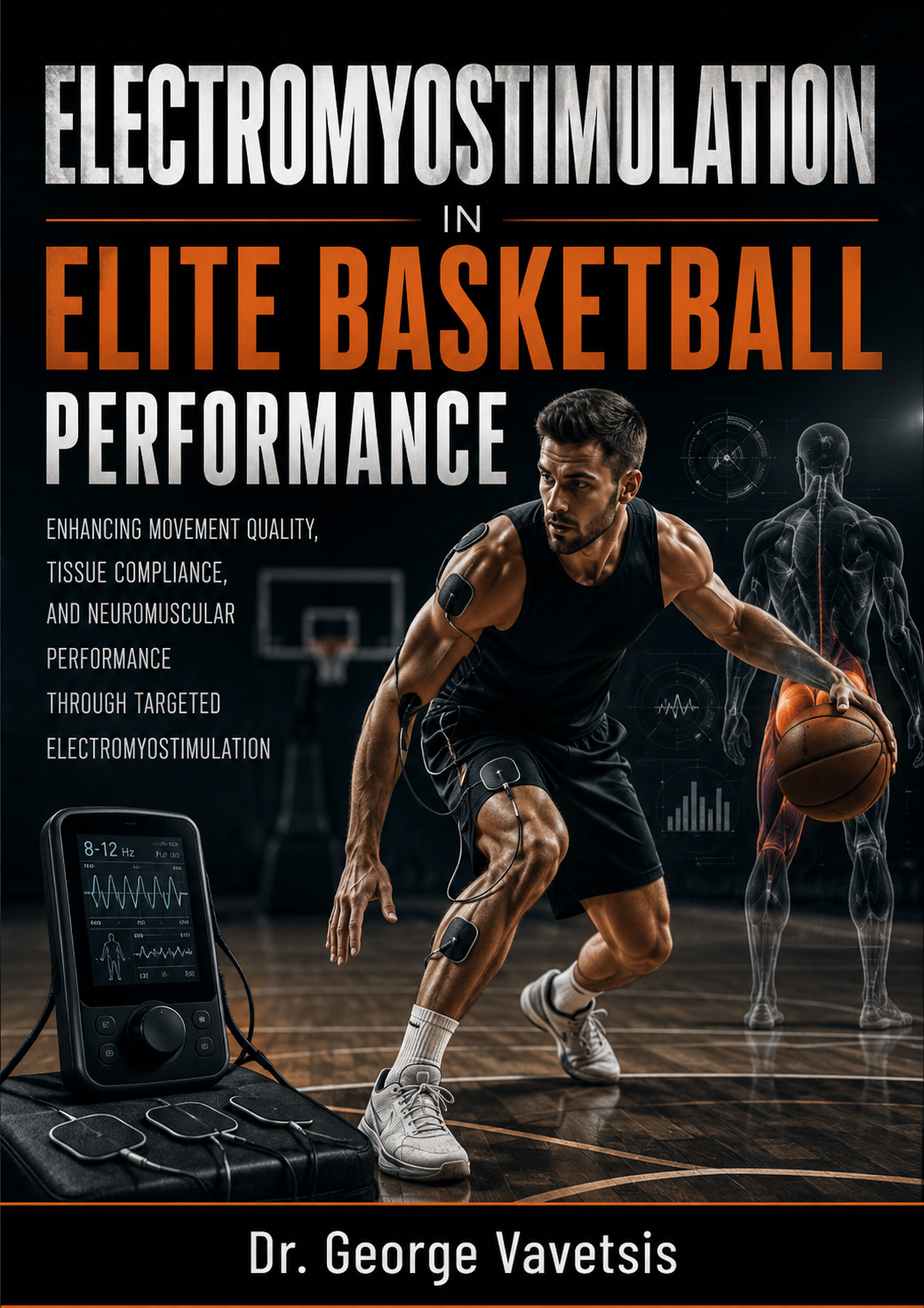
Electromyostimulation in Elite Basketball Performance
Pages: 813
The modern game of basketball is no longer governed solely by talent, technical precision, or tactical intelligence. Elite performance has evolved into an intricate convergence of neuromechanics, force-production efficiency, tissue resilience, perceptual decision-making, recovery science, and adaptive physiological regulation. Within this increasingly complex performance ecosystem, electromyostimulation (EMS) emerges not merely as an accessory modality, but as a sophisticated neurophysiological intervention capable of reshaping the preparation, restoration, and performance capacities of the basketball athlete.
For decades, EMS was largely misunderstood within sport performance environments. Its application was often confined to simplistic strength augmentation models, passive rehabilitation settings, or generalized recovery protocols lacking sport specificity. In many high-performance systems, EMS became associated with isolated muscle contraction divorced from authentic movement integration. Such reductionist thinking failed to appreciate the central reality of elite basketball performance: movement quality is never the product of isolated muscular activity, but rather the outcome of coordinated neuromechanical sequencing occurring across multiple planes, velocities, and cognitive demands.
Basketball is a sport of perpetual transitions. Accelerations rapidly become decelerations. Vertical projection instantly converts into landing absorption. Rotational dissociation precedes shot creation. Hip repositioning determines defensive containment. Foot and ankle stiffness oscillate dynamically between elastic responsiveness and mobility access. Every possession represents a continuous negotiation between stability and freedom, tension and relaxation, propulsion and braking. Under these conditions, the nervous system—not merely the muscular system—becomes the true battlefield of performance.
This book was created to redefine the role of electromyostimulation within basketball through the lens of modern strength and conditioning science, applied neuromechanics, and elite movement preparation. The aim is not to present EMS as a standalone technology, but as an integrated performance strategy capable of influencing motor control, afferent regulation, tissue compliance, intermuscular coordination, and sport-specific movement transfer.
Throughout these chapters, EMS is approached as a tool for enhancing movement quality rather than replacing movement itself. The focus is deliberately centered on basketball-specific transfer: defensive slide mechanics, braking efficiency, rotational sequencing, jump preparation, penultimate-step control, hip repositioning, frontal-plane stabilization, trunk dissociation, ankle stiffness regulation, and neuromuscular recovery following repeated high-intensity exposures. Every protocol, progression, and recommendation is designed with the demands of elite basketball in mind.
A central philosophical foundation of this work is that high-performance preparation must respect the adaptive intelligence of the athlete’s nervous system. Excessive tension, maladaptive stiffness, altered afferent feedback, and protective movement guarding often limit performance more profoundly than insufficient force capacity alone. Consequently, many EMS applications within this text intentionally avoid maximal motor-unit recruitment strategies. Instead, emphasis is frequently placed upon low-frequency neuromodulation, submaximal tissue activation, eccentric compliance exposure, rotational sequencing enhancement, and integrated movement restoration.
The basketball athlete rarely suffers simply from weakness. More commonly, performance deteriorates through poor force timing, delayed positional transitions, altered stiffness regulation, compromised joint access, inefficient deceleration mechanics, or excessive neural fatigue accumulation. EMS, when integrated intelligently, offers the possibility of influencing these systems simultaneously.
The material presented in this book combines principles from strength and conditioning, sports neuroscience, fascial dynamics, biomechanics, motor learning, tissue adaptation, and basketball movement analysis. Readers will encounter practical systems integrating EMS with:
- defensive slide mechanics,
- deceleration training,
- change-of-direction preparation,
- ankle dorsiflexion re-education,
- thoracic rotational sequencing,
- jump approach mechanics,
- reactive stiffness modulation,
- lumbopelvic dissociation,
- hip internal-rotation restoration,
- frontal-plane force absorption,
- recovery-oriented neuromodulation,
- and basketball-specific movement integration.
Importantly, this text rejects the simplistic notion that more stimulation equals greater adaptation. In elite environments, precision outweighs intensity. The correct frequency, amplitude, timing, positional integration, breathing strategy, and movement pairing determine whether EMS enhances performance or disrupts it. Overstimulation can create protective stiffness, movement degradation, altered reactivity, and excessive fatigue. Intelligent application, however, can facilitate cleaner mechanics, smoother transitions, improved tissue tolerance, and more efficient force redistribution across the kinetic chain.
Another major objective of this work is to bridge the persistent gap between rehabilitation and performance preparation. Basketball athletes frequently exist in a state between these domains: not injured enough for medical restriction, yet not fully prepared for unrestricted explosive competition. EMS provides a valuable intermediary tool capable of restoring movement access while preserving neuromuscular readiness. This is particularly relevant during congested competitive schedules, travel periods, return-to-play transitions, or cumulative fatigue phases where traditional loading strategies may become excessively stressful.
The future of basketball performance science will increasingly depend upon individualized neuromechanical management rather than generalized conditioning alone. Athletes possess unique stiffness signatures, recovery responses, movement compensations, tendon behaviors, and nervous-system tolerances. EMS offers a rare opportunity to individualize intervention strategies with remarkable precision. When paired with movement diagnostics, force-plate monitoring, jump profiling, HRV assessment, and technical analysis, electromyostimulation can become a highly targeted tool within the broader architecture of performance management.
This book is intended for strength and conditioning coaches, sport scientists, physiotherapists, rehabilitation specialists, basketball performance directors, and advanced practitioners seeking deeper integration between technology and movement science. It is written from the perspective that elite performance preparation must remain dynamic, adaptable, and biologically intelligent.
Ultimately, basketball is a sport of organized chaos. The athlete who can maintain mechanical efficiency, reactive fluidity, positional control, and neuromuscular adaptability under chaotic conditions gains the competitive advantage. Electromyostimulation, when applied with scientific rigor and basketball-specific intent, can contribute meaningfully to that advantage.
This text invites the reader to move beyond outdated interpretations of EMS and toward a more integrated vision of human performance—one where neural regulation, movement quality, tissue behavior, and basketball-specific execution coexist within a unified high-performance framework.