





Support & Resistance Explained — Measured (PDF Guide)
You have been told that a level tested three times is stronger than one tested once, and also that every test uses up the orders behind it. Both are stated with total confidence, by people who trade for a living, and they cannot both be true. Nobody shows you the number.
Here is the number. Every multi-touch level in 35,944 bars of real history was walked forward touch by touch and each test recorded as a hold or a break. The hold rate barely moves - and what that means for how you use levels is the rest of this guide. This is a 36-page PDF that teaches Support & Resistance from the first thing you see on the screen through to a written strategy with an entry, a stop and an explicit rule for when the trade is wrong.
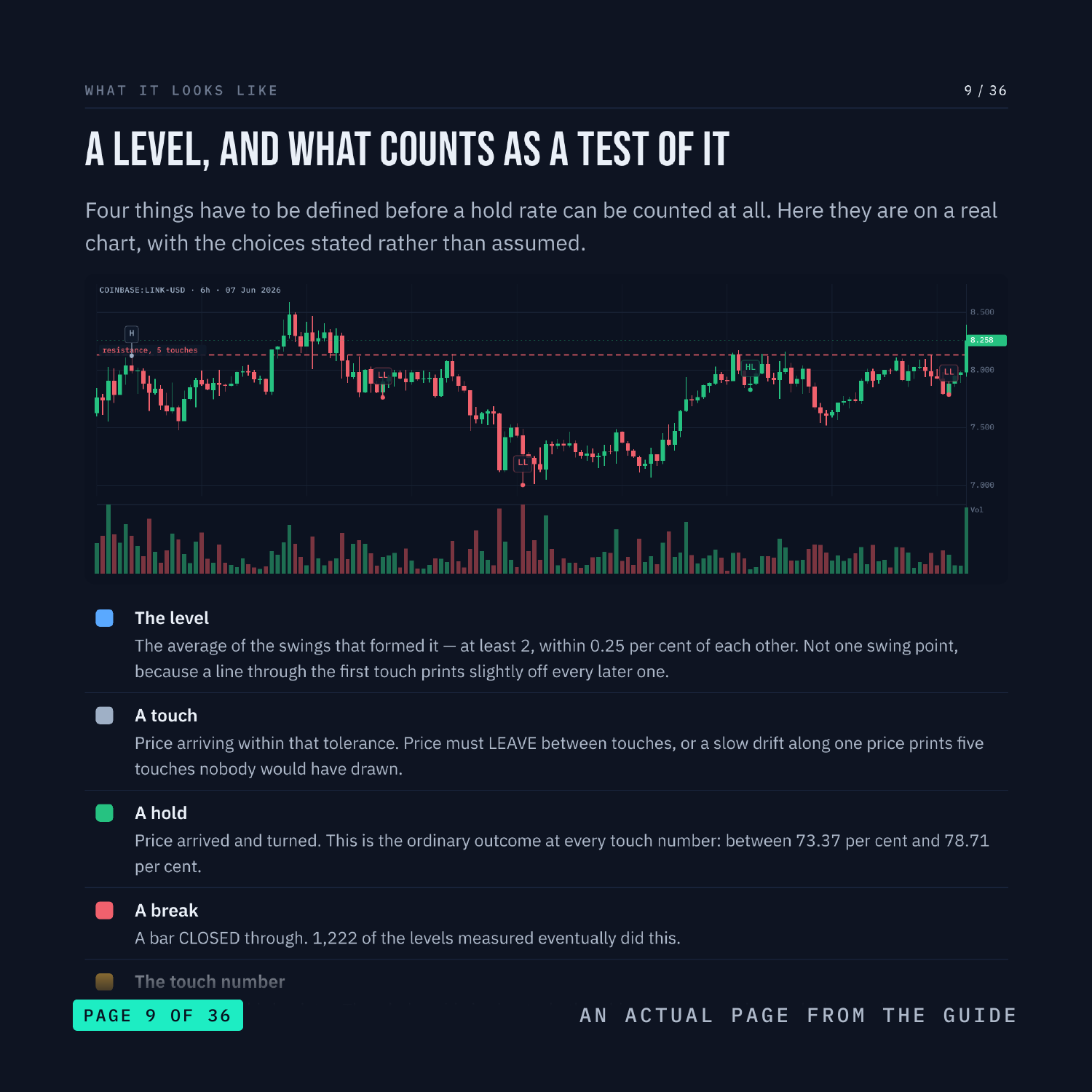
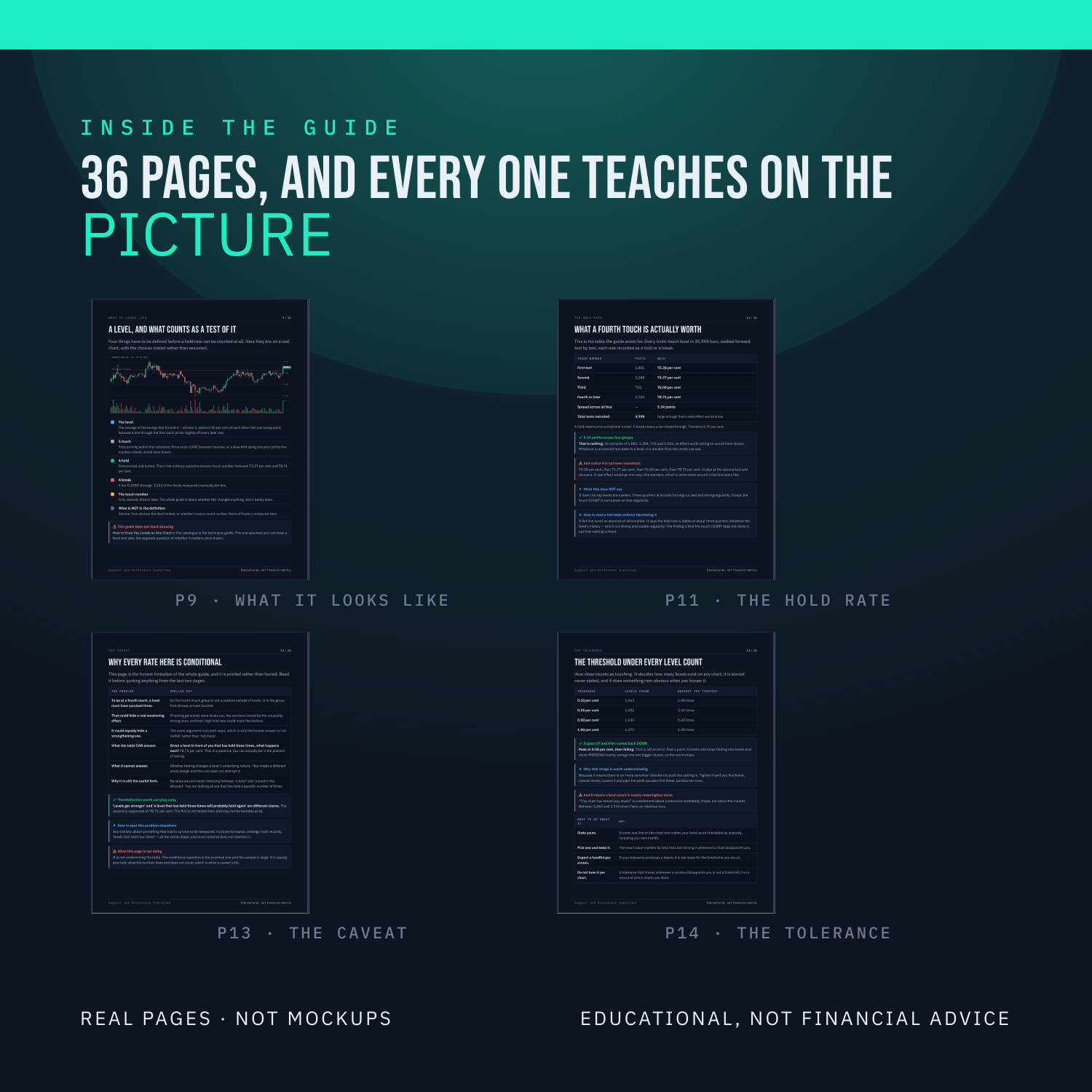
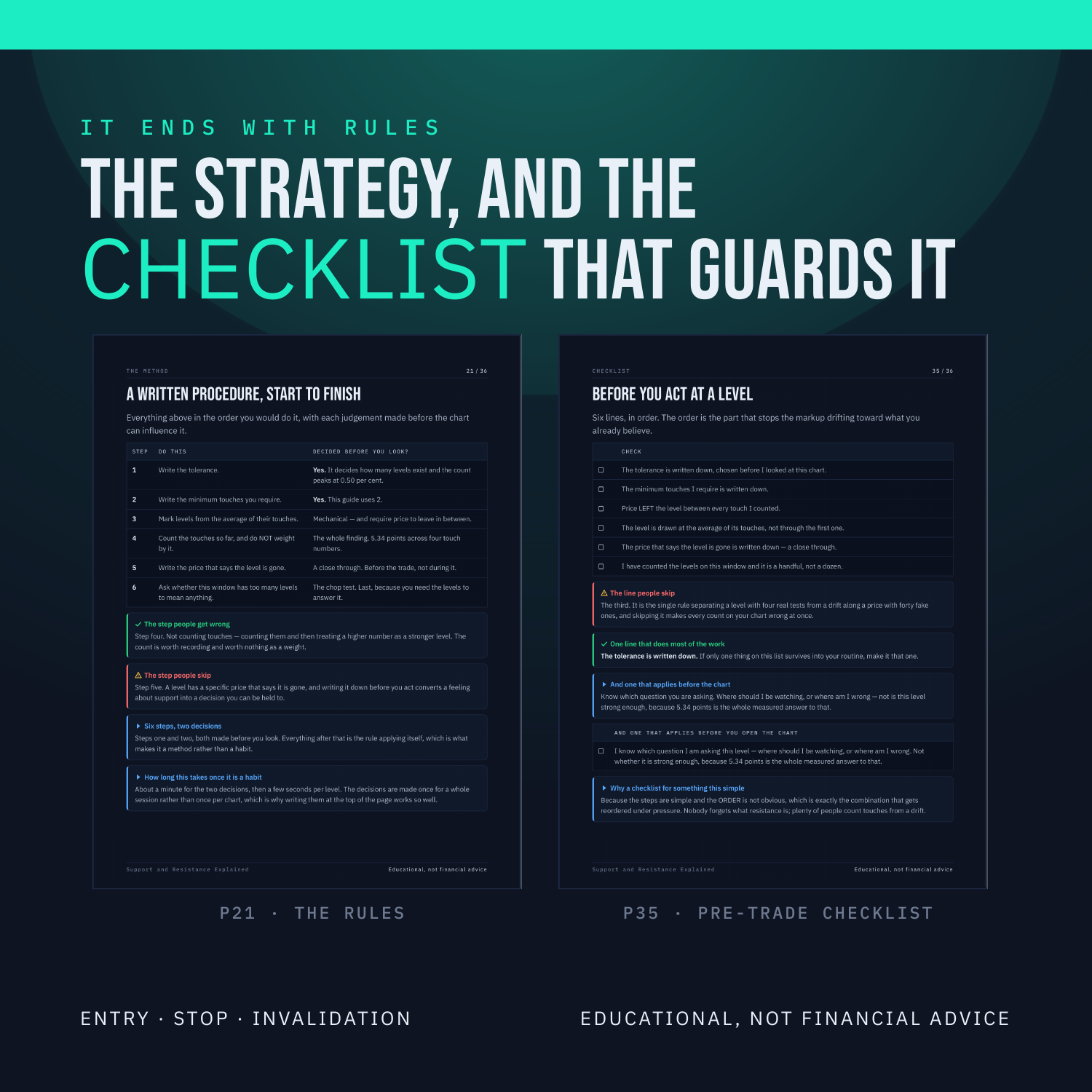
Nothing is taught underneath a chart. Every label sits on the candle, the line or the level it is describing, on real BTC, ETH, SOL and LINK charts. There are three quizzes on real charts, each followed by the same chart re-shown annotated with the reasoning, plus faded practice pages where the first steps are filled in and you finish the rest.
WHAT'S INSIDE
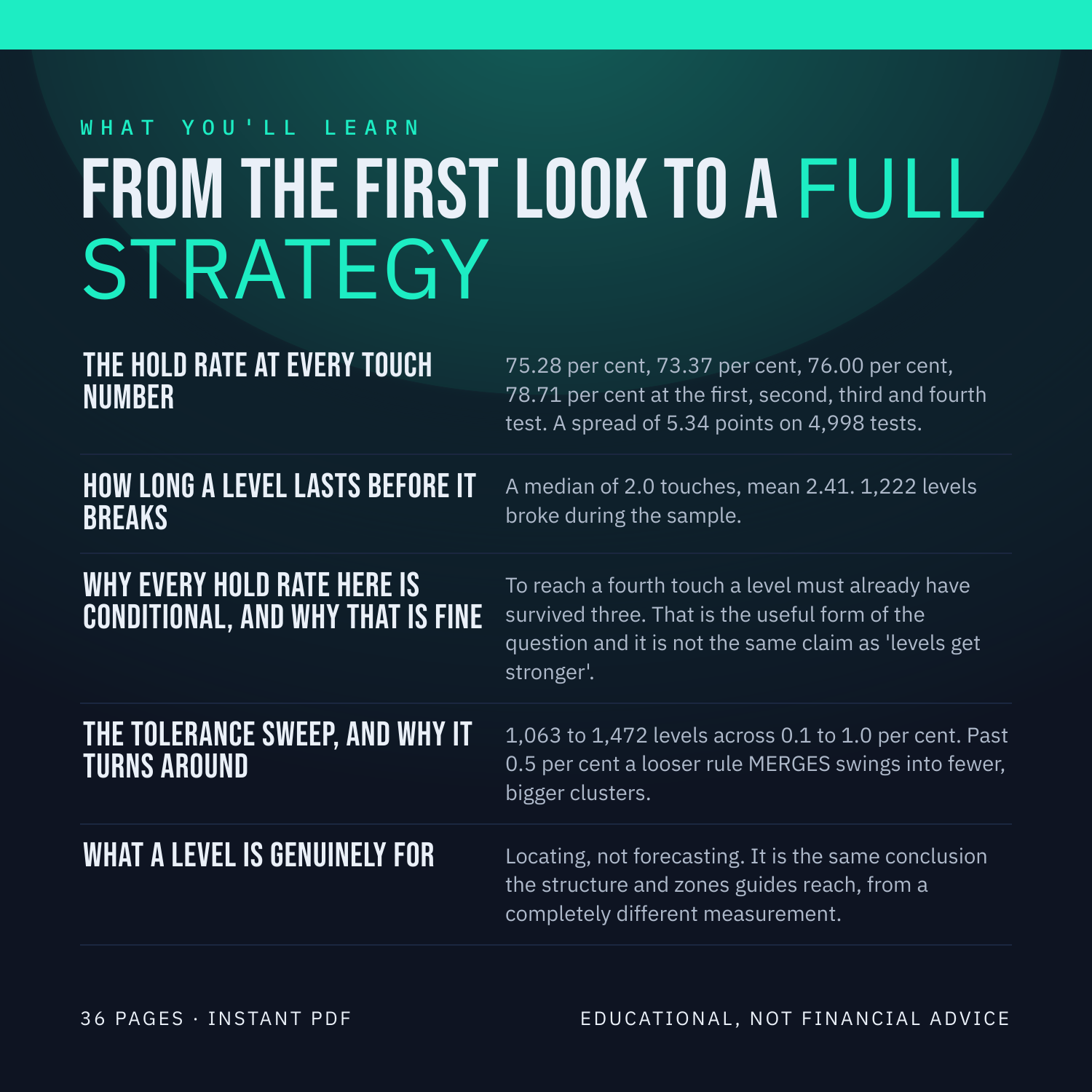
The hold rate at every touch number - 75.28 per cent, 73.37 per cent, 76.00 per cent, 78.71 per cent at the first, second, third and fourth test. A spread of 5.34 points on 4,998 tests.
How long a level lasts before it breaks - A median of 2 touches, mean 2.41. 1,222 levels broke during the sample.
Why every hold rate here is conditional, and why that is fine - To reach a fourth touch a level must already have survived three. That is the useful form of the question and it is not the same claim as 'levels get stronger'.
The tolerance sweep, and why it turns around - 1,063 to 1,472 levels across 0.1 to 1.0 per cent. Past 0.5 per cent a looser rule MERGES swings into fewer, bigger clusters.
What a level is genuinely for - Locating, not forecasting. It is the same conclusion the structure and zones guides reach, from a completely different measurement.
WHAT YOU'LL BE ABLE TO DO
Say what a fourth touch is worth, with a number.
Read a conditional rate without over-reading it.
State the tolerance behind any level count, including your own.
Stop waiting for a level to 'prove itself' before acting.
Explain why two confident, opposite claims can both be unsupported.
AN HONEST NOTE
A level is a clue, not a crystal ball. It describes what price has already done. This guide contains no win-rates, no backtest results and no promises about what you will make, because nobody can verify those and you should not trust anyone who prints them. What it hands you instead is a set of rules you can test yourself on TradingView in an afternoon. Educational, not financial advice.
Instant download. 36 pages, PDF.