
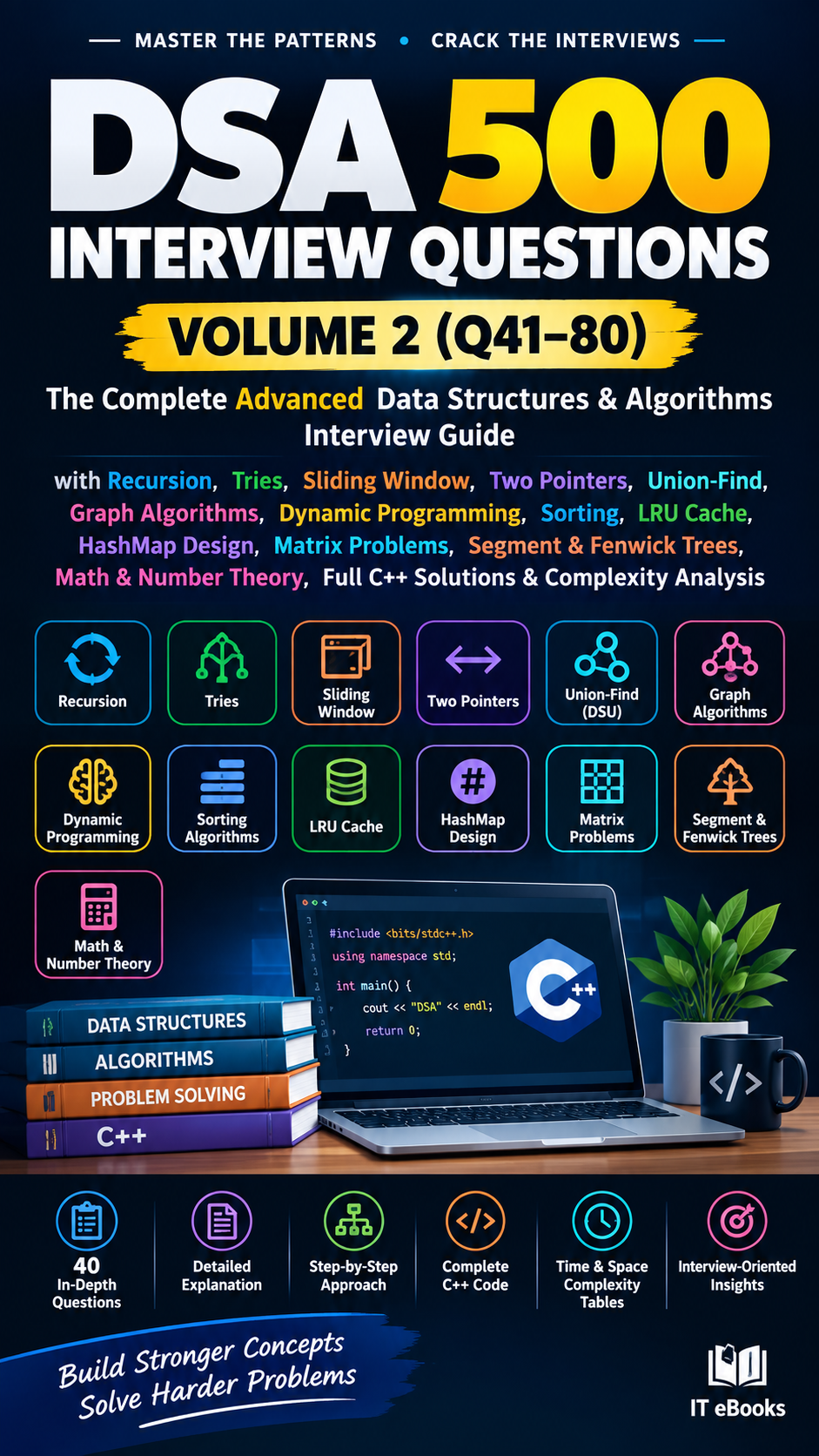



🚀 DSA 500 Interview Questions – Volume 2 (Q41–80) 📘: The Complete Advanced Data Structures & Algorithms Interview Guide 💻 | Recursion 🔁, Tries 🌳, Sliding Window 🪟, Two Pointers 👉, Union-Find 🔗, Advanced Graph Algorithms 🕸️, Dynamic Programming 🧠, Sorting
🚀 DSA 500 Interview Questions – Volume 2: Advanced Algorithms, Data Structures & C++ Problem Solving
📘 Volume 2 (Q41–80) takes your DSA interview preparation to the next level with 40 in-depth coding interview questions covering advanced algorithms, powerful problem-solving patterns, data structures, design problems, Dynamic Programming, graph algorithms, mathematical techniques, and more.
💻 Every question follows a consistent interview-focused format with a clear problem statement, detailed explanation, step-by-step approach, complete working C++ code, and time & space complexity analysis.
Whether you're a 🎓 student, 👨💻 software developer, 💼 interview candidate, or 🧠 competitive programmer, this volume is designed to help you understand how to solve DSA problems efficiently—not simply memorize solutions.
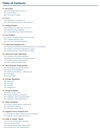
🔥 What You'll Learn in Volume 2
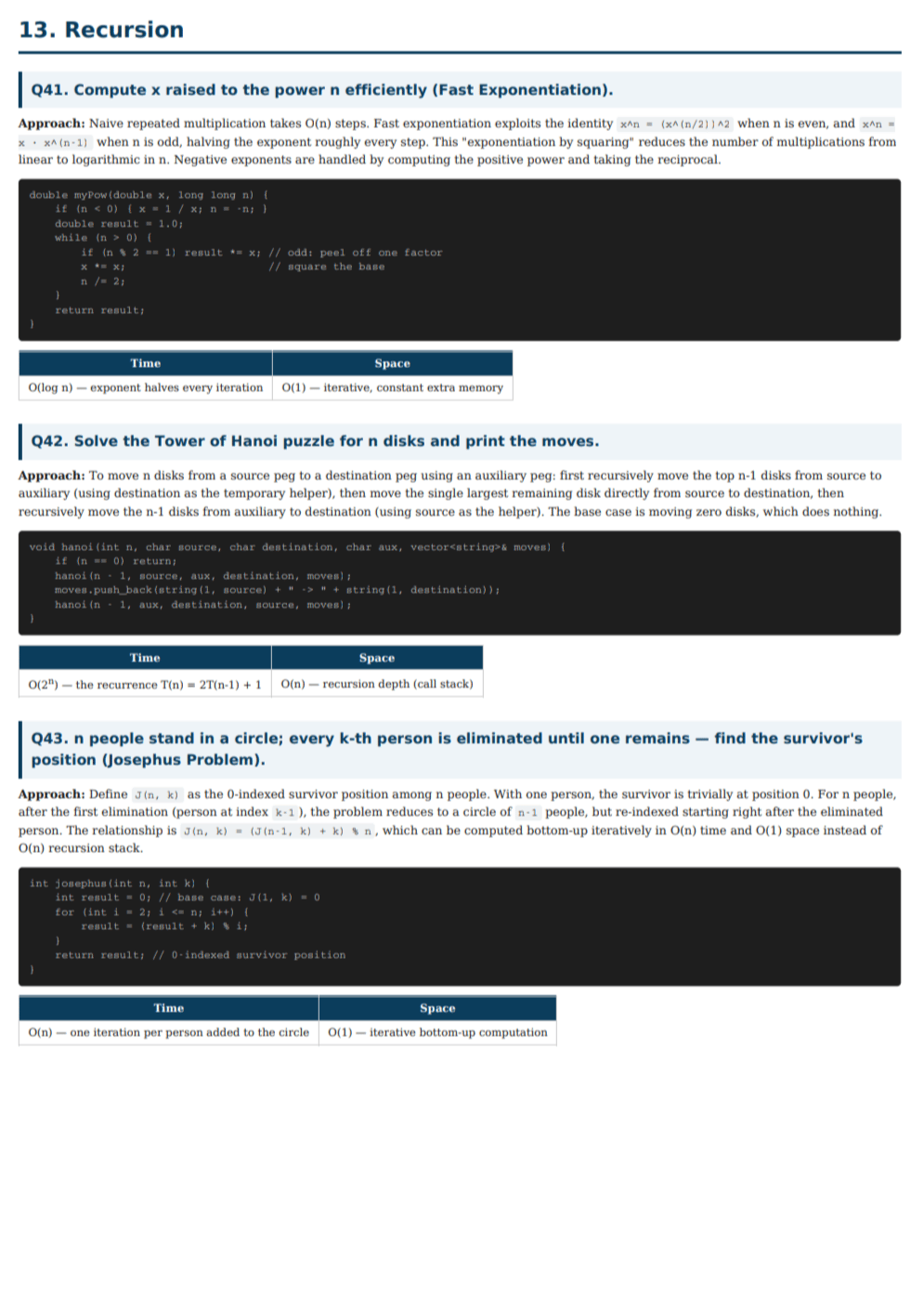
🔁 Recursion & Advanced Problem Solving
Master recursive thinking and learn how to break complex problems into smaller, manageable subproblems.
You'll explore:
- 🔹 Recursive problem-solving techniques
- 🔹 Base cases and recursive transitions
- 🔹 Efficient recursive implementations
- 🔹 Converting problem statements into recursive solutions
🌳 Tries
Learn how Trie data structures can make prefix and string-based searching highly efficient.
You'll understand:
- 🔹 Trie construction
- 🔹 Insert and search operations
- 🔹 Prefix searching
- 🔹 Practical Trie applications
- 🔹 C++ implementation
🪟 Sliding Window
Master one of the most important patterns for array and string interview problems.
You'll learn how to:
- ⚡ Maintain a dynamic window
- ⚡ Handle subarray and substring problems
- ⚡ Optimize brute-force solutions
- ⚡ Track frequencies and conditions efficiently
👉 Two Pointers
Learn how to recognize and apply the Two Pointer technique to efficiently solve array and string problems.
Topics include:
- 🔹 Pointer movement strategies
- 🔹 Sorted-array problems
- 🔹 Pair and subarray problems
- 🔹 Efficient search techniques
- 🔹 Optimization from brute force to linear solutions
🔗 Union-Find / Disjoint Set Union
Understand the powerful DSU / Union-Find data structure and its applications.
You'll explore:
- 🔹 Path Compression
- 🔹 Union by Rank
- 🔹 Union by Size
- 🔹 Connectivity problems
- 🔹 Cycle detection
- 🔹 Minimum Spanning Tree applications
🕸️ Advanced Graph Algorithms
Take your graph knowledge further with important algorithms frequently used in advanced coding problems.
📌 Topics include:
- 🧭 Topological Sort
- ⚡ Bellman-Ford Algorithm
- 🌉 Kruskal's Algorithm
- 🌲 Prim's Algorithm
- 🔗 Graph connectivity
- 🛣️ Weighted graph problems
- 🌐 Minimum Spanning Trees
Each topic includes clear explanations and complete C++ implementations.
🧠 Dynamic Programming
Strengthen your ability to identify and solve complex Dynamic Programming problems.
You'll work with concepts and problems such as:
- 🔹 Edit Distance
- 🔹 Matrix Chain Multiplication
- 🔹 Word Break
- 🔹 House Robber
- 🔹 Memoization
- 🔹 Tabulation
- 🔹 State transitions
- 🔹 Optimization techniques
🎯 Learn how to identify DP problems, define states, build transitions, establish base cases, and optimize solutions.
🔀 Sorting Algorithms
Explore important sorting concepts and understand how different sorting strategies work.
📊 You'll learn to analyze:
- 🔹 Sorting logic
- 🔹 Algorithmic efficiency
- 🔹 Time complexity
- 🔹 Space complexity
- 🔹 Practical applications
💻 Design & Data Structure Problems
Go beyond traditional algorithm questions with problems that require combining multiple data structures and designing efficient solutions.
🔥 Topics include:
- 🗃️ LRU Cache
- 🧩 HashMap Design
- 🔍 Efficient lookup strategies
- ⚙️ Custom data structures
- 🔗 Combining multiple data structures
- ⏱️ Designing operations for efficient complexity
These problems help develop the kind of structured problem-solving mindset needed for challenging coding interviews.
🧮 Matrix Problems
Master two-dimensional arrays and grid-based problem solving.
You'll practice:
- 🔹 Matrix traversal
- 🔹 Searching
- 🔹 Transformation
- 🔹 Boundary handling
- 🔹 Grid-based algorithms
- 🔹 Efficient matrix manipulation
🌲 Segment Trees & Fenwick Trees
Dive into advanced data structures designed for efficient range queries and updates.
You'll explore:
- 🌲 Segment Trees
- 📊 Fenwick Trees / Binary Indexed Trees
- 🔎 Range Queries
- 🔄 Point Updates
- ⚡ Efficient data processing
- 📈 Complexity optimization
🔢 Math & Number Theory
Build your mathematical problem-solving skills with algorithmic techniques involving numbers and number theory.
You'll learn how to approach:
- 🔹 Mathematical properties
- 🔹 Divisibility
- 🔹 Number-based problems
- 🔹 Efficient calculations
- 🔹 Algorithmic optimization
📚 Every Question Follows a Consistent Format
Each of the 40 questions in Volume 2 is presented in an interview-friendly structure:
📝 1. Problem Statement
Understand exactly what the problem is asking.
💡 2. Detailed Explanation
Break down the problem and understand the reasoning behind the solution.
🧭 3. Approach & Algorithm
Learn how to move from the problem statement to an efficient algorithm.
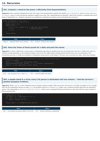
💻 4. Complete C++ Code
Study a complete implementation and understand how the algorithm translates into working code.
⏱️ 5. Time Complexity
Understand how efficiently the solution performs.
💾 6. Space Complexity
Analyze the additional memory requirements.
🎯 7. Interview-Oriented Insights
Identify useful patterns, edge cases, observations, and techniques that can help with similar problems.
🚀 Why This Volume?
Many candidates understand basic DSA concepts but struggle when interview questions become more complex and require multiple concepts to work together.
Volume 2 focuses on developing that next level of problem-solving ability.
Instead of treating every problem as completely new, you'll learn to recognize reusable patterns such as:
🔁 Recursion
🪟 Sliding Window
👉 Two Pointers
🔗 Union-Find
🕸️ Graph Algorithms
🧠 Dynamic Programming
🌲 Advanced Trees
💻 Data Structure Design
🧮 Matrix Techniques
🔢 Mathematical Algorithms
Once you recognize these patterns, you can approach unfamiliar problems with a much more structured strategy.
💼 Useful for Interview Preparation
This volume can be used as:
🎯 Technical Interview Preparation
💻 C++ Coding Interview Practice
📚 DSA Revision
🧠 Problem-Solving Practice
🏢 Coding Assessment Preparation
🎓 College DSA Studies
⚡ Quick Interview Revision
🚀 Advanced Algorithm Practice
💻 Strengthen Your C++ Skills
The book doesn't focus only on getting the correct output.
🎯 The goal is to understand why the solution works, how the algorithm is constructed, and how efficiently it performs.
By studying the explanations, implementations, and complexity tables, you can strengthen your ability to:
✅ Analyze problems
✅ Identify patterns
✅ Choose appropriate data structures
✅ Develop efficient algorithms
✅ Write clean C++ solutions
✅ Analyze time and space complexity
✅ Handle edge cases
✅ Approach unfamiliar interview problems
📖 Continue the 500-Question DSA Journey
🔥 Volume 2 covers Questions 41–80 and continues the larger DSA 500 Interview Questions collection.
This volume expands your knowledge beyond foundational DSA and introduces a wider range of advanced algorithms, data structures, optimization techniques, and interview-oriented problem-solving patterns.
Whether you're preparing for your first technical interview or sharpening your existing coding skills, this volume provides a structured collection of problems to help you practice and improve.
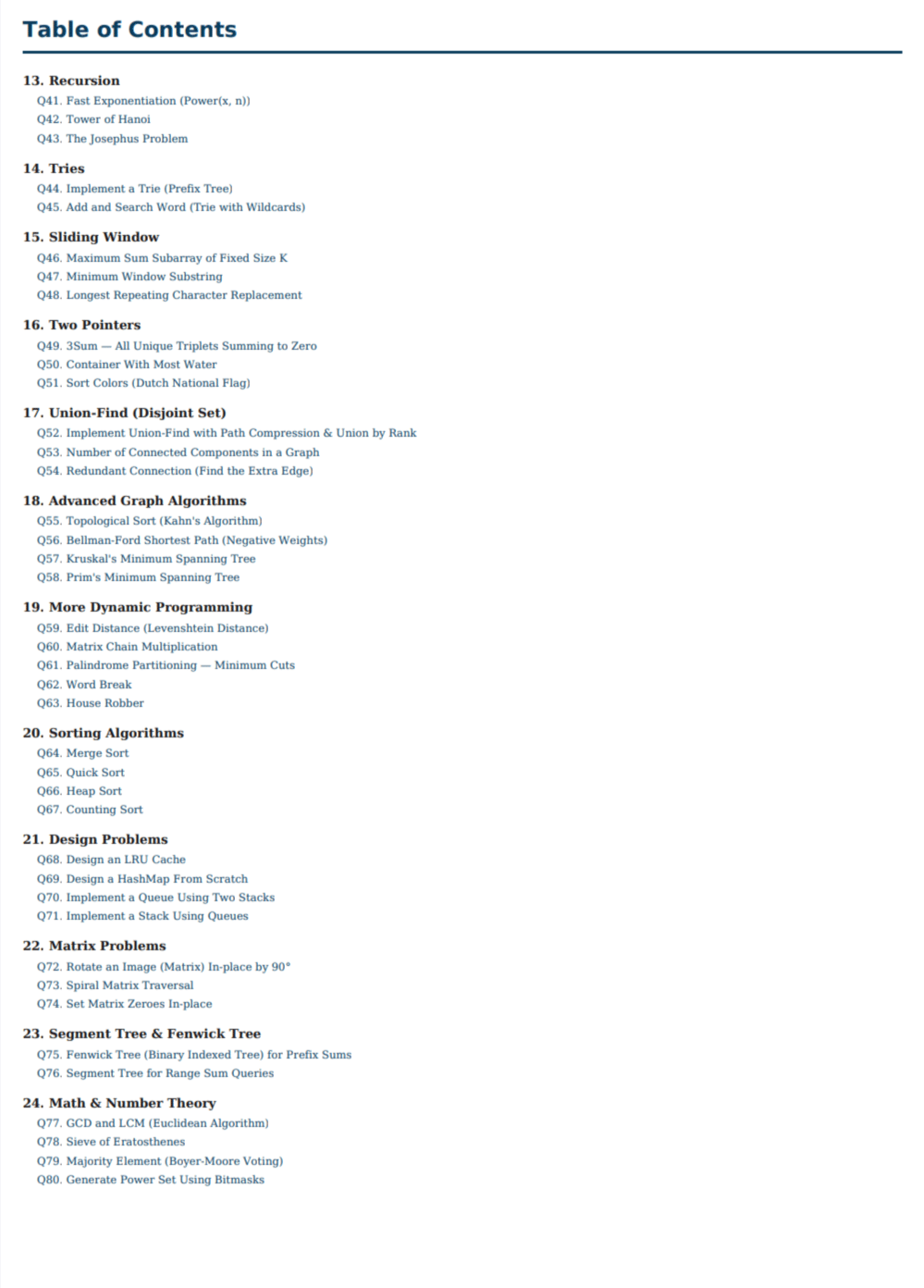
🏆 Topics at a Glance
🔁 Recursion
🌳 Tries
🪟 Sliding Window
👉 Two Pointers
🔗 Union-Find / DSU
🕸️ Topological Sort
⚡ Bellman-Ford
🌉 Kruskal's Algorithm
🌲 Prim's Algorithm
🧠 Dynamic Programming
✏️ Edit Distance
🔗 Matrix Chain Multiplication
📝 Word Break
🏠 House Robber
🔀 Sorting Algorithms
💻 LRU Cache
🗃️ HashMap Design
🧮 Matrix Problems
🌲 Segment Trees
📊 Fenwick Trees
🔢 Math & Number Theory
🚀 Master the Patterns. Understand the Algorithms. Write the Code. Analyze the Complexity.
📘 DSA 500 Interview Questions – Volume 2 (Q41–80) is designed to help you move from basic problem solving toward advanced DSA thinking and efficient C++ implementation.
💡 Learn the concept → Understand the pattern → Implement the solution → Analyze the complexity → Practice the technique.