

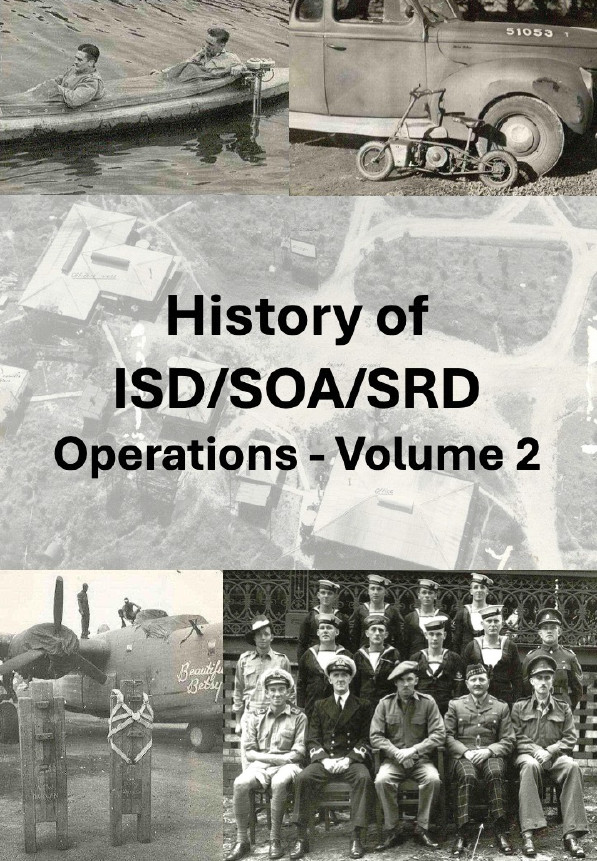
History of ISD/SOA/SRD - Operations - Volume 2
History of ISD/SOA/SRD – Operations - Volume 2
This PDF file (227 pages) is a transcription of the official operational history of Special Operations Australia (SOA). It was initially constituted as the Inter-Allied Services Department (ISD) and when SOA replaced ISD the cover name Services Reconnaissance Department (SRD) was adopted. This history covers the many Operations behind enemy lines from June 1942 to November 1945 and is divided geographically into five major sections.
PART I — TIMOR, LESSER SUNDAS AND JAVA
PART II — NEW GUINEA
PART III — BORNEO
PART IV — CELEBES AND MOLUCCAS
PART V — MALAYA AND CHINA SEA
The central purpose of ISD/SOA/SRD was to conduct special operations behind Japanese lines. Its activities included:-
- intelligence collection;
- establishing secret intelligence networks;
- recruiting and organising local populations;
- guerrilla warfare;
- sabotage and demolition;
- reconnaissance;
- rescuing or evacuating Allied personnel;
- establishing communications with Australia;
- identifying targets for Allied air and naval forces;
- preparing occupied territories for eventual Allied liberation.
This history demonstrates how heavily these operations depended on submarines, aircraft, small vessels, radio equipment and local guides.
ISD was formed in March 1942. It initially came under the Australian Commander-in-Chief, then GHQ South-West Pacific Area, with the Allied Intelligence Bureau AIB becoming the coordinating authority. In April 1943 ISD was replaced by Special Operations Australia SOA, which soon adopted the cover name Services Reconnaissance Department or SRD.
Taken as a whole, the history shows several recurring themes.
1. Intelligence was usually more important than sabotage
Although SRD was created as a special operations organisation, many of its most valuable contributions were actually intelligence, reconnaissance, communications and local networks. The Borneo experience is the clearest example.
2. Local knowledge was critical
The best operations were generally those in which the SRD personnel understood the country and could establish relationships with local people. This was particularly important in Borneo and Timor.
3. Transport was SRD's greatest weakness
Again and again, submarines, Catalinas, PT boats and other craft were unavailable, delayed, diverted or unsuitable.
The New Guinea section explicitly identifies transport as the organisation's "bugbear", with projects repeatedly abandoned because transport could not be obtained.
4. Communications were often inadequate
Wireless equipment was frequently too heavy, unreliable or difficult to operate under field conditions. Delays in establishing communications could make otherwise successful intelligence useless.
5. Plans frequently became obsolete
A project might take months to obtain approval, transport and equipment. By the time it was ready, the Allied advance could have changed the strategic situation completely.
6. SRD learned from failure
The history itself argues that the spectacular success in Borneo was partly the result of lessons learned from earlier failures in Timor, New Guinea and elsewhere.
7. Cooperation with the Army, RAAF and Navy was decisive
The most successful operations increasingly became joint operations. Semut, for example, depended heavily upon RAAF support, while the submarine-based operations in the China Sea depended upon cooperation with the US Navy.
The Borneo campaign is the high point of the history. Semut and Agas demonstrate what SRD could accomplish when it had experienced personnel, local knowledge, adequate communications, Allied air support and a clearly defined military objective.
Conversely, New Guinea and some of the Timor/Java projects demonstrate the enormous waste caused by inadequate transport, excessive administrative control and changing strategic priorities.
The document is therefore much more than a catalogue of secret missions. It is effectively a record of how Australia's wartime special operations capability evolved through experimentation, failure and accumulated experience.