
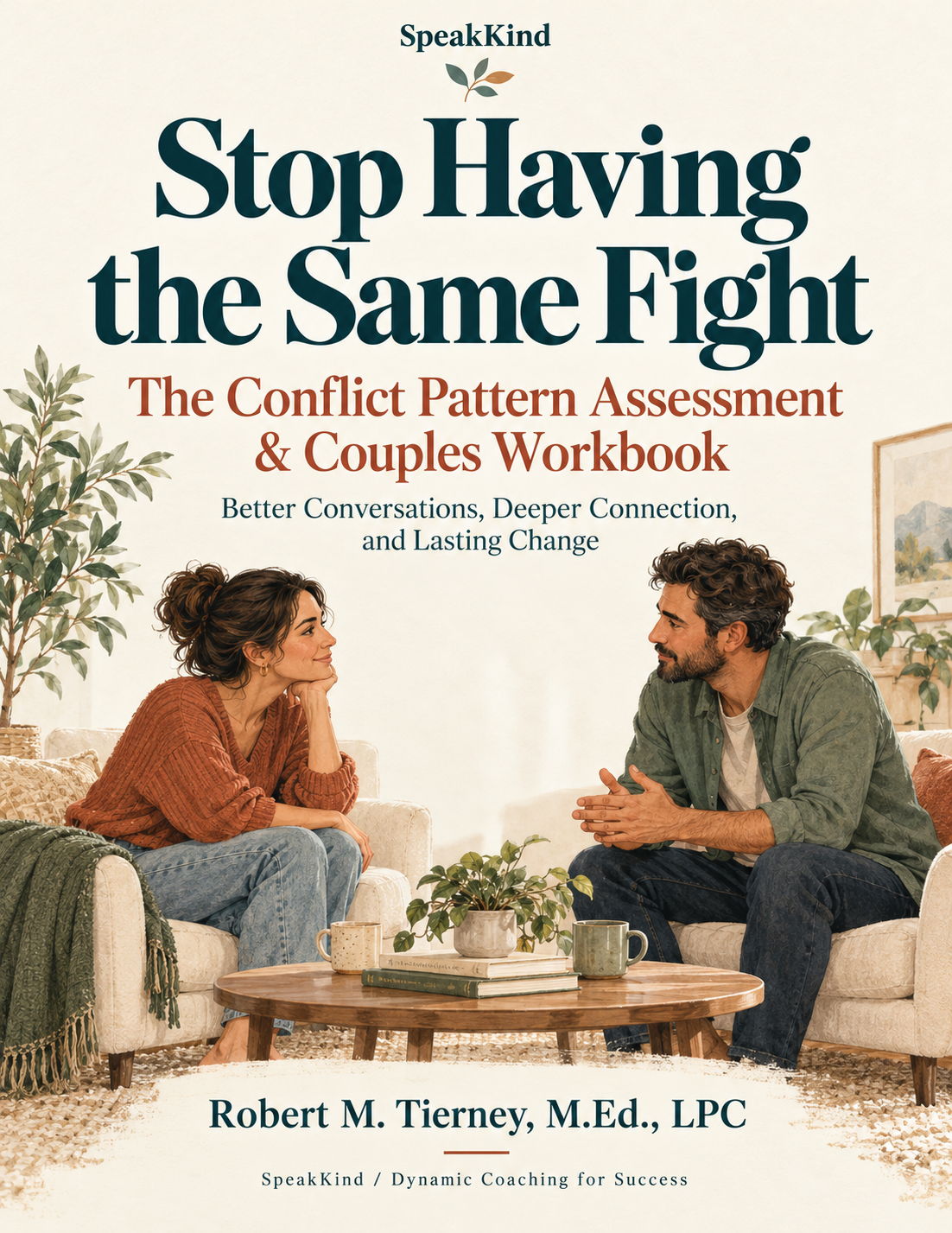
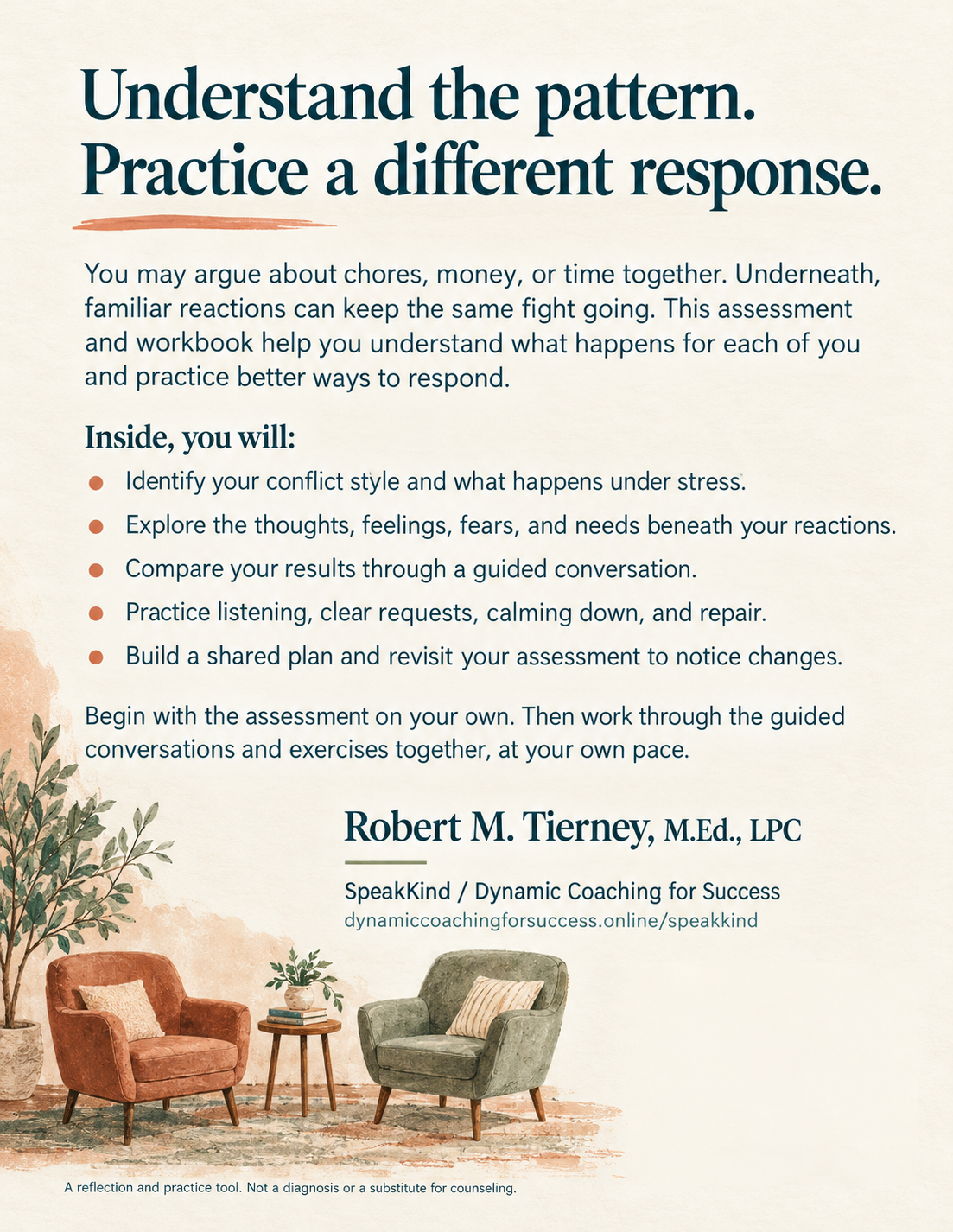

Stop Having the Same Fight | Conflict Assessment & Couples Workbook.
Stop Having the Same Fight
You Know How the Argument Starts. You Already Know How It Ends. So Why Does It Keep Happening?
You've had this argument before. Maybe dozens of times.
The subject changes. The words change. But somehow, you end up in the same place.
One of you feels unheard. The other feels attacked. Someone pushes harder to get an answer. Someone pulls away to avoid another fight.
Later, you might apologize, make up, or simply stop talking about it. Things settle down until the next disagreement brings you right back to where you started.
What if you could recognize that familiar pattern before another conversation goes wrong?
That's where Stop Having the Same Fight begins.
Find Out What's Keeping Your Arguments Going
Created by couples' therapist Robert M. Tierney, M.Ed., LPC, this downloadable toolkit combines a
Relationship Conflict Assessment and a Guided Relationship Workbook.
You'll identify how you respond during disagreements, understand what may be driving those reactions, and practice specific ways to handle difficult conversations.
What You'll Be Able to Practice
1. Recognize when you're slipping into the same argument.
Instead of realizing afterward that you've had another familiar fight, learn to notice the early warning signs.
For example: A simple question about household responsibilities begins turning into accusations about who does more. You'll practice recognizing when the conversation shifts away from solving the problem and into defending yourselves.
2. Understand why one person pushes while the other pulls away.
Learn to recognize what may be happening underneath your partner's words and behavior.
For example: One partner says, "We need to talk about this right now." The other responds, "I can't do this again."
You'll explore how the first partner may be worried that nothing will change, while the second may feel overwhelmed or afraid of being criticized.
3. Know what to say when a conversation starts getting heated.
Practice replacing accusations with statements that explain what you're feeling and what you need.
Instead of:
"You never listen to me!"
Try:
"I'm getting frustrated because I don't feel heard. Could you tell me what you understood me to say?"
4. Take a break without leaving the problem unresolved.
Learn how to pause a conversation when emotions become overwhelming while reassuring your partner that you're willing to return.
Instead of walking away or insisting on continuing an argument that's getting worse, practice saying:
"I want us to work this out, but I'm getting overwhelmed. Can we take 20 minutes and come back to it?"
5. Return to difficult conversations with a clearer plan.
Practice picking up an unfinished discussion without immediately returning to the same accusations.
You'll work on expressing one concern at a time, listening to your partner's perspective, and identifying what needs to happen next.
6. Begin making changes even if your partner isn't participating.
You can use the assessment and workbook individually.
You'll examine your own triggers, recognize your usual reactions, and identify one specific response to practice during your next disagreement.
You can't control your partner's behavior, but you can work on how you communicate and respond.
Exactly What You Receive for $19.99
One complete downloadable PDF containing two connected resources.
Part 1: Relationship Conflict Assessment
A structured assessment that helps you identify:
- How you typically react during disagreements.
- What situations tend to trigger your strongest responses.
- Whether you tend to pursue, withdraw, defend yourself, or avoid conflict.
- How these reactions may contribute to recurring arguments.
Part 2: Guided Relationship Workbook
Practical exercises designed to help you:
- Examine recent arguments and identify where communication broke down.
- Recognize the feelings and needs beneath familiar reactions.
- Practice less confrontational ways to begin difficult discussions.
- Develop a plan for taking breaks and returning to unfinished conversations.
- Choose specific communication changes to try in everyday life.
Your purchase includes:
- One PDF combining the assessment and workbook.
- Guided self-reflection questions.
- Practical communication exercises.
- Material you can use individually or with your partner.
- A digital copy you can save and revisit.
Format: Digital PDF download
Delivery: Download through Payhip after successful payment
Price: $19.99, one-time purchase
No subscription or physical shipment
Personalized counseling, individual assessment interpretation, and companion videos are not included.
What Could Be Different the Next Time You Disagree?
- Imagine recognizing that you're becoming defensive before you say something hurtful.
- Or noticing that your partner is getting overwhelmed and suggesting a break without making them feel abandoned.
- Maybe you return to a conversation you would normally have avoided. You listen a little longer. You explain what you need without blaming each other.
These may sound like small changes, but they're practical skills you can begin working on.
This workbook won't promise to fix your relationship or prevent every argument. It gives you a way to understand what keeps happening and specific responses to practice when it happens again.
You've Had the Same Fight Enough Times. Give Yourself Another Way to Respond.
For $19.99, get the Conflict Assessment and Guided Relationship Workbook together in one downloadable PDF.
Start by identifying your conflict pattern. Choose one communication habit you'd like to change. Then use the exercises to prepare for your next difficult conversation.
Get Stop Having the Same Fight Today for $19.99.
You already know how the usual argument ends. Give the next conversation a better chance.
Created by Robert M. Tierney, M.Ed., LPC
SpeakKind | Practical tools for better conversations and stronger relationships.
For educational and personal use. This toolkit is not a diagnostic assessment and does not replace professional mental health care or couples therapy. If disagreements involve intimidation, threats, or violence, seek appropriate professional support rather than relying on joint communication exercises.