
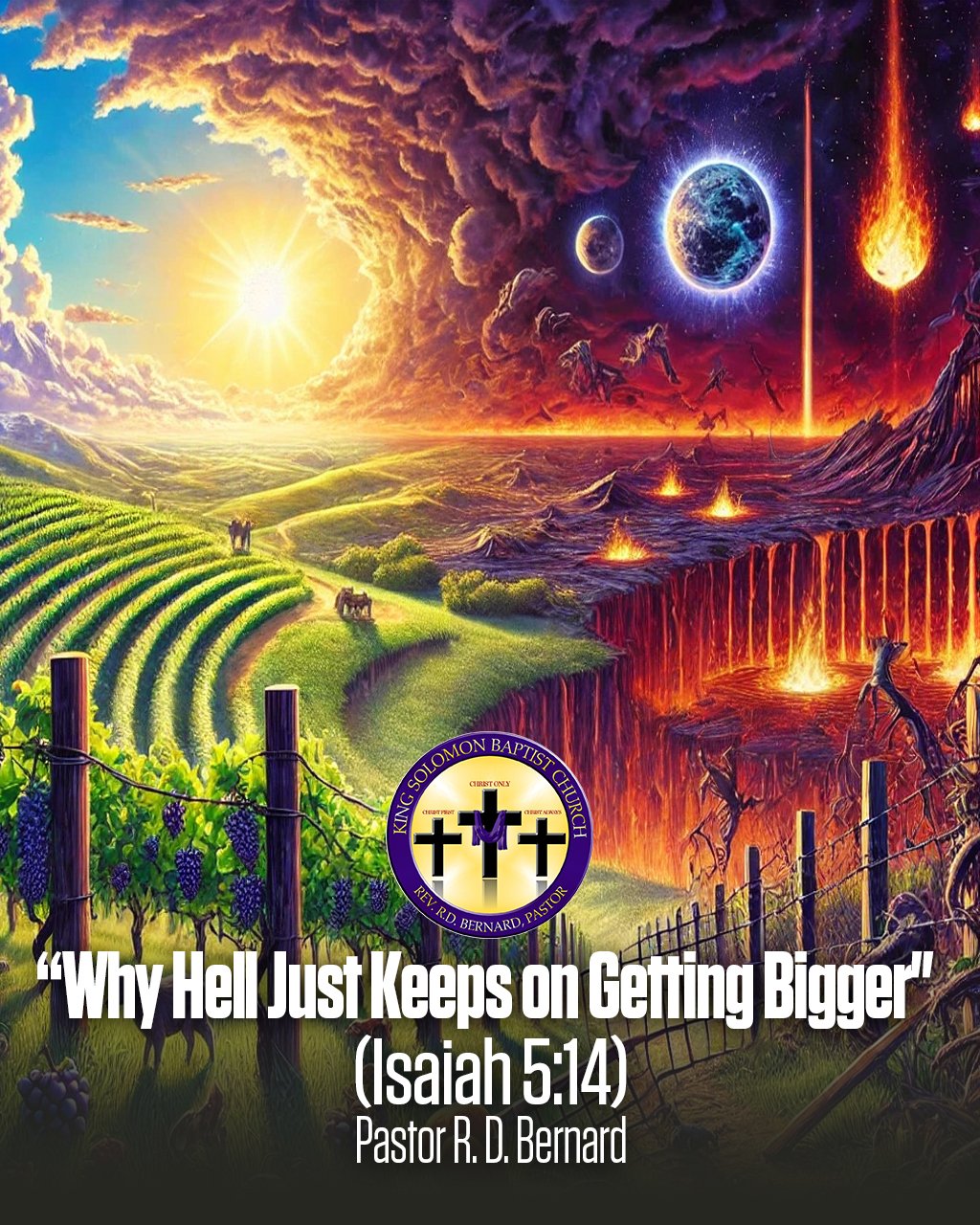
Why Hell Just Keeps on Getting Bigger" (Isaiah 5:14) 1/5/25 11am
Why Hell Just Keeps on Getting Bigger" (Isaiah 5:14)
The verses under our consideration provide a stark warning about the dangers of indulgence and neglect of our godly duties as the people of God. Isaiah lived during a tumultuous time in Judah's history, marked by political instability, social injustice, and spiritual decay.
As a prophet, Isaiah's role was to call the people back to faithfulness and warn them of the consequences if they did not return. His message was filled with vivid imagery, not only of the people's sins but also of the very real possibility of Hell.
The people of God were so consumed by their own pursuits that they neglected to put God in His proper place. This was a call to self-examination and repentance for all who heard it. Consider the following four points:
- God always has a community that is His.
- God planted Israel in a "very fruitful hill" (Isaiah 5:1).
- He placed a fence around His community, cast out the stones that would hinder growth, and established a protected tower in it (Isaiah 5:2).
- God expects His community to produce.
- Despite His care, the vineyard brought forth sour (wild) grapes (Isaiah 5:2).
- In verse 3, God challenges His people to reflect on His goodness: “What more could I have done for my vineyard to produce?”
- God will judge those in His community who claim to be His but are disobedient.
- God declares in verse 5 that He will take away the fence and allow it to be overtaken by weeds and wild animals.
- In verse 6, God says He will no longer cultivate it but will allow briers and thorns to grow.
- Verse 7 identifies the vineyard as the Old Testament Church—Israel and Judah.
- Hell is designed to hold the large number of people who remain unrepentant.
- Hell is described as a place of punishment that never fills but expands to accommodate the unrepentant (Isaiah 5:14).
- It has housed countless individuals, such as those who perished during the antediluvian period (1 Peter 3:18-20).
"Christ First, Christ Only, Christ Always."