
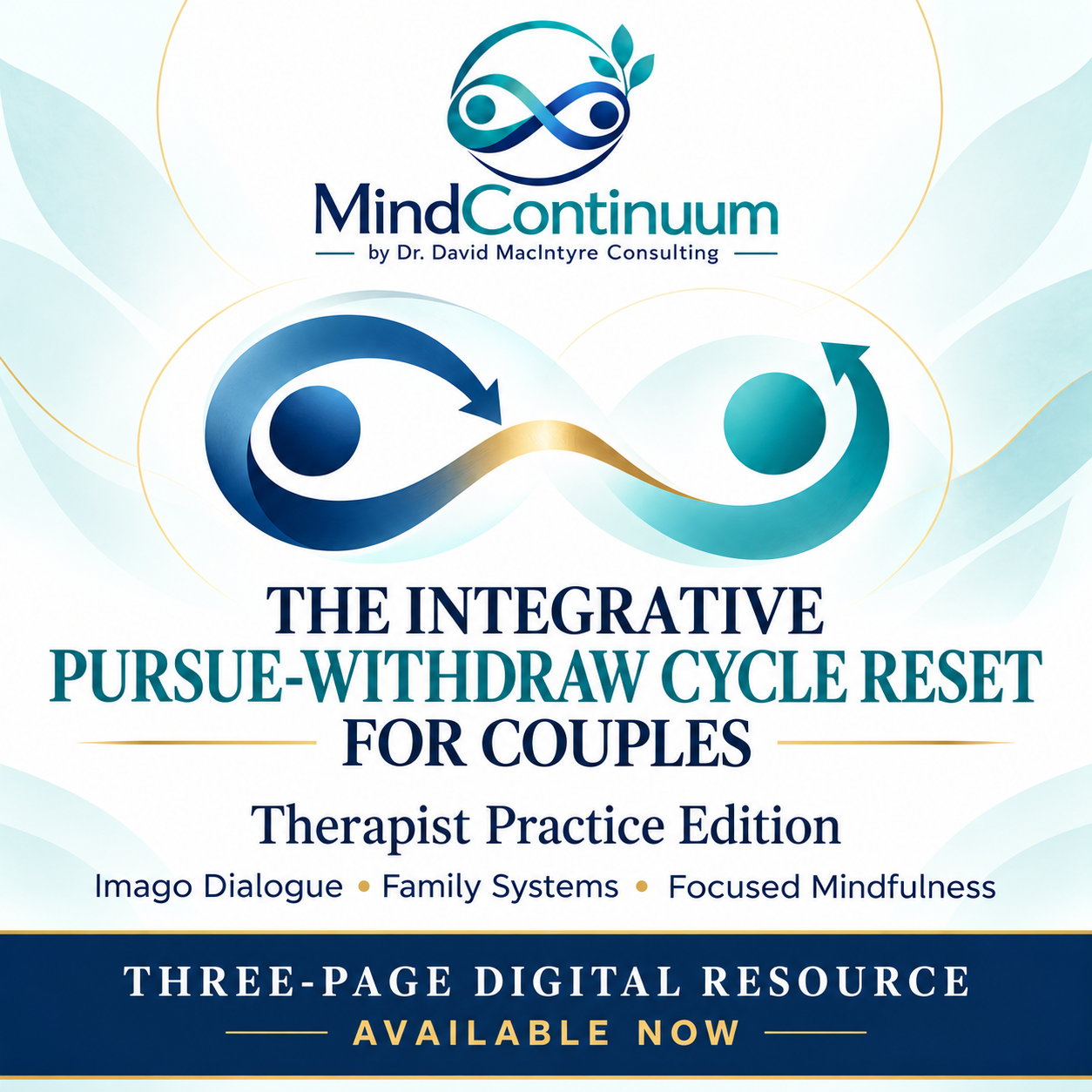
The Integrative Pursue-Withdraw Cycle Reset for Couples-Therapist Edition-Session 3
THE INTEGRATIVE PURSUE-WITHDRAW CYCLE RESET FOR COUPLES
Couples Practice Edition
✨ Created by MindContinuum by Dr. David MacIntyre Consulting
Help couples recognize the pursue-withdraw cycle before it takes over the relationship—and learn how to create a healthier balance between connection, space, reassurance, and return.
In many relationships, one partner responds to disconnection by moving closer, asking more questions, seeking reassurance, or pushing for resolution. The other may respond by becoming quieter, needing space, shutting down, becoming overwhelmed, or pulling away.
Neither position is necessarily the “problem.”
Both can be protective responses driven by fear, attachment needs, nervous-system activation, and learned relational patterns.
The Integrative Pursue-Withdraw Cycle Reset for Couples helps couples understand what is happening beneath both positions so they can stop fighting over the surface behavior and begin responding to the deeper needs underneath it.
This professionally designed, three-page digital resource integrates Imago Relationship Therapy, Family Systems, and Focused Mindfulness into an accessible and practical framework couples can use together.
✅ WHAT’S INCLUDED
🧠 An accessible explanation of the pursue-withdraw relationship cycle
🔄 A clear guide to the fears and longings beneath pursuing and withdrawing
💬 Imago-informed mirroring, validation, and empathy prompts
🧩 Family Systems questions for identifying protective parts
🌿 Focused Mindfulness awareness of body sensations, activation, and gaze
🛠️ The six-step BRIDGE Method
📝 A reusable Pursue-Withdraw Cycle Map
🤝 A practical contact, space, and return plan
🔐 A therapist practice license for use with individual couples
📥 Immediate PDF access following purchase
🌿 THE BRIDGE METHOD
B — Breathe and Pause
Slow the interaction enough for both partners to recognize that the cycle has started.
R — Recognize Your Position
Notice whether you are moving toward your partner for reassurance or moving away to reduce overwhelm.
I — Identify the Protective Part
Recognize the part that is pursuing, withdrawing, demanding, shutting down, explaining, or avoiding—and what it is trying to protect.
D — Describe the Vulnerable Need
Move underneath the protective reaction and name the fear, longing, need, or emotional experience driving it.
G — Give an Accurate Reflection
Mirror and validate your partner’s experience before defending, correcting, or solving.
E — Establish a Balanced Next Step
Create an agreement that respects both the need for connection and the need for regulated space.
The BRIDGE Method helps couples move away from the belief that one person is “too needy” and the other is “too distant.”
Instead, couples learn to recognize the pattern as a shared cycle that can be interrupted and reshaped.
💙 WHY THIS RESOURCE IS DIFFERENT
Pursue-withdraw patterns are often misunderstood.
The pursuing partner may appear demanding, critical, emotional, or controlling when underneath there may be fear of disconnection, abandonment, or not mattering.
The withdrawing partner may appear cold, uncaring, avoidant, or detached when underneath there may be fear of conflict, failure, engulfment, criticism, or emotional overload.
When couples focus only on the visible behavior, each partner’s response can intensify the other’s fear.
Pursuit creates more withdrawal.
Withdrawal creates more pursuit.
This resource helps couples identify the protective parts beneath both positions and develop a more intentional rhythm of connection, pause, reassurance, and return.
By combining relational dialogue, parts awareness, and nervous-system regulation, couples can create more flexibility and emotional safety during difficult moments.
👥 WHO IS THIS FOR?
Designed for:
• Mental health therapists
• Couples counselors
• Marriage and family therapists
• Relationship specialists
• Focused Mindfulness practitioners
• Other helping professionals supporting couples experiencing recurring pursue-withdraw patterns
This resource may be especially useful for couples who struggle with:
• One partner wanting to talk while the other shuts down
• Repeated arguments about needing space
• Reassurance seeking
• Emotional withdrawal
• Feeling abandoned during conflict
• Feeling overwhelmed by conflict
• Difficulty reconnecting after taking space
• Escalating cycles of pursuit and avoidance
🔄 THE PURSUE-WITHDRAW CYCLE MAP
Couples are guided to identify:
• The trigger that starts the cycle
• The pursuing behaviors that follow
• The withdrawing behaviors that follow
• What each partner fears or needs underneath the pattern
• What combination of contact and space would be more helpful
The goal is not to decide who is right.
The goal is to help both partners recognize the cycle early enough to choose a different response.
🤝 THE PRACTICAL PLAN
Couples create specific agreements for:
CONTACT
A respectful way to ask for reassurance, closeness, or connection.
SPACE
A respectful way to request a regulated pause without creating abandonment or uncertainty.
RETURN
A clear agreement about exactly when and how the couple will reconnect.
This is especially important because taking space without a return plan can intensify anxiety, while demanding immediate resolution can intensify overwhelm.
🔐 THERAPIST PRACTICE LICENSE
Purchase grants one licensed mental health professional permission to print or digitally provide this resource to their own individual couples for therapeutic or educational use.
The resource may not be shared with colleagues, uploaded to shared drives or organizational resource libraries, modified for resale, redistributed, sublicensed, or resold.
Clinics and organizations require a separate multi-user license.
📄 PRODUCT DETAILS
Format: Digital PDF
Length: Three pages
Delivery: Immediate digital download
Price: $14.99
⚠️ IMPORTANT INFORMATION
This educational resource is not a substitute for couples therapy, individualized mental health treatment, crisis care, legal advice, or emergency services.
This exercise is not appropriate during threats, intimidation, coercive control, or violence. Appropriate professional or emergency support should be sought when safety is a concern.
Because this is an immediately delivered digital product, purchases are nonrefundable except where required by law.
© 2026 Dr. David MacIntyre. All rights reserved.